Spondylolisthesis Treatment in Gaur City: Causes of Back Pain and Leg Pain
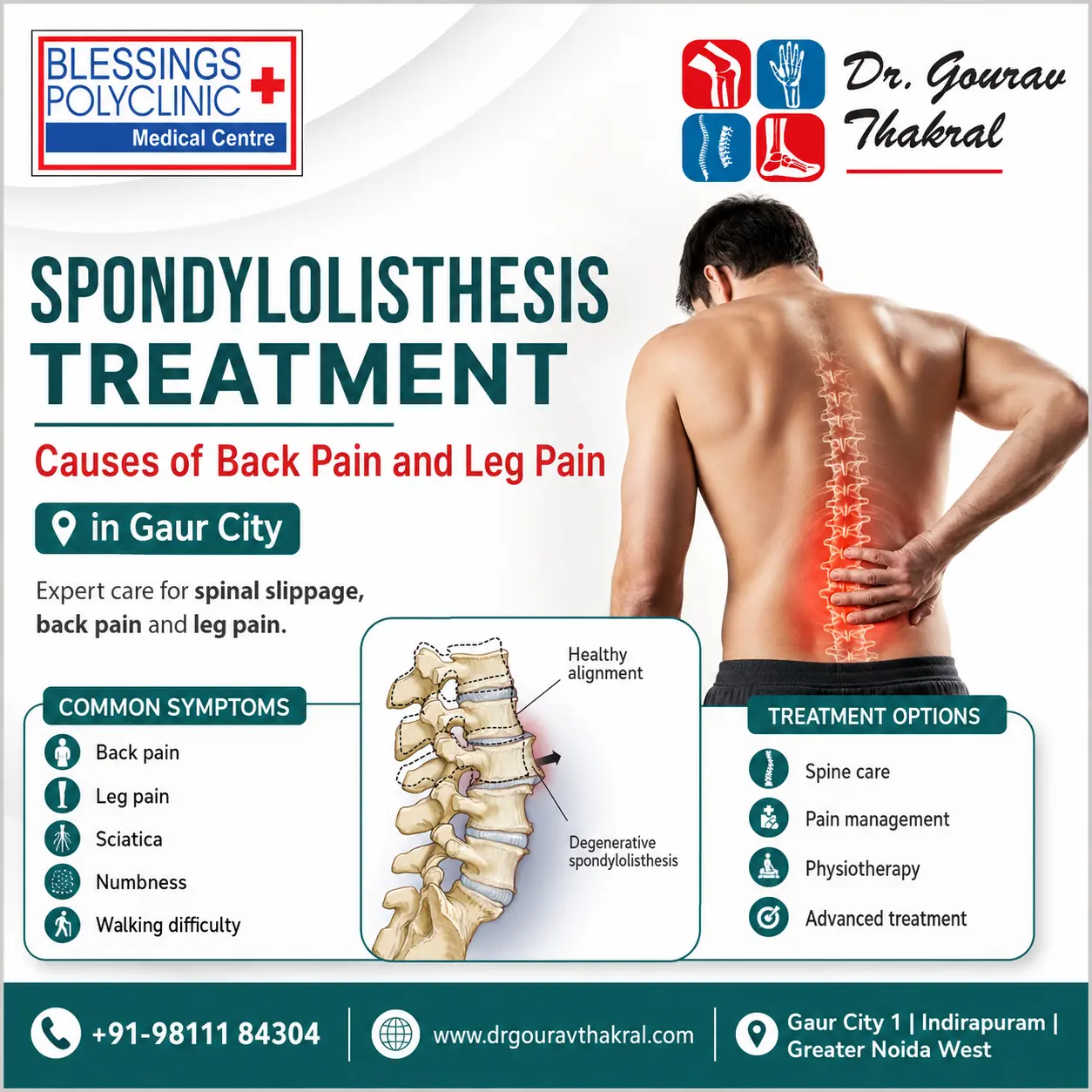
Spondylolisthesis Treatment in Gaur City may be needed when one spinal bone slips forward over the bone below it. This condition can cause lower back pain, stiffness, leg pain, numbness, tingling, or walking difficulty.
Many patients first think it is normal back pain or a slip disc. However, spondylolisthesis is different. It involves spinal slippage, which may irritate nearby nerves and cause pain that travels to the legs.
For patients looking for Back pain treatment, Sciatica treatment, Slip disc surgery, and Spine care in Gaur City, Dr. Gourav Thakral provides expert orthopaedic evaluation and treatment guidance. As an experienced Orthopaedic specialist and Spine specialist, he helps patients understand whether physiotherapy, medicines, injections, lifestyle changes, or surgery may be needed.
Cleveland Clinic explains that spondylolisthesis happens when one vertebra slips out of place and rests on the bone below it. Treatment may include rest, medicines, physical therapy, bracing, injections, or surgery in selected cases.
What Is Spondylolisthesis?
Spondylolisthesis is a spine condition in which one vertebra shifts forward over another vertebra. It commonly affects the lower back. Because of this slippage, the spinal canal or nerve openings may become narrow.
When nerves get compressed, pain may travel from the back to the buttock, thigh, calf, or foot. This can feel similar to sciatica. Therefore, proper diagnosis is important before starting treatment.
NIH StatPearls describes spondylolisthesis as displacement of one vertebra relative to the one below it, most commonly near the lower spine at the lumbosacral junction.
Common Symptoms of Spondylolisthesis
Symptoms may be mild in some patients. However, others may feel constant pain or nerve-related discomfort.
Common symptoms include:
Lower back pain
Back stiffness
Pain going to the buttock or leg
Sciatica-like pain
Numbness or tingling in the legs
Weakness in the legs
Pain while standing or walking
Relief while sitting or bending forward
Tight hamstrings
Difficulty walking for long periods
Mayo Clinic notes that back pain can radiate down a leg and may feel like shooting, burning, or stabbing pain. This is why leg pain along with back pain needs proper evaluation.
Why Does Spondylolisthesis Cause Back Pain?
Spondylolisthesis can change normal spinal alignment. As a result, muscles, joints, discs, and nerves may face extra stress.
Back pain may happen because of:
Spinal instability
Muscle spasm
Disc stress
Facet joint pressure
Nerve compression
Spinal canal narrowing
Poor posture
Weak core muscles
When nerves are affected, the pain may travel to the leg. This may feel like sciatica. Therefore, some patients search for Sciatica treatment even when the main cause is spondylolisthesis.
Causes of Spondylolisthesis
Spondylolisthesis can happen due to different reasons. In younger patients, it may happen due to a stress fracture in part of the vertebra. In older adults, it may happen due to age-related disc and joint degeneration.
Common causes include:
Age-related spine changes
Stress fracture in the vertebra
Repeated back bending sports
Spinal injury
Degenerative disc disease
Weak spine joints
Congenital spine defect
Previous spine surgery
Trauma
Poor spine stability
AAOS explains that spondylolysis and spondylolisthesis can happen when a stress fracture or weakness allows the vertebra to slip forward.
Spondylolisthesis vs Slip Disc
Many patients confuse spondylolisthesis with a slip disc. However, both are different spine problems.
In spondylolisthesis, one vertebra slips over another. In a slip disc, the disc material may bulge or herniate and press on a nerve.
Both conditions can cause back pain and leg pain. Also, both may cause sciatica-like symptoms. That is why a Spine specialist checks symptoms, X-rays, MRI, and nerve signs before planning treatment.
Patients looking for Slip disc treatment should get a proper diagnosis first, because leg pain may be due to disc herniation, spondylolisthesis, spinal stenosis, or nerve compression.
When Should You Consult a Spine Specialist?
You should consult a Spine specialist if back pain continues, keeps returning, or travels to the leg. Also, seek care if pain affects walking, standing, sleep, or daily work.
Consultation becomes important when:
Back pain lasts for weeks
Leg pain travels below the knee
Numbness or tingling appears
Walking distance reduces
Pain increases while standing
Weakness develops in the leg
Pain does not improve with rest
Daily work becomes difficult
Patients searching for the Best orthopaedic doctor in Gaur City can consult Dr. Gourav Thakral for back pain, leg pain, and spine evaluation.
Red Flag Symptoms: When to Seek Urgent Care
Some symptoms need urgent medical attention. Do not ignore them.
Seek urgent care if you notice:
Loss of bladder control
Loss of bowel control
Severe leg weakness
Numbness in the groin area
Severe pain after trauma
Fever with back pain
Unexplained weight loss
Pain that is worsening rapidly
These symptoms may point to serious nerve compression or other spine conditions.
Diagnosis of Spondylolisthesis
Diagnosis starts with a detailed history and physical examination. The doctor checks posture, walking pattern, back movement, nerve function, leg strength, reflexes, and pain pattern.
Tests may include:
X-ray
Flexion-extension X-rays
MRI
CT scan
Nerve evaluation
Bone health check if needed
X-rays can show vertebral slippage. MRI can show nerve compression, disc condition, and spinal canal narrowing. CT scan may help in complex bony defects.
A proper diagnosis helps separate spondylolisthesis from slip disc, sciatica, arthritis, spinal stenosis, or muscle strain.
Grades of Spondylolisthesis
Doctors may grade spondylolisthesis based on how much the vertebra has slipped. Low-grade slips are more common. High-grade slips are less common but may cause more symptoms.
Low-grade cases often improve with non-surgical care. However, high-grade slips or severe nerve compression may need more advanced treatment.
Treatment depends on symptoms, slip grade, nerve compression, age, activity level, and response to earlier care.
Non-Surgical Spondylolisthesis Treatment
Many patients improve with non-surgical care. The aim is to reduce pain, improve spine support, and prevent symptoms from worsening.
Non-surgical treatment may include:
Rest for a short time
Activity modification
Pain medicines
Anti-inflammatory medicines
Physiotherapy
Core strengthening
Posture correction
Weight management
Back brace in selected cases
Epidural injection if advised
AAOS notes that nonsurgical treatment may include rest, avoiding activities that put stress on the lower back, medicines, physical therapy, and sometimes bracing.
Role of Physiotherapy and Spine Care
Physiotherapy is a key part of Spine care. It helps improve core strength, posture, flexibility, and walking comfort.
A guided exercise plan may focus on:
Core strengthening
Hamstring stretching
Back muscle control
Hip mobility
Posture correction
Safe bending habits
Walking tolerance
Pain control exercises
However, exercises should be selected carefully. Some back extension movements may worsen symptoms in certain patients. Therefore, guided physiotherapy is better than random exercises.
Sciatica Treatment in Spondylolisthesis
Sciatica means pain that travels along the sciatic nerve pathway. Spondylolisthesis can cause sciatica-like leg pain when the slipped vertebra narrows the nerve passage.
Sciatica treatment may include medicines, physiotherapy, nerve pain control, posture changes, injections, or surgery in selected cases.
The main goal is to reduce nerve irritation and improve walking comfort. However, if leg weakness or severe nerve compression is present, the doctor may suggest further treatment.
When Is Surgery Needed?
Surgery is not needed for every patient. It may be considered when pain, leg symptoms, or walking difficulty continue despite proper non-surgical treatment.
Surgery may be advised when:
Pain remains severe
Leg pain does not improve
Walking becomes difficult
Nerve compression is significant
Leg weakness develops
The slip keeps worsening
Daily life is badly affected
Non-surgical care fails
AAOS states that nonsurgical treatment is successful in most degenerative and isthmic spondylolisthesis patients. However, when surgery is indicated, good clinical outcomes have been reported in many patients.
Surgical Treatment Options
Surgery depends on the cause and severity. The goal is to decompress nerves and stabilize the spine if needed.
Surgical options may include decompression, spinal fusion, or decompression with fusion. In decompression, pressure on nerves is reduced. In fusion, two or more vertebrae are stabilized together.
The final plan depends on MRI findings, slip grade, instability, nerve compression, and patient health.
Recovery After Treatment
Recovery depends on the treatment type. Non-surgical recovery may take weeks to months with regular exercises and lifestyle changes. Surgical recovery may take longer and needs structured follow-up.
Recovery may include:
Pain control
Physiotherapy
Walking program
Posture training
Weight management
Avoiding heavy lifting
Follow-up visits
Gradual return to work
Long-term spine strengthening
Consistency matters. Patients who follow the treatment plan often recover better.
Lifestyle Tips for Spondylolisthesis
Simple changes can reduce back stress and support recovery.
Maintain healthy weight
Avoid sudden heavy lifting
Use proper sitting posture
Avoid repeated back bending
Strengthen core muscles
Walk regularly if advised
Take breaks from long sitting
Use safe lifting techniques
Follow physiotherapy plan
Avoid self-treatment for severe pain
These steps can support long-term spine health.
Spondylolisthesis Treatment in Gaur City by Dr. Gourav Thakral
If you have lower back pain, leg pain, sciatica-like symptoms, numbness, tingling, or walking difficulty, consult Dr. Gourav Thakral in Gaur City.
He evaluates spine alignment, nerve symptoms, X-rays, MRI findings, slip grade, posture, and activity needs before suggesting treatment. Patients searching for Spondylolisthesis treatment, Back pain treatment, Sciatica treatment, Slip disc treatment, or Spine specialist care can consult Dr. Gourav Thakral for expert guidance.
Final Thoughts
Spondylolisthesis can cause back pain, leg pain, stiffness, and walking difficulty. However, many patients improve with medicines, physiotherapy, spine care, posture correction, and activity changes. Surgery is needed only in selected cases with severe symptoms or nerve compression.
For Spondylolisthesis Treatment in Gaur City, consult Dr. Gourav Thakral, an experienced Orthopaedic specialist and Spine specialist, for proper diagnosis and treatment planning.
FAQs
1. What is spondylolisthesis?
Spondylolisthesis is a spine condition where one vertebra slips forward over the bone below it.
2. Can spondylolisthesis cause leg pain?
Yes. It can compress or irritate nerves, which may cause leg pain, numbness, tingling, or sciatica-like symptoms.
3. Is spondylolisthesis the same as slip disc?
No. In spondylolisthesis, a vertebra slips. In slip disc, disc material bulges or herniates and may press on a nerve.
4. Can spondylolisthesis be treated without surgery?
Yes. Many patients improve with medicines, physiotherapy, activity changes, posture correction, and spine care.
5. When is surgery needed for spondylolisthesis?
Surgery may be needed when severe back pain, leg pain, nerve compression,