Failed Knee Replacement Surgery in Greater Noida West: Warning Signs and Revision Options
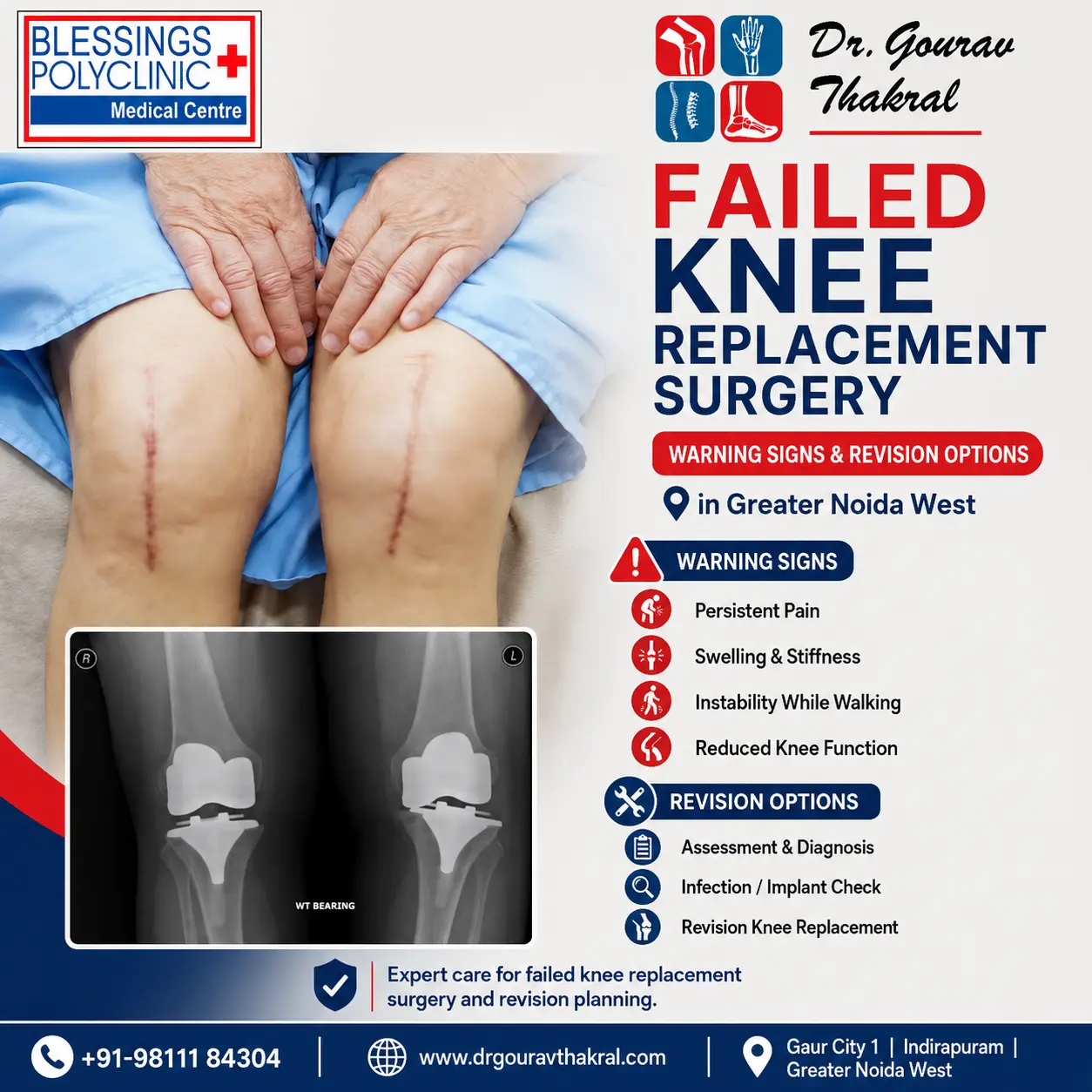
Failed Knee Replacement Surgery in Greater Noida West can cause persistent knee pain, swelling, stiffness, instability, difficulty walking, or poor joint function after knee replacement. Knee replacement usually helps reduce arthritis pain and improve movement. However, in some patients, the implant may loosen, wear out, become infected, or stop working properly over time.
A failed knee replacement does not always mean the first surgery was done wrongly. Sometimes, implants wear with time. In other cases, infection, bone loss, trauma, instability, alignment issues, or patient-related factors may affect the result.
For patients looking for Revision knee replacement, Knee replacement specialist, Joint replacement surgery, or a trusted Orthopaedic clinic in Greater Noida West, Dr. Gourav Thakral provides expert evaluation and treatment guidance. As an experienced Orthopaedic specialist and Joint replacement specialist, he helps patients understand the cause of pain and whether revision surgery is needed.
AAOS explains that when a knee replacement fails, the knee can become painful, swollen, stiff, or unstable, which may make daily activities difficult.
What Is Failed Knee Replacement Surgery?
Failed knee replacement surgery means the artificial knee joint is no longer working as expected. The patient may feel pain, weakness, stiffness, swelling, instability, or difficulty walking.
Sometimes symptoms appear soon after surgery. However, in many cases, problems develop years later. The implant may become loose, infected, worn out, unstable, or misaligned.
A Knee replacement specialist checks the implant, bone, ligaments, infection risk, walking pattern, and X-rays before planning treatment.
Common Warning Signs of Failed Knee Replacement
A failed knee replacement can show many warning signs. Some symptoms are mild at first. However, they may worsen with time.
Common signs include:
Persistent knee pain
Swelling around the knee
Stiffness or reduced bending
Instability or knee giving way
Pain while walking
Difficulty climbing stairs
Clicking or grinding sensation
Warmth or redness around the knee
Pain after a previously good recovery
Reduced joint function
Difficulty standing for long
Need for walking support
HSS notes that common symptoms of a failed knee implant include pain, reduced joint function, instability, swelling, and stiffness.
Why Knee Replacement May Fail
Knee replacement can fail due to several reasons. The exact cause must be diagnosed before treatment.
Common causes include:
Implant loosening
Infection
Wear of plastic liner
Instability
Implant malalignment
Bone loss
Ligament imbalance
Stiffness
Fracture around implant
Poor healing
Repeated trauma
Medical conditions affecting recovery
Mayo Clinic notes that infection can occur at the incision or deeper tissue after knee replacement, and surgery is sometimes needed to treat it.
Implant Loosening After Knee Replacement
Implant loosening is one of the common reasons for revision surgery. It happens when the bond between the implant and bone becomes weak. As a result, the implant may move slightly and cause pain.
Symptoms may include pain while walking, difficulty standing, swelling, instability, or worsening discomfort over time.
Loosening may happen due to long-term wear, bone loss, infection, poor bone quality, or high stress on the implant.
Infection After Knee Replacement
Infection is a serious cause of failed knee replacement. It may happen soon after surgery or years later. It can cause pain, swelling, warmth, redness, wound drainage, fever, or stiffness.
AAOS lists warning signs of an infected joint replacement, including increased pain or stiffness in a previously well-functioning joint, swelling, warmth, redness, wound drainage, and fatigue.
If infection is suspected, early evaluation is very important. Blood tests, X-rays, and joint fluid testing may be needed.
Instability After Knee Replacement
Some patients feel the knee is loose or gives way. This can happen due to ligament imbalance, implant position, wear, or soft tissue weakness.
Instability can make walking unsafe. It can also increase the risk of falls. A medical review notes that instability is one of the common reasons for revision after total knee replacement.
A Joint replacement specialist checks the knee carefully to find the exact type and cause of instability.
Stiffness After Knee Replacement
Some patients cannot bend or straighten the knee properly after surgery. Stiffness may happen due to scar tissue, delayed physiotherapy, infection, implant problems, or long-term inflammation.
Mild stiffness may improve with therapy. However, severe stiffness needs proper medical evaluation to rule out deeper problems.
When Should You See an Orthopaedic Specialist?
You should consult an Orthopaedic surgeonif knee pain continues after recovery or suddenly returns after months or years of comfort.
Consultation becomes important when:
Pain keeps increasing
Swelling does not settle
The knee feels unstable
Walking becomes difficult
The knee becomes warm or red
There is wound discharge
Movement becomes restricted
You hear painful clicking
The knee gives way
Pain affects sleep or daily life
Patients searching for the Best orthopaedic doctor in Gaur City or an Orthopaedic clinic in Greater Noida West can consult Dr. Gourav Thakral for evaluation and treatment planning.
Diagnosis of Failed Knee Replacement
Diagnosis starts with history and examination. The doctor asks about the original surgery, implant age, pain pattern, walking difficulty, swelling, and medical history.
Tests may include:
X-rays
Blood tests
ESR and CRP infection markers
Joint fluid aspiration
CT scan if needed
Bone scan in selected cases
Gait and stability assessment
Review of old surgery records
The aim is to find the exact cause before suggesting Revision knee replacement.
What Is Revision Knee Replacement?
Revision knee replacement is a surgery done to replace or repair a failed knee implant. It is more complex than primary Knee replacement surgery because bone loss, scar tissue, implant removal, infection, or instability may be present.
AAOS explains that revision total knee replacement can involve removing some or all parts of the original implant and replacing them with new components.
Revision surgery needs careful planning, proper implants, and experienced joint replacement care.
Revision Knee Replacement Options
Revision surgery depends on the cause of failure. Treatment is not the same for every patient.
Common revision options include:
1. Liner Exchange
If only the plastic liner is worn and the implant is stable, the surgeon may replace the liner.
2. Partial Component Revision
If one component is loose or damaged, only that part may be replaced in selected cases.
3. Full Revision Knee Replacement
If multiple components are loose, worn, infected, or malaligned, the surgeon may replace the full knee implant.
4. Infection-Based Revision
If infection is present, treatment may involve implant removal, antibiotics, temporary spacer, and later re-implantation.
5. Complex Revision With Special Implants
If bone loss or ligament instability is severe, special revision implants may be required.
Non-Surgical Treatment: Is It Possible?
Not every painful knee replacement needs revision surgery. Some cases may improve with non-surgical treatment if the implant is stable and there is no infection.
Non-surgical care may include:
Medicines
Physiotherapy
Weight management
Activity modification
Bracing
Infection treatment if mild and suitable
Regular follow-up
Pain management
However, if the implant is loose, infected, badly worn, or unstable, revision surgery may be needed.
Recovery After Revision Knee Replacement
Recovery after revision surgery can take longer than first-time knee replacement. It depends on the cause, implant type, bone quality, infection status, age, and overall health.
Recovery may include:
Pain control
Wound care
Physiotherapy
Walking support
Blood clot prevention
Follow-up X-rays
Strength exercises
Gradual return to activity
Long-term implant monitoring
The patient must follow the rehabilitation plan carefully. This helps improve movement, strength, and walking confidence.
Why Expert Evaluation Matters
Pain after knee replacement should not be ignored. However, it should also not be treated blindly. The exact cause must be found first.
A Knee replacement specialist checks the implant, bone, soft tissues, infection markers, and walking pattern. This helps avoid unnecessary treatment and supports better outcomes.
Failed Knee Replacement Surgery Treatment in Greater Noida West by Dr. Gourav Thakral
If you have knee pain, swelling, stiffness, instability, or walking difficulty after knee replacement, Dr. Gourav Thakral can help with proper evaluation in Greater Noida West.
He checks implant position, loosening, infection risk, bone quality, joint stability, and previous surgery details before suggesting treatment. Patients searching for Failed knee replacement surgery, Revision knee replacement, Joint replacement surgery, or Joint replacement specialist care can consult Dr. Gourav Thakral for expert guidance.
Final Thoughts
Failed knee replacement surgery can cause pain, stiffness, swelling, instability, and poor movement. The cause may be implant loosening, infection, wear, instability, stiffness, or fracture around the implant. Early diagnosis is important because treatment depends on the exact reason.
For Failed Knee Replacement Surgery in Greater Noida West, consult Dr. Gourav Thakral, an experienced Orthopaedic specialist, Knee replacement specialist, and Joint replacement specialist, for accurate diagnosis and revision treatment planning.
FAQs
1. What is failed knee replacement surgery?
Failed knee replacement surgery means the artificial knee joint is no longer working well and is causing pain, swelling, stiffness, instability, or poor function.
2. What are the warning signs of knee replacement failure?
Common signs include persistent pain, swelling, stiffness, instability, clicking, difficulty walking, warmth, redness, or reduced movement.
3. What causes knee replacement failure?
Common causes include implant loosening, infection, plastic wear, instability, malalignment, stiffness, bone loss, or fracture around the implant.
4. What is revision knee replacement?
Revision knee replacement is surgery to remove or replace part or all of a failed knee implant.
5. Does every painful knee replacement need revision?
No. Some painful knee replacements can be managed without surgery if the implant is stable and there is no infection.