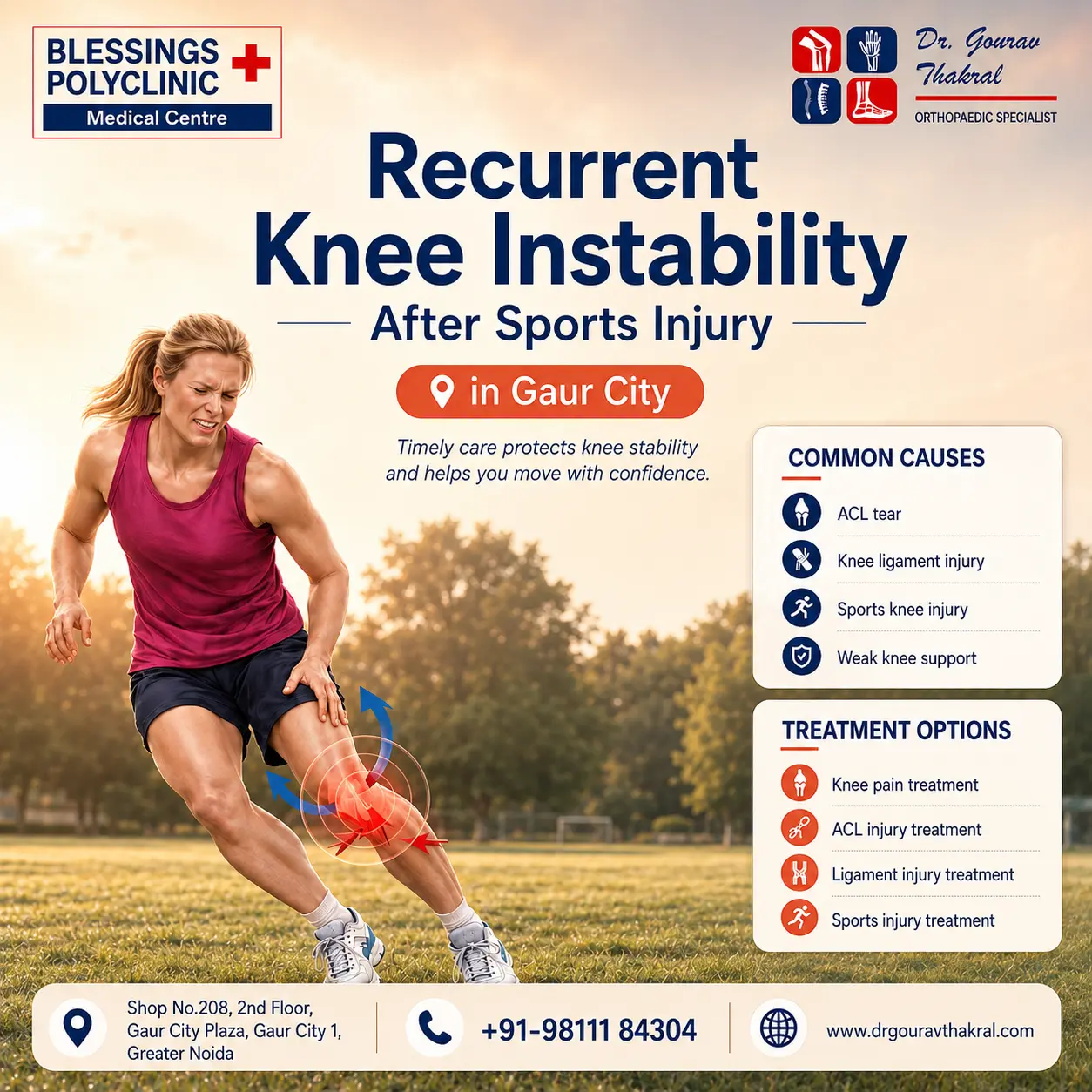
Recurrent Knee Instability After Sports Injury: Causes and Treatment in Gaur City
Knee instability after a sports injury can make walking, running, stair climbing, turning, and daily movement uncomfortable. Many patients describe it as a feeling that the knee is loose, weak, shaky, or suddenly “giving way.” Sometimes, this happens again and again after a twisting injury, fall, jump landing, or sudden direction change during sports.
Recurrent knee instability should not be ignored. It can indicate a Knee ligament injury, especially an ACL tear or combined ligament damage. ACL injuries often happen during sports that involve sudden stops, direction changes, jumping, or landing. Many people feel a pop during injury, followed by swelling, pain, and instability.
For patients looking for Recurrent Knee Instability Treatment in Gaur City, Dr. Gourav Thakral provides expert orthopaedic evaluation and treatment guidance for sports-related knee problems. He helps patients understand the cause of instability and choose the right treatment plan based on injury severity, knee stability, activity level, and MRI findings.
What Is Recurrent Knee Instability?
Recurrent knee instability means the knee repeatedly feels unsafe during movement. The knee may buckle, shift, twist, or give way while walking, running, climbing stairs, playing sports, or changing direction. This is not the same as simple knee pain. Instability means the knee is not getting enough support from its ligaments, muscles, meniscus, or joint structures.
A Sports knee injury can damage one or more structures inside the knee. The ACL, PCL, MCL, LCL, meniscus, cartilage, and surrounding muscles all help maintain knee control. When any of these structures fails to support the joint properly, the patient may feel repeated instability.
Some patients continue to play or exercise after the first injury. This can increase the risk of repeated giving-way episodes and further damage.
Common Causes of Knee Instability After Sports Injury
The most common cause of recurrent knee instability after sports injury is ligament damage. The ACL plays a major role in controlling forward and rotational movement of the knee. When the ACL tears, the knee may feel unstable during turning, pivoting, running, or landing.
Other causes may include meniscus injury, cartilage damage, patellar instability, muscle weakness, poor rehabilitation, incomplete recovery after a previous injury, or combined ligament injuries. AAOS explains that a complete ligament tear can make the knee joint unstable, and two or more ligaments can also get injured at the same time in more complex cases.
In some patients, instability remains because the first injury did not receive proper diagnosis. Pain may reduce with rest, but the underlying ligament tear may continue to affect knee stability.
Symptoms You Should Not Ignore
Knee instability can show up in different ways. Some patients feel a sudden shift inside the knee. Others feel weakness while turning, walking on uneven ground, or playing sports.
Common symptoms include:
Knee giving way during walking or running
Pain after twisting or pivoting movement
Swelling after activity
Difficulty climbing stairs
Fear of sudden movement
Weakness around the knee
Reduced confidence while playing sports
Repeated injury-like episodes
Clicking, locking, or catching if meniscus injury exists
If knee instability keeps returning, you should consult an Orthopaedic specialist instead of depending only on rest, painkillers, or knee supports.
Why Sports Injuries Often Cause Knee Instability
Sports movements place high demand on the knee. Running, jumping, landing, tackling, sudden stopping, and quick turning can stress the ligaments. Football, cricket, badminton, basketball, volleyball, running, gym training, and contact sports can all cause knee injuries if the knee twists under load.
A Sports injury treatment plan should focus on more than pain relief. It should also restore strength, stability, balance, movement control, and confidence. If the patient returns to sports too early, the knee may give way again.
Mayo Clinic explains that ACL treatment may include rehabilitation to regain strength and stability, or surgery to replace the torn ligament followed by rehabilitation, depending on injury severity.
Role of ACL Injury in Recurrent Knee Instability
The ACL is one of the most important ligaments for knee stability. It prevents excessive forward movement of the shin bone and controls rotational stability. When the ACL tears, patients may feel the knee giving way during pivoting activities.
ACL injury treatment depends on the patient’s age, activity level, symptoms, instability, and associated injuries. Some patients may improve with structured physiotherapy and activity modification. Others may need ACL reconstruction if they have repeated instability, high activity demands, or associated meniscus injury.
AAOS notes that whether an ACL injury needs surgery varies from patient to patient and depends on activity level, injury degree, and instability symptoms.
Diagnosis of Recurrent Knee Instability
Proper diagnosis starts with clinical examination. The doctor checks swelling, tenderness, range of motion, ligament stability, walking pattern, and muscle strength. Special knee tests may help identify ACL, PCL, MCL, LCL, or meniscus injury.
X-rays may help rule out fracture or alignment issues. MRI helps detect ligament tears, meniscus injury, cartilage damage, bone bruising, and other internal knee problems. For recurrent instability, MRI plays an important role because pain may reduce while internal damage remains.
Dr. Gourav Thakral may also assess the patient’s sports activity, previous injuries, rehabilitation history, and instability pattern before planning treatment.
Non-Surgical Treatment Options
Not every patient with knee instability needs surgery. Mild injuries, partial ligament sprains, muscle weakness, and early instability may improve with non-surgical care. The main goal is to restore stability and prevent repeated giving-way episodes.
Non-surgical treatment may include rest, activity modification, bracing, medicines, swelling control, physiotherapy, strengthening exercises, balance training, and movement correction. Rehabilitation focuses on quadriceps, hamstrings, hip strength, core control, and neuromuscular training.
For Knee pain treatment, doctors may also manage inflammation, stiffness, and movement restriction. However, pain relief alone is not enough if the knee remains unstable.
When Is Surgery Needed?
Surgery may become necessary when the knee continues to give way, the ACL is completely torn, multiple ligaments are damaged, the patient wants to return to sports, or meniscus/cartilage injury exists with instability. The decision depends on the injury pattern and patient goals.
Ligament injury treatment may include ligament repair or reconstruction. ACL reconstruction is one common surgical option for patients with symptomatic ACL instability. In complex cases, additional treatment may be needed for meniscus, cartilage, or other ligaments.
The aim of surgery is to restore knee stability, protect the joint from repeated giving-way episodes, and help the patient return to daily activities or sports more safely. Rehabilitation after surgery is essential for strength, movement, balance, and long-term recovery.
Why Delaying Treatment Can Be Risky
Ignoring recurrent knee instability can increase the risk of further knee damage. Each giving-way episode can put stress on the meniscus and cartilage. Over time, this may increase pain, swelling, stiffness, and movement difficulty.
Early diagnosis helps identify whether the problem is due to ACL injury, meniscus tear, muscle weakness, or combined ligament injury. Timely care also helps patients avoid unsafe return to sports.
If you have repeated instability after a sports injury, consult an Orthopaedic specialist early. A proper treatment plan can reduce uncertainty and help you recover with better confidence.
Recurrent Knee Instability Treatment in Gaur City by Dr. Gourav Thakral
If you are facing repeated knee instability after sports injury, Dr. Gourav Thakral can help with proper evaluation and treatment planning. He examines the knee, reviews imaging, checks ligament stability, and explains whether the condition needs rehabilitation, bracing, medicines, injections, or surgery.
Patients searching for the Best orthopaedic care in Gaur City can consult Dr. Gourav Thakral for knee instability, ligament injuries, sports knee injuries, and ACL-related problems. His treatment approach focuses on accurate diagnosis, patient education, pain relief, stability, and safe return to activity.
Final Thoughts
Recurrent knee instability after sports injury is a warning sign that the knee may not be functioning normally. If your knee gives way, feels loose, swells after activity, or feels unsafe during movement, do not ignore it.
Early consultation with Dr. Gourav Thakral, an experienced Orthopaedic specialist in Gaur City, can help identify the cause and guide the right treatment. Timely care can improve knee stability, reduce pain, and support safer movement.
FAQs
1. What causes recurrent knee instability after sports injury?
It commonly happens due to ACL injury, other ligament tears, meniscus injury, muscle weakness, poor rehabilitation, or combined knee injuries.
2. Is knee giving way a serious symptom?
Yes, repeated giving-way may indicate ligament damage or internal knee injury. It should be checked by an orthopaedic specialist.
3. Can ACL injury cause knee instability?
Yes, ACL injury is one of the most common causes of knee instability, especially during twisting, pivoting, running, or sports activity.
4. Does every knee ligament injury need surgery?
No. Mild or partial injuries may improve with rehabilitation and bracing. Severe tears or repeated instability may need surgical treatment.
5. What tests are needed for recurrent knee instability?
The doctor may suggest clinical examination, X-ray, and MRI to check ligaments, meniscus, cartilage, swelling, and internal knee damage.