Periprosthetic Fracture Around Knee Replacement in Gaur City: Expert Trauma & Joint Care
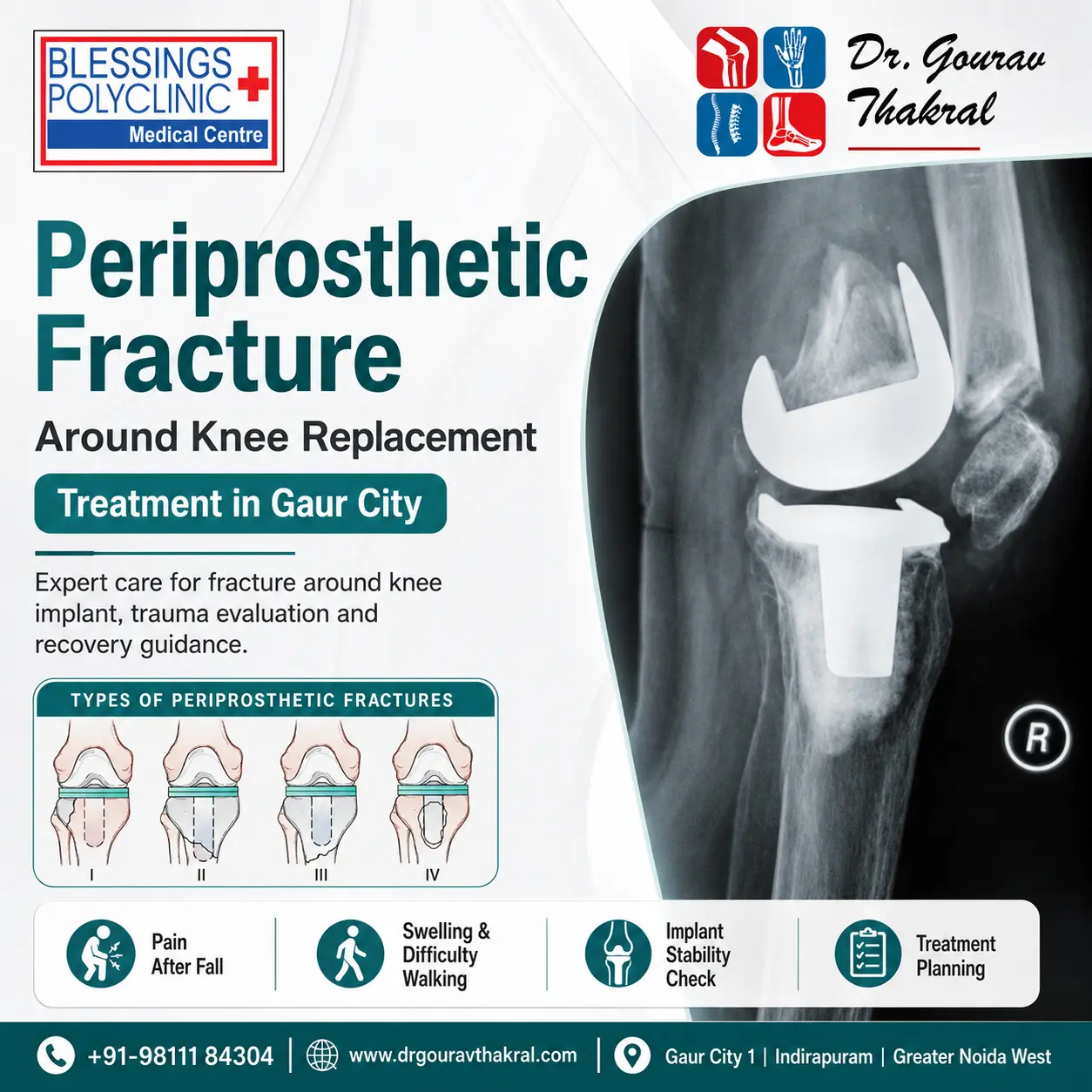
Periprosthetic fracture around knee replacement is a fracture that happens near an artificial knee implant. It may occur above the knee replacement, below the knee replacement, or around the kneecap area. This type of fracture needs careful treatment because the bone, implant stability, age, and bone quality all matter.
A fracture around knee replacement can happen after a fall, road accident, twist injury, or direct trauma. It may also happen in weak bones due to osteoporosis. In older patients, even a minor fall can sometimes cause a serious fracture.
For patients looking for Fracture treatment, Orthopaedic trauma treatment, or a Knee replacement in Gaur City, Dr. Gourav Thakral provides expert evaluation and treatment guidance. As an experienced Bone fracture specialist, Joint replacement specialist, and Orthopaedic specialist, he helps patients understand the safest treatment option after proper X-rays and clinical examination.
AAOS explains that fractures around total knee replacement may be treated with open reduction and internal fixation, revision total knee replacement, or a combination of both.
What Is a Periprosthetic Fracture Around Knee Replacement?
A periprosthetic fracture means a bone break around an existing joint replacement implant. In the knee, it usually occurs around the thigh bone, shin bone, or kneecap near the artificial joint.
After Knee replacement surgery, metal and plastic components replace the damaged knee joint surfaces. Mayo Clinic explains that artificial knee joints usually include metal parts for the thighbone and shinbone, while plastic replaces cartilage and kneecap surfaces.
When a fracture occurs near these implants, treatment becomes more complex than a simple fracture. The doctor must check whether the implant is stable or loose. He must also check bone quality and fracture pattern.
Why This Fracture Needs Special Care
A normal fracture is treated by aligning and stabilizing the broken bone. However, a periprosthetic knee fracture needs extra planning because the fracture is close to an implant.
The surgeon must answer important questions:
Is the knee implant stable?
Is the implant loose?
Is the bone stock good?
Is the fracture simple or complex?
Is there infection?
Can the bone hold screws or plates?
Does the patient have osteoporosis?
Can the patient safely walk after surgery?
Orthobullets notes that treatment depends on fracture location, implant stability, available bone stock, and patient health conditions.
Common Causes of Periprosthetic Fracture
A periprosthetic fracture may happen after sudden injury. However, bone weakness also plays a major role in many patients.
Common causes include:
Fall at home
Road accident
Slip injury
Twisting injury
Weak bones
Osteoporosis
Previous knee replacement surgery
Loose implant
High-impact trauma
Poor bone stock
In elderly patients, poor bone quality can make the fracture more difficult to treat. A medical review explains that most patients with periprosthetic fractures around the knee are elderly and often have poor bone quality, which increases treatment difficulty.
Symptoms of Fracture Around Knee Replacement
Symptoms usually start suddenly after injury. However, if the implant is loose or the bone is weak, pain may increase gradually before the fracture becomes clear.
Common symptoms include:
Sudden knee pain
Swelling around the knee
Inability to stand or walk
Pain after a fall
Visible deformity
Bruising
Tenderness near the knee
Difficulty moving the leg
Feeling that the knee is unstable
Pain around a previous knee replacement
If a patient with a previous knee replacement develops sudden pain after a fall, urgent orthopaedic evaluation is important.
When Should You Seek Urgent Trauma Care?
You should seek urgent Trauma care if there is severe pain, swelling, deformity, or inability to bear weight after a fall. Do not try to walk forcefully on the injured leg.
Immediate evaluation is important when:
Pain starts after injury
The leg looks deformed
Walking is not possible
Swelling increases quickly
The knee feels unstable
There is severe bruising
The patient has a knee replacement implant
The patient has osteoporosis
Early diagnosis helps reduce risk and supports better planning.
Diagnosis of Periprosthetic Knee Fracture
Diagnosis starts with physical examination and X-rays. The doctor checks swelling, pain location, wound condition, leg alignment, knee movement, and blood supply.
X-rays help identify the fracture location and implant position. In some cases, CT scan may be needed to understand the fracture pattern more clearly. Blood tests may be advised if infection is suspected.
The doctor also checks previous knee replacement records if available. This helps identify implant type and previous surgical details.
Main Treatment Factors
Treatment is not the same for every patient. The final plan depends on:
Fracture location
Implant stability
Bone quality
Fracture displacement
Patient age
Walking ability before injury
Medical fitness
Osteoporosis status
Infection risk
Previous knee surgery history
A Bone fracture specialist and Joint replacement specialist must plan treatment carefully because both fracture healing and implant function are important.
Non-Surgical Treatment
Non-surgical treatment may be possible in selected stable fractures. It may include brace support, immobilization, pain control, limited weight-bearing, and regular X-ray follow-up.
However, non-surgical care is not suitable for every case. If the fracture is displaced, unstable, or associated with a loose implant, surgery may be needed.
The goal is safe healing without disturbing the knee replacement.
Surgical Treatment Options
Many periprosthetic knee fractures need surgery. The main options include fixation surgery, revision knee replacement, or both.
AAOS lists the general treatment approaches as open reduction and internal fixation, revision total knee replacement, or a combination of both.
1. Open Reduction and Internal Fixation
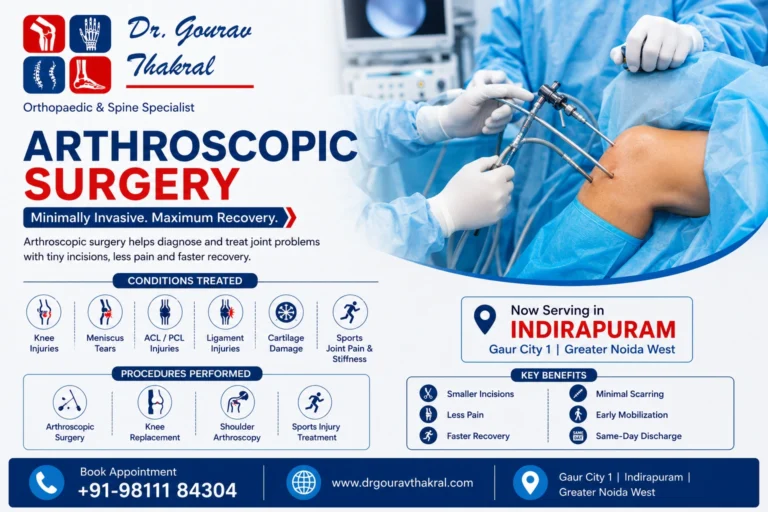
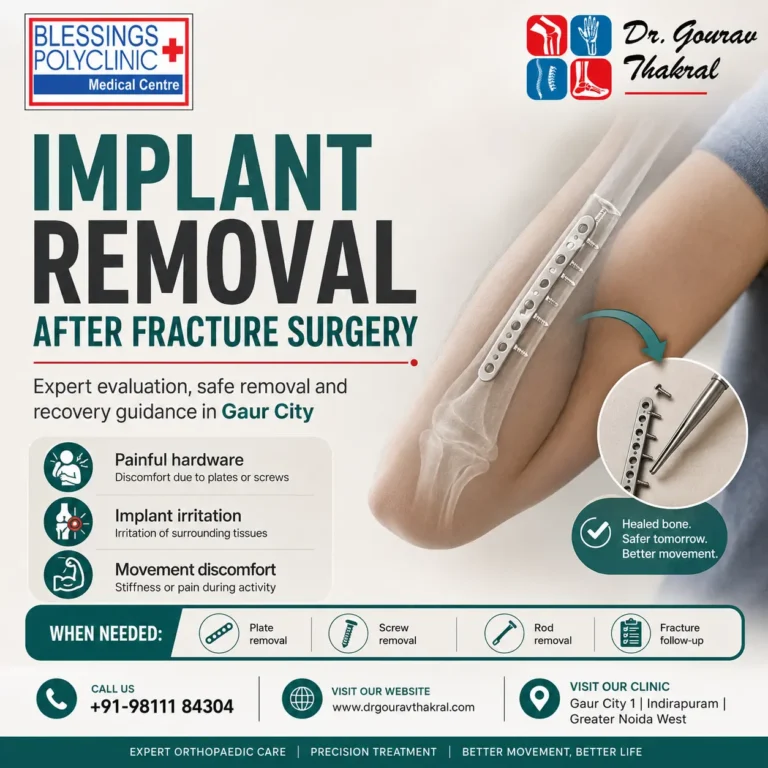
In this method, the surgeon realigns the broken bone and fixes it using plates, screws, rods, or special locking plates. This may be suitable when the implant is stable and the bone can hold fixation.
2. Revision Knee Replacement
If the implant is loose or the bone around it is badly damaged, revision knee replacement may be required. In this surgery, the old implant may be replaced with a special revision implant.
3. Combined Treatment
Some patients need both fracture fixation and implant revision. This depends on fracture complexity, bone quality, and implant condition.
A reconstruction review notes that nonoperative treatment, locking plate fixation, intramedullary nailing, and revision total knee arthroplasty can all be useful when chosen for the right situation.
Recovery After Treatment
Recovery depends on the fracture type, implant condition, surgery type, age, bone strength, and overall health. Some patients may need protected weight-bearing for weeks. Others may start guided movement earlier.
Recovery may include:
Pain control
Wound care
Brace support if advised
Physiotherapy
Walker support
Gradual weight-bearing
Follow-up X-rays
Bone health treatment
Fall prevention guidance
Regular review with doctor
Rehabilitation should be guided. Too much pressure too early may affect healing. However, too much bed rest may also cause weakness and stiffness.
Why Bone Health Matters
Many patients with periprosthetic fractures have weak bones. Therefore, osteoporosis evaluation and bone-strengthening treatment may be needed.
Bone health care may include vitamin D, calcium, osteoporosis medicines, safe exercises, and fall prevention. This is important because poor bone quality can increase the risk of another fracture.
Periprosthetic Fracture Treatment in Gaur City by Dr. Gourav Thakral
If you or your family member has knee pain, swelling, or inability to walk after a fall with a previous knee replacement, consult Dr. Gourav Thakral in Gaur City.
He evaluates the fracture, implant stability, bone quality, X-ray findings, and patient condition before suggesting treatment. Patients searching for Periprosthetic fracture care, Knee replacement specialist, Fracture treatment, Orthopaedic trauma treatment, or Best orthopaedic doctor in Gaur City can consult Dr. Gourav Thakral for expert guidance.
Final Thoughts
A periprosthetic fracture around knee replacement is a serious injury. It needs careful diagnosis and expert planning because the fracture happens near an artificial knee implant. Treatment may include bracing, plate fixation, rod fixation, revision knee replacement, or combined surgery.
For Periprosthetic Fracture treatment in Gaur City, consult Dr. Gourav Thakral, an experienced Bone fracture specialist, Joint replacement specialist, and Orthopaedic specialist, for safe evaluation and treatment planning.
FAQs
1. What is a periprosthetic fracture?
A periprosthetic fracture is a bone break that happens around a joint replacement implant, such as a knee replacement.
2. Is a fracture around knee replacement serious?
Yes. It is serious because the fracture is close to an artificial knee implant. Implant stability and bone quality must be checked.
3. What causes periprosthetic knee fracture?
It may happen after a fall, road accident, twist injury, weak bones, osteoporosis, or trauma around a previous knee replacement.
4. Does every periprosthetic fracture need surgery?
No. Some stable fractures may be treated with braces and restricted weight-bearing. However, unstable fractures often need surgery.
5. What surgery is done for this fracture?
Treatment may include plate fixation, rod fixation, revision knee replacement, or a combination of fracture fixation and revision surgery.