Lumbar Fusion Surgery in Gaur City: Treatment for Spine Instability and Nerve Pain
Lumbar Fusion Surgery in Gaur City may be needed when lower spine instability causes ongoing back pain, leg pain, sciatica, numbness, or walking difficulty. The lumbar spine is the lower back area. It carries body weight and helps with bending, standing, walking, and movement.
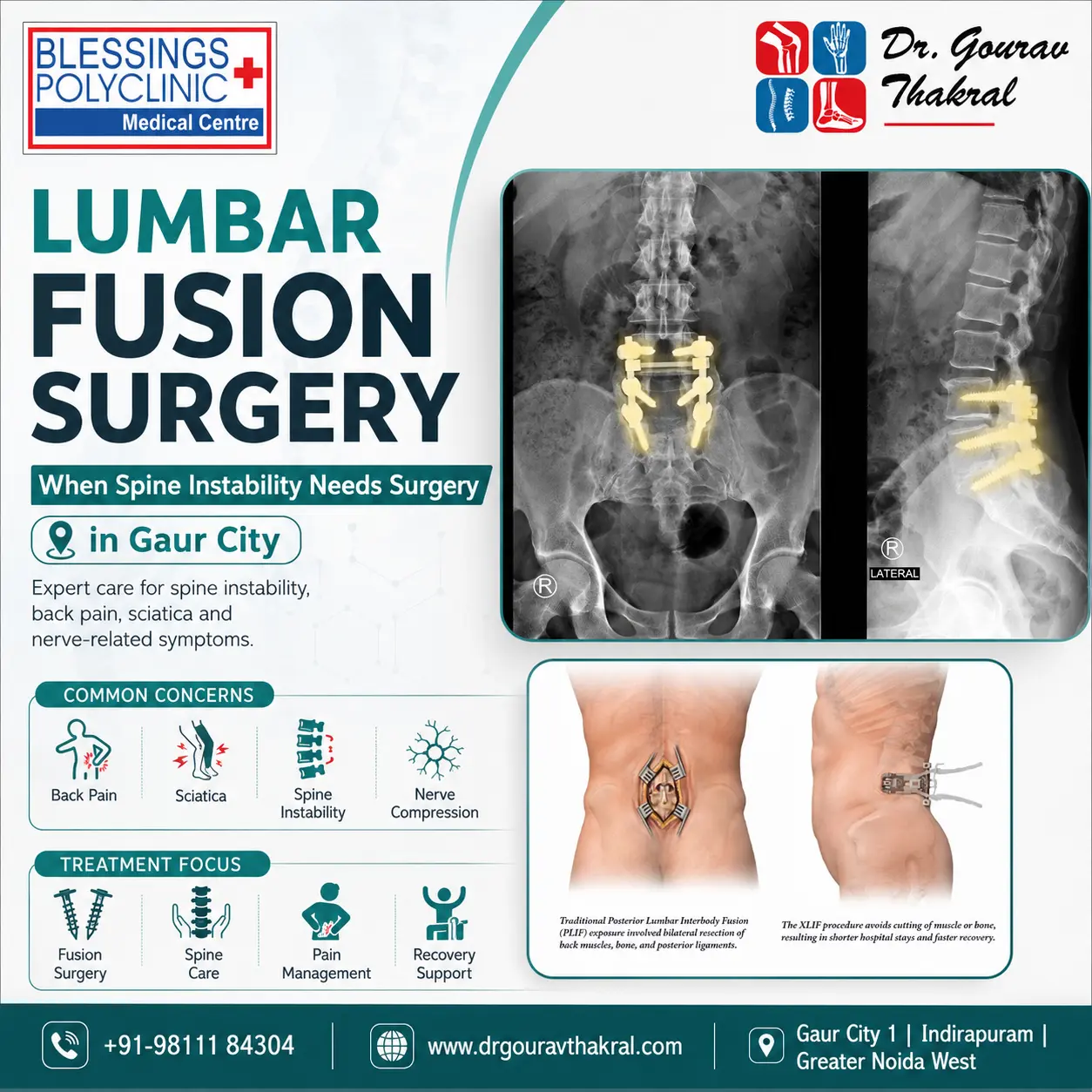
When one spinal level becomes unstable, painful motion may develop between two vertebrae. As a result, the patient may feel constant back pain, nerve pain, stiffness, or leg weakness. In selected cases, lumbar fusion helps stabilize the spine by joining two or more vertebrae together.
For patients looking for Back pain treatment, Sciatica treatment, Slip disc surgery, and Spine care in Gaur City, Dr. Gourav Thakral provides expert orthopaedic evaluation and treatment guidance. As an experienced Orthopaedic specialist and Spine specialist, he helps patients understand whether medicines, physiotherapy, injections, decompression, or lumbar fusion surgery may be suitable.
AAOS explains that spinal fusion uses screws and rods to fuse two or more vertebrae into one solid bone. This can stop motion at an unstable spinal level.
What Is Lumbar Fusion Surgery?
Lumbar fusion surgery is a spine procedure that joins two or more bones in the lower back. The goal is to reduce painful movement and improve spinal stability.
During fusion, the surgeon may use bone graft, screws, rods, cages, or plates to support the spine while the bones heal together. Mayo Clinic describes spinal fusion as surgery to connect two or more bones in any part of the spine so there is no movement between them.
This surgery is not needed for every back pain case. It is usually considered when spine instability, severe degeneration, deformity, nerve compression, or slippage causes significant symptoms.
Why Spine Instability Causes Pain
Spine instability means one spinal segment moves more than it should. This abnormal movement can irritate discs, joints, muscles, and nerves.
It may cause:
Lower back pain
Leg pain
Sciatica-like pain
Numbness or tingling
Weakness in the legs
Pain while standing
Difficulty walking
Relief while sitting
Repeated back stiffness
Reduced daily activity
Because these symptoms can also happen in slip disc and spinal stenosis, proper diagnosis is important.
Common Conditions That May Need Lumbar Fusion
Lumbar fusion may be considered in selected spine conditions. However, the decision depends on symptoms, imaging, nerve compression, instability, and response to non-surgical care.
Common conditions include:
Spondylolisthesis
Spine instability
Degenerative disc disease
Severe spinal stenosis with instability
Recurrent slip disc with instability
Spinal deformity
Fracture-related instability
Post-surgery instability
Severe arthritis of spine joints
AAOS notes that spinal fusion may help relieve symptoms of several back problems, including degenerative disc disease, spondylolisthesis, spinal stenosis, scoliosis, fractured vertebrae, and infection.
Lumbar Fusion and Spondylolisthesis
Spondylolisthesis happens when one vertebra slips forward over another. This may cause back pain, leg pain, nerve compression, and walking difficulty.
In patients with major degenerative changes, spinal fusion is often performed to stop painful movement and stabilize the unstable level.
Cleveland Clinic also notes that surgery may be considered for high-grade spondylolisthesis, severe symptoms affecting standing or walking, or symptoms that continue despite non-surgical treatment.
Lumbar Fusion for Sciatica and Leg Pain
Sciatica happens when a nerve in the lower spine gets irritated or compressed. It can cause pain that travels from the lower back to the buttock, thigh, calf, or foot.
Not every sciatica case needs fusion. Many cases improve with Sciatica treatment, medicines, physiotherapy, posture correction, and injections. However, if sciatica is caused by nerve compression along with spinal instability, fusion may be considered along with decompression.
AAOS notes that if nerve compression is present, the surgeon may also decompress the spine through a laminectomy.
Lumbar Fusion vs Slip Disc Treatment
Many patients confuse lumbar fusion with Slip disc treatment. A slip disc usually happens when disc material presses on a nerve. In many cases, it improves with medicines, physiotherapy, injections, or discectomy.
Lumbar fusion is different. It is mainly used when the spine needs stabilization. It may be considered if there is recurrent disc problem with instability, severe disc degeneration, or painful abnormal movement.
Therefore, a Spine specialist checks MRI, X-rays, symptoms, nerve signs, and stability before suggesting surgery.
When Should You Consult a Spine Specialist?
You should consult a Spine specialist if back pain continues for weeks, keeps returning, or travels to the legs. Also, seek care if pain affects walking, standing, sleep, or daily work.
Consultation becomes important when:
Back pain does not improve
Leg pain travels below the knee
Numbness or tingling appears
Walking distance reduces
Pain increases while standing
Weakness develops in the leg
Pain returns after previous treatment
Daily activity becomes difficult
Patients searching for the Best orthopaedic doctor in Gaur City can consult Dr. Gourav Thakral for spine evaluation and treatment planning.
Red Flag Symptoms That Need Urgent Care
Some symptoms need urgent medical attention. Do not delay care if you notice:
Loss of bladder control
Loss of bowel control
Severe leg weakness
Numbness around the groin area
Severe pain after injury
Fever with back pain
Rapidly worsening symptoms
Unexplained weight loss
These symptoms may point to serious nerve compression or infection.
Diagnosis Before Lumbar Fusion Surgery
A proper diagnosis is very important before planning Lumbar Fusion Surgery. The doctor first checks pain history, walking ability, posture, nerve function, strength, reflexes, and spine movement.
Tests may include:
X-ray
Flexion-extension X-rays
MRI
CT scan
Nerve evaluation
Blood tests if needed
Bone health check
MRI helps detect nerve compression, disc problems, and spinal stenosis. X-rays can show slippage or instability. Flexion-extension X-rays may show abnormal movement between vertebrae.
Non-Surgical Treatment Before Fusion
Lumbar fusion is usually not the first step for back pain. Many patients improve with non-surgical care.
Non-surgical treatment may include:
Rest for a short time
Pain medicines
Anti-inflammatory medicines
Physiotherapy
Core strengthening
Posture correction
Weight management
Activity modification
Epidural injection if advised
Lifestyle changes
AAOS notes that for lumbar spinal stenosis, spinal fusion may be recommended when arthritis has progressed to spinal instability.
When Is Lumbar Fusion Surgery Needed?
Lumbar fusion surgery may be considered when pain and nerve symptoms continue despite proper non-surgical treatment. It may also be needed when imaging shows clear instability.
Your doctor may suggest fusion when:
Spine instability is confirmed
Back pain is linked to abnormal spinal movement
Leg pain is due to nerve compression with instability
Spondylolisthesis causes severe symptoms
Walking becomes difficult
Non-surgical care fails
Slip disc keeps recurring with instability
Spinal stenosis is associated with unstable joints
Daily life is badly affected
The final decision depends on symptoms, X-ray findings, MRI findings, age, activity level, and overall health.
What Happens During Lumbar Fusion Surgery?
During lumbar fusion surgery, the surgeon stabilizes the painful spinal segment. The damaged disc may be removed in selected cases. Bone graft may be placed to help two vertebrae fuse. Screws and rods may support the spine during healing.
If nerves are compressed, decompression may also be done. This can create more space for nerves and reduce leg pain.
The surgical method depends on the patient’s condition. Some cases may need posterior fusion. Others may need interbody fusion or minimally invasive techniques.
Types of Lumbar Fusion Procedures
Different lumbar fusion methods may be used depending on the problem.
1. Posterolateral Fusion
Bone graft is placed along the back part of the spine. Screws and rods may stabilize the vertebrae.
2. PLIF
Posterior Lumbar Interbody Fusion removes the disc from the back and places a cage or graft between vertebrae.
3. TLIF
Transforaminal Lumbar Interbody Fusion approaches the disc space from one side and helps reduce nerve handling.
4. ALIF
Anterior Lumbar Interbody Fusion approaches the spine from the front of the body in selected cases.
5. Minimally Invasive Fusion
Some patients may be suitable for smaller incision techniques. Cleveland Clinic explains that minimally invasive spine surgery uses small incisions and special tools to access the spine with less muscle disruption.
Recovery After Lumbar Fusion Surgery
Recovery depends on age, diagnosis, surgery type, bone health, and rehabilitation. Fusion takes time because bones must heal together.
Recovery may include:
Pain control
Walking with support
Wound care
Avoiding bending and heavy lifting
Physiotherapy when advised
Follow-up X-rays
Posture training
Gradual return to daily activity
Core strengthening later
Long-term spine care
Cleveland Clinic notes that recovery after laminectomy with spinal fusion may take around six months to heal completely, although every patient recovers differently.
Risks of Lumbar Fusion Surgery
Like any surgery, lumbar fusion has possible risks. These may include infection, bleeding, blood clots, nerve injury, poor wound healing, persistent pain, or failure of fusion.
Mayo Clinic lists possible spinal fusion risks such as infection, poor wound healing, bleeding, blood clots, and injury to blood vessels or nerves around the spine.
The doctor discusses benefits and risks before surgery. Good planning, patient selection, and rehabilitation can help improve outcomes.
Why Physiotherapy Matters After Surgery
Physiotherapy supports safe recovery after lumbar fusion. In the early stage, walking and basic movement are important. Later, therapy focuses on posture, flexibility, leg strength, and core support.
Patients should avoid random exercises. Instead, they should follow a guided plan. This helps protect the fusion and reduce strain on the back.
Spine Care Tips After Lumbar Fusion
Long-term Spine care is important after recovery.
Helpful tips include:
Avoid smoking
Maintain healthy weight
Walk regularly
Follow physiotherapy advice
Avoid heavy lifting early
Use correct posture
Avoid sudden twisting
Control diabetes if present
Take calcium and vitamin D if advised
Keep follow-up appointments
These steps can support healing and reduce future spine stress.
Lumbar Fusion Surgery in Gaur City by Dr. Gourav Thakral
If you have chronic back pain, leg pain, sciatica, slip disc-like symptoms, or spine instability, consult Dr. Gourav Thakral in Gaur City.
He evaluates your symptoms, MRI, X-rays, nerve signs, walking ability, and previous treatment history before suggesting the right treatment plan. Patients searching for Lumbar fusion surgery, Back pain treatment, Sciatica treatment, Slip disc treatment, or Spine specialist care can consult Dr. Gourav Thakral for expert guidance.
Final Thoughts
Lumbar fusion surgery may help selected patients with spine instability, severe back pain, leg pain, or nerve compression that does not improve with non-surgical care. However, it is not needed for every back pain or slip disc case.
For Lumbar Fusion Surgery in Gaur City, consult Dr. Gourav Thakral, an experienced Orthopaedic specialist and Spine specialist, for proper diagnosis and treatment planning.
FAQs
1. What is lumbar fusion surgery?
Lumbar fusion surgery joins two or more bones in the lower spine to reduce painful movement and improve stability.
2. When is lumbar fusion needed?
It may be needed when spine instability, spondylolisthesis, severe degeneration, or nerve compression causes symptoms that do not improve with non-surgical care.
3. Is lumbar fusion needed for every slip disc?
No. Most slip disc cases do not need fusion. Fusion is usually considered when instability is present.
4. Can lumbar fusion help sciatica?
It may help selected patients when sciatica is caused by nerve compression along with spinal instability.
5. How long is recovery after lumbar fusion?
Recovery varies. Bone healing and functional recovery can take several months, depending on the surgery and patient health.