Implant Removal After Fracture Surgery in Gaur City
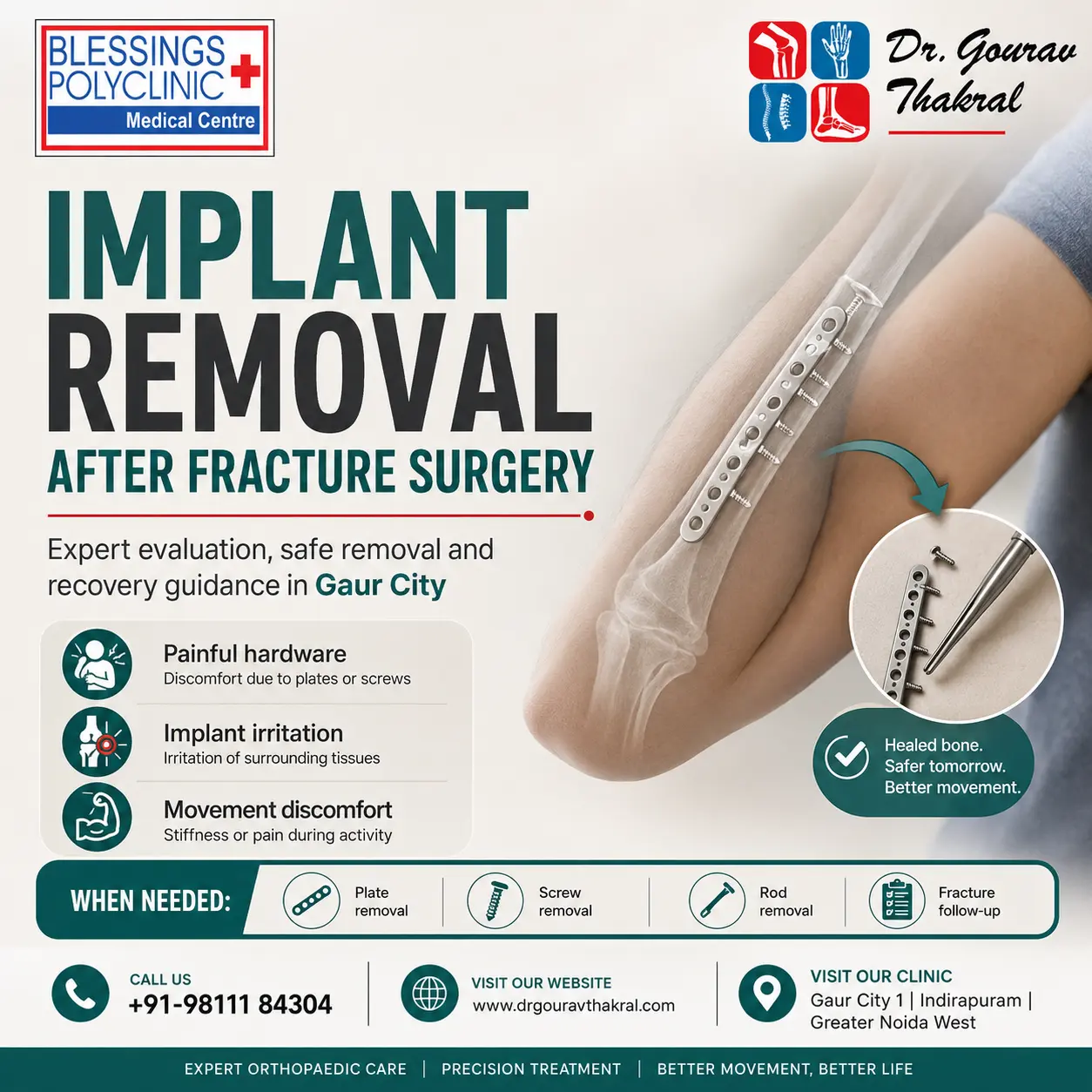
Implant Removal Surgery in Gaur City may be needed when plates, screws, rods, wires, or other fracture implants cause pain, irritation, stiffness, infection, or movement discomfort after bone healing. Many fracture implants are designed to support the broken bone while it heals. However, not every implant must be removed after recovery.
In many cases, implants can safely remain inside the body. Still, some patients may need removal when the implant becomes painful, prominent, infected, loose, or limits daily movement. AAOS explains that plates used in fracture fixation may be left in place after healing, although they may be removed in selected cases.
For patients looking for Fracture treatment, Orthopaedic trauma treatment, Trauma care, or a trusted Bone fracture specialist in Gaur City, Dr. Gourav Thakral provides expert orthopaedic evaluation and treatment guidance. As an experienced Orthopaedic doctor, Orthopaedic specialist, and Bone specialist, he helps patients understand whether implant removal is needed or not.
What Is Implant Removal After Fracture Surgery?
Implant removal means removing metal hardware that was used earlier to fix a fracture. This hardware may include plates, screws, rods, nails, pins, wires, or external fixation parts.
During fracture surgery, implants hold the bone in proper position. This helps the broken bone heal with better alignment. Cleveland Clinic explains that internal fixation uses screws, plates, or rods to hold bones together while they heal.
Once the bone has healed, the implant may not always be necessary. However, removal is only planned after proper examination, X-rays, healing assessment, and discussion of risks and benefits.
Does Every Fracture Implant Need Removal?
No. Every fracture implant does not need removal. Many patients live comfortably with plates, screws, or rods for years. If the implant is not causing pain, infection, irritation, or movement restriction, removal may not be needed.
In fact, implant removal can be technically difficult in some cases. Orthobullets notes that hardware removal can have complications and results may be unpredictable when removal is done only for pain relief.
Therefore, the decision should never be casual. It should be made after a detailed check-up by an experienced Orthopaedic doctor.
When Is Implant Removal Surgery Needed?
Implant removal surgery may be considered when the implant causes symptoms or complications. It may also be needed before another planned surgery in the same area.
Common reasons include:
Pain over the implant site
Screw or plate irritation
Implant prominence under skin
Restricted joint movement
Infection around implant
Loose or broken implant
Allergy or tissue irritation in rare cases
Implant interfering with tendon movement
Need for another orthopaedic procedure
Patient discomfort after complete bone healing
However, pain does not always mean the implant is the cause. Sometimes pain may come from stiffness, arthritis, nerve irritation, weak muscles, tendon problems, or incomplete healing. Therefore, proper diagnosis is important.
Why Proper Bone Healing Must Be Confirmed First
Before removing any implant, the doctor must confirm that the fracture has healed properly. If the bone is not fully united, implant removal can increase the risk of re-fracture or deformity.
X-rays are usually needed. In some cases, CT scan may also be advised. The doctor checks bone union, alignment, implant position, pain location, and movement.
This step is very important in Orthopaedic trauma treatment because every fracture heals differently. Healing time depends on bone type, injury severity, surgery type, age, diabetes, smoking, nutrition, and activity level.
Symptoms That May Suggest Implant Irritation
Implant irritation can feel different in different patients. Some feel pain while touching the area. Others feel discomfort while walking, bending, kneeling, wearing shoes, or doing sports.
Possible symptoms include:
Pain exactly over the plate or screw
Swelling near the implant
Skin irritation over prominent hardware
Pain during movement
Pain while sleeping on that side
Reduced joint comfort
Clicking or rubbing sensation
Tenderness around the surgical area
If these symptoms continue, consult a Bone fracture specialist for proper assessment.
Diagnosis Before Implant Removal Surgery
Diagnosis starts with a detailed history. The doctor asks about the original fracture, surgery date, pain type, activity level, and current symptoms.
Then he checks:
Surgical scar
Tenderness
Skin condition
Joint movement
Bone alignment
Muscle strength
Walking pattern
Nerve and blood supply
X-ray findings
Fracture union status
In some cases, blood tests may be advised if infection is suspected. MRI or CT scan may be needed in selected cases.
What Happens During Implant Removal Surgery?
During implant removal surgery, the surgeon usually opens the previous surgical scar and reaches the implant carefully. Then the screws, plates, rods, wires, or pins are removed with special instruments.
The exact steps depend on the implant type and location. Some screws may be easy to remove. However, old or buried implants may be difficult. Sometimes screws can be tight, stripped, broken, or covered by bone.
Because of this, implant removal should be performed by a trained Orthopaedic specialist with proper planning and instruments.
Is Implant Removal Surgery Risk-Free?
No surgery is completely risk-free. Implant removal is usually safe in suitable cases, but it still needs careful planning.
Possible risks may include:
Infection
Bleeding
Nerve irritation
Pain after surgery
Delayed wound healing
Broken screw during removal
Difficulty removing old hardware
Weakness around the bone temporarily
Re-fracture in rare cases
Stiffness if rehab is delayed
Orthobullets highlights that hardware removal can be technically difficult and may have its own complications.
Therefore, removal should be done only when the benefit is clear.
Recovery After Implant Removal Surgery
Recovery depends on the bone involved, implant type, surgery complexity, and patient health. Small screw or wire removal may heal faster. Large plate or rod removal may need more care.
After surgery, patients may need dressing care, medicines, limited activity, and follow-up visits. Some patients may need physiotherapy to regain strength and movement.
Recovery may include:
Rest for a short period
Pain and swelling control
Wound care
Avoiding heavy activity
Gradual movement
Physiotherapy if advised
Follow-up X-rays
Return to work guidance
In some cases, doctors may advise protected weight-bearing after removal. A review on pediatric fracture implant removal explains that screw holes can temporarily reduce bone strength, and protected weight-bearing has been recommended in some cases after screw removal.
Can Bone Become Weak After Implant Removal?
Yes, the bone can remain temporarily weaker after implant removal, especially where screws were removed. The screw holes need time to fill in with bone. Therefore, patients should avoid sudden heavy loading, sports, falls, or high-impact activity until the doctor allows.
This is why post-surgery guidance is important. A safe recovery plan reduces the risk of injury.
Implant Removal in Children and Young Adults
Implant removal may be considered more often in children and young adults because bones are growing, activity levels are higher, and implants may cause irritation. However, the decision still depends on fracture type, healing, symptoms, and implant position.
Parents should not assume that every implant must be removed. The Bone specialist should evaluate the case properly.
Implant Removal in Adults
In adults, implants are commonly left in place if they are not causing symptoms. Removal may be considered when the implant causes pain, irritation, infection, or functional problems.
Older patients, diabetic patients, smokers, and patients with weak bones may need extra care before surgery. The doctor may also check general fitness before planning removal.
Implant Removal Surgery in Gaur City by Dr. Gourav Thakral
If you have pain, swelling, irritation, stiffness, or discomfort around a plate, screw, rod, or fracture implant, Dr. Gourav Thakral can help with proper evaluation in Gaur City.
He checks fracture healing, implant position, X-ray findings, pain source, movement, and recovery needs before suggesting implant removal. Patients searching for Implant removal surgery, Fracture treatment, Orthopaedic trauma treatment, or Trauma care can consult Dr. Gourav Thakral for expert guidance.
Final Thoughts
Implant removal after fracture surgery is not needed for every patient. Many implants can stay safely after bone healing. However, removal may be useful when hardware causes pain, irritation, infection, stiffness, or movement problems.
For Implant Removal Surgery in Gaur City, consult Dr. Gourav Thakral, an experienced Orthopaedic doctor, Bone fracture specialist, and Bone specialist, for proper diagnosis and safe treatment planning.
FAQs
1. Is implant removal necessary after fracture surgery?
No. Implant removal is not necessary for every patient. It is usually considered when the implant causes pain, irritation, infection, or movement problems.
2. When can fracture implants be removed?
Implants are usually removed only after the bone has healed properly. The doctor confirms healing with examination and X-rays.
3. Is implant removal surgery painful?
Pain is usually managed with medicines after surgery. Discomfort depends on implant type, location, and surgery complexity.
4. Can a plate or screw stay inside the body forever?
Yes, many plates and screws can stay inside the body if they are not causing symptoms or complications.
5. What are the risks of implant removal?
Possible risks include infection, bleeding, nerve irritation, pain, stiffness, difficulty removing hardware, and rare re-fracture.