Osteoporotic Spine Fracture Treatment in Gaur City: Kyphoplasty and Vertebroplasty Guide
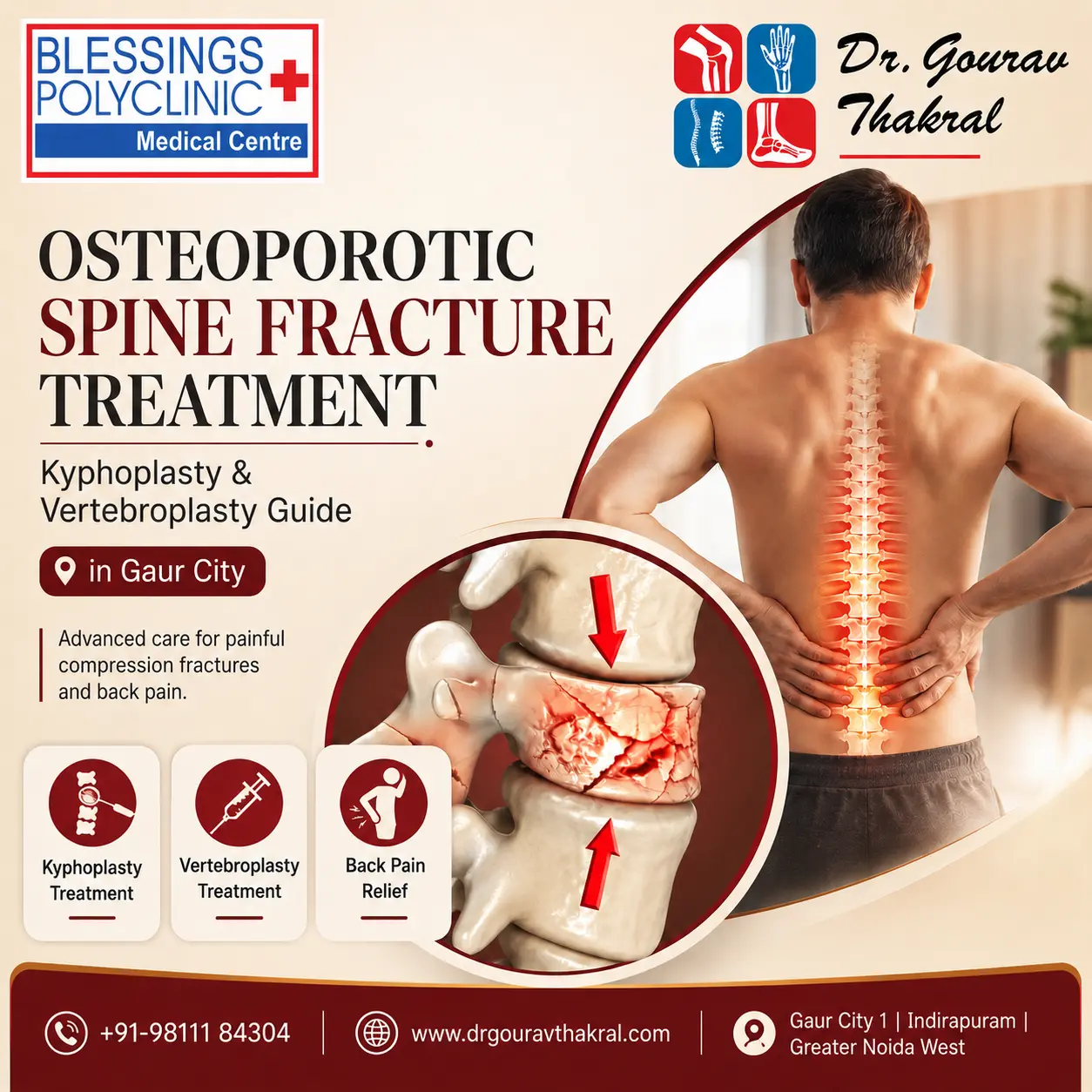
Osteoporotic Spine Fracture Treatment in Gaur City becomes important when weak bones lead to a painful spinal compression fracture. Osteoporosis makes bones fragile. As a result, even a minor fall, sudden bend, cough, or daily movement can sometimes cause a vertebral fracture.
A spine fracture can cause sudden back pain, reduced height, forward bending posture, stiffness, and difficulty standing or walking. Many patients think it is normal back pain. However, severe back pain in an elderly patient or a person with weak bones needs proper evaluation.
For patients looking for spine fracture treatment, Back pain treatment, and Fracture treatment in Gaur City, Dr. Gourav Thakral provides expert orthopaedic evaluation and treatment guidance. As an experienced Orthopaedic specialist, Spine specialist, and Bone fracture specialist, he helps patients understand whether medicines, bracing, rest, osteoporosis care, Kyphoplasty treatment, or Vertebroplasty treatment may be suitable.
Mayo Clinic explains that vertebroplasty treats compression fractures, which often happen because of osteoporosis. In this procedure, the doctor injects bone cement into the broken spinal bone to stabilize it. AAOS also explains that kyphoplasty uses a balloon before cement placement, while vertebroplasty injects cement directly into the broken vertebra.
What Is an Osteoporotic Spine Fracture?
An osteoporotic spine fracture is a break in one or more vertebrae due to weak bones. It often happens in the middle back or lower back. The fractured vertebra may collapse from the front, which creates a wedge shape. This can cause pain, posture changes, and movement difficulty.
This condition is also called a vertebral compression fracture. It may happen suddenly after a small injury. In some cases, patients do not remember any major trauma.
A Spine specialist checks the pain pattern, age, bone health, posture, X-rays, MRI, and daily movement before planning treatment.
Common Symptoms of Osteoporotic Spine Fracture
Symptoms can vary. Some patients feel sudden severe back pain. Others notice pain that increases while standing, walking, bending, or turning in bed.
Common symptoms include:
Sudden back pain
Pain after a minor fall or bend
Pain that improves with rest
Difficulty standing or walking
Reduced spine movement
Forward bending posture
Loss of height over time
Tenderness over the spine
Weakness due to pain and reduced activity
If back pain starts suddenly in an older adult or in a patient with osteoporosis, consult an Orthopaedic surgeonearly.
Why Osteoporotic Spine Fractures Happen
Osteoporosis reduces bone strength. Because of this, the spine may not tolerate normal daily stress. A minor fall, lifting movement, sudden twist, or even coughing can trigger a fracture in weak bones.
Risk factors include older age, menopause, low calcium or vitamin D, long-term steroid use, low body weight, smoking, family history, previous fracture, and inactive lifestyle.
A good treatment plan should not focus only on pain relief. It should also include bone-strengthening care to reduce future fracture risk.
Diagnosis Before Treatment
Diagnosis starts with history and physical examination. The doctor checks pain location, posture, movement, nerve signs, walking ability, and tenderness over the spine.
X-rays can show vertebral collapse. MRI can help identify a fresh fracture and nerve compression. CT scan may help in selected cases. Bone density testing may also help confirm osteoporosis.
The doctor may also check calcium, vitamin D, and other health factors when needed.
Non-Surgical Treatment for Spine Fracture
Not every osteoporotic spine fracture needs a procedure. Many patients improve with conservative care. The goal is to reduce pain, support healing, improve movement, and treat osteoporosis.
Non-surgical care may include:
Pain medicines
Short-term rest
Back brace
Activity modification
Physiotherapy
Calcium and vitamin D support
Osteoporosis medicines
Fall prevention advice
Follow-up imaging
A review on spinal compression fracture management notes that conservative pain management remains a major first-line treatment, while vertebral augmentation may help selected patients.
What Is Kyphoplasty Treatment?
Kyphoplasty treatment is a minimally invasive procedure for selected painful vertebral compression fractures. The doctor places a small balloon into the collapsed vertebra. The balloon creates space and may help restore some height. Then the doctor fills the space with bone cement to stabilize the fracture.
Kyphoplasty may help reduce pain and improve movement in selected patients. It may also help correct some vertebral collapse in suitable cases.
A 2018 review explains that kyphoplasty includes cavity creation, often with a balloon, before PMMA cement injection. It also notes that kyphoplasty and vertebroplasty may reduce pain and disability in selected patients.
What Is Vertebroplasty Treatment?
Vertebroplasty treatment also uses bone cement to stabilize a fractured vertebra. However, it does not use a balloon. The doctor injects cement directly into the broken spinal bone under imaging guidance.
Vertebroplasty may help selected patients with painful compression fractures that do not improve with conservative care. Mayo Clinic describes vertebroplasty as a procedure that involves injecting cement into broken spinal bones, with osteoporosis as the most common cause of such fractures.
However, doctors do not recommend it for every patient. Some guidelines and studies disagree on its role. Therefore, the decision needs careful evaluation, imaging, and discussion.
Kyphoplasty vs Vertebroplasty: Main Difference
Both treatments aim to stabilize the fractured vertebra and reduce pain. The main difference is the balloon step.
In kyphoplasty, the doctor first creates a cavity with a balloon. Then cement goes into that cavity. In vertebroplasty, cement goes directly into the fractured vertebra without balloon expansion.
AAOS explains this difference clearly. Kyphoplasty uses a balloon before cement placement, while vertebroplasty injects cement directly into the broken vertebra.
The better option depends on fracture age, pain severity, vertebral collapse, spinal alignment, osteoporosis severity, and patient health.
When Is Kyphoplasty or Vertebroplasty Needed?
Your doctor may consider these procedures when pain stays severe despite proper non-surgical care. They may also help when pain prevents walking, standing, sleep, or daily movement.
Treatment may be considered when:
Back pain remains severe
MRI shows a fresh compression fracture
Pain limits walking or standing
Medicines and brace do not help enough
The fracture causes major functional limitation
The patient cannot tolerate prolonged bed rest
The spine remains stable enough for the procedure
The doctor must also rule out infection, tumor-related fracture, severe nerve compression, and other causes of pain before treatment.
Recovery After Kyphoplasty or Vertebroplasty
Recovery varies from patient to patient. Many patients can walk soon after the procedure, as advised by the doctor. Some may feel pain relief quickly. Others may improve gradually.
Recovery usually includes:
Short observation after the procedure
Pain control
Walking guidance
Avoiding heavy lifting for some time
Physiotherapy when advised
Osteoporosis treatment
Fall prevention
Follow-up visits
AAOS notes that after kyphoplasty or vertebroplasty, patients may return to normal activities when they feel able, based on medical guidance.
Osteoporosis Care After Spine Fracture
A spine fracture shows that bone strength needs attention. If osteoporosis remains untreated, future fractures can happen. Therefore, long-term care matters.
Osteoporosis care may include calcium, vitamin D, bone-strengthening medicines, balance training, fall prevention, safe exercise, and lifestyle correction. The doctor may also review medicines that affect bone health.
Patients should avoid smoking, excess alcohol, unsafe lifting, and prolonged inactivity. Regular follow-up helps protect spine health.
Osteoporotic Spine Fracture Treatment in Gaur City by Dr. Gourav Thakral
If you have sudden back pain, suspected spinal compression fracture, or osteoporosis-related spine pain, Dr. Gourav Thakral can help with proper diagnosis and treatment planning in Gaur City.
He evaluates pain severity, X-rays, MRI findings, bone health, walking ability, nerve symptoms, and overall condition before suggesting treatment. Patients searching for Osteoporotic spine fracture treatment, Kyphoplasty treatment, Vertebroplasty treatment, or spine fracture treatment can consult Dr. Gourav Thakral for expert guidance.
Final Thoughts
An osteoporotic spine fracture can cause severe pain and limit daily movement. Many patients improve with medicines, bracing, physiotherapy, and osteoporosis care. However, selected patients may need kyphoplasty or vertebroplasty when pain remains severe and imaging confirms a suitable fracture.
For Osteoporotic Spine Fracture Treatment in Gaur City, consult Dr. Gourav Thakral, an experienced Orthopaedic specialist, Spine specialist, and Bone fracture specialist, for proper evaluation and recovery guidance.
FAQs
1. What is an osteoporotic spine fracture?
It is a spinal bone fracture caused by weak bones due to osteoporosis. It often affects the vertebrae and can cause sudden back pain.
2. What is kyphoplasty treatment?
Kyphoplasty uses a balloon to create space inside the collapsed vertebra. The doctor then fills the space with bone cement to stabilize the fracture.
3. What is vertebroplasty treatment?
Vertebroplasty injects bone cement directly into the fractured vertebra to stabilize it and reduce pain in selected patients.
4. Is kyphoplasty better than vertebroplasty?
Both can help selected patients. Kyphoplasty uses a balloon step, while vertebroplasty does not. The best option depends on fracture type and imaging.
5. Does every spine fracture need surgery?
No. Many osteoporotic spine fractures improve with medicines, bracing, rest, physiotherapy, and osteoporosis treatment.