Knee Loose Body Treatment in Indirapuram: Causes of Locking and Catching
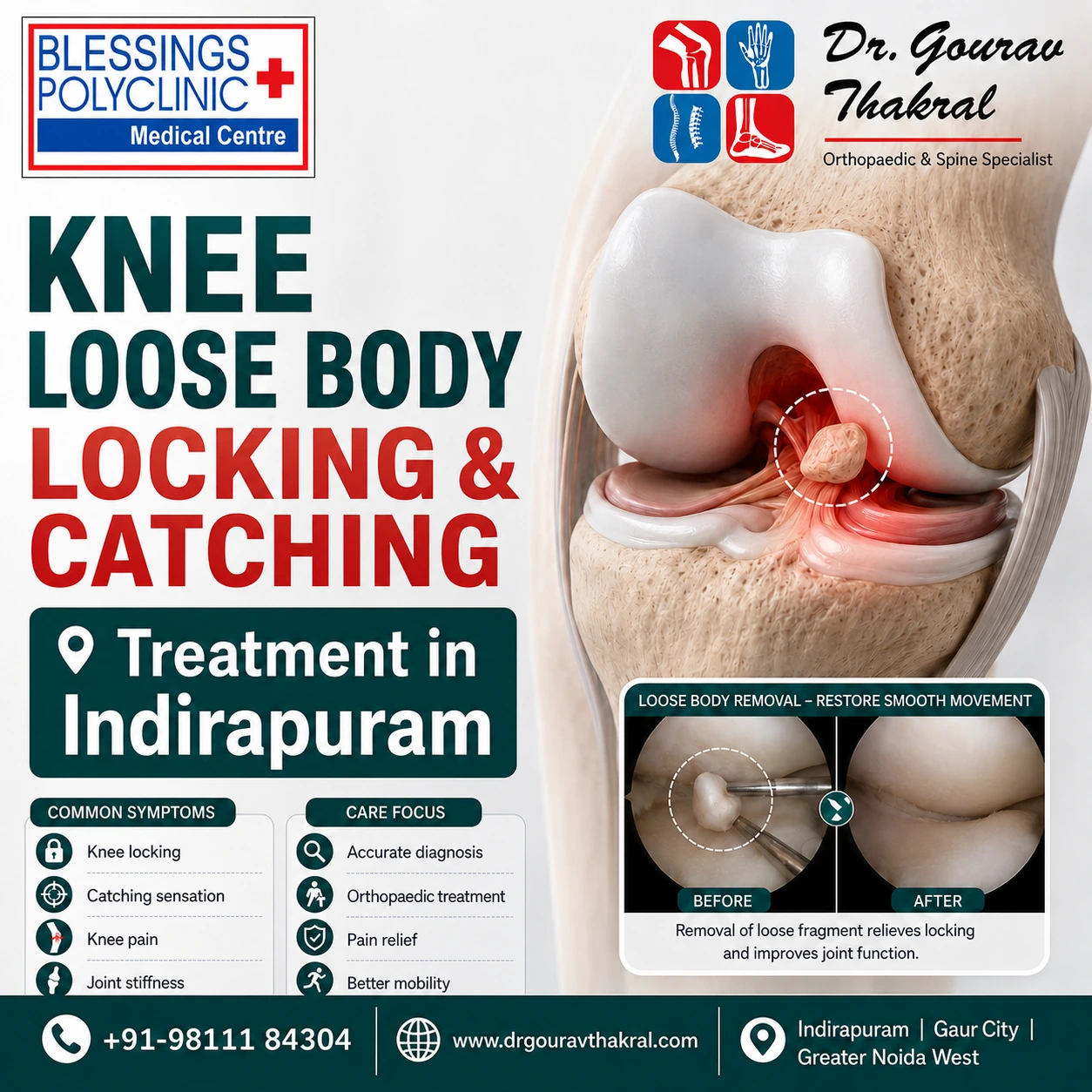
Knee loose body treatment in Indirapuram may be needed when a small piece of bone or cartilage moves freely inside the knee joint. This loose piece can disturb smooth knee movement. As a result, the knee may lock, catch, click, swell, or feel stuck during walking, bending, or climbing stairs.
A loose body can happen after injury, cartilage damage, arthritis, osteochondritis dissecans, or bone chip fracture. Sometimes, it may not cause symptoms. However, when it blocks joint movement, it can feel like something is trapped inside the knee. Mayo Clinic explains that a loose body may form when bone or cartilage breaks off and floats in the joint space. It may interfere with knee movement like a pencil caught in a door hinge.
For patients looking for Knee loose body treatment, Knee locking treatment, Knee pain treatment, Joint stiffness treatment, or expert Orthopaedic treatment in Indirapuram, Dr. Gourav Thakral provides proper knee evaluation and treatment guidance at Blessings Polyclinic.
What Is a Loose Body in the Knee?
A loose body is a small fragment of cartilage, bone, or both inside the knee joint. It may move around in the joint fluid. Because of this movement, symptoms can come and go.
Sometimes the knee feels normal. Then suddenly, it may catch or lock during movement. Smaller loose bodies may move more easily in the joint and can cause unpredictable locking and pain.
Common Symptoms of Knee Loose Body
Loose bodies can affect movement and comfort. Symptoms may become worse during walking, squatting, running, or stair climbing.
Common symptoms include:
- Knee locking
- Catching sensation
- Knee pain
- Joint stiffness
- Clicking or grinding
- Swelling after activity
- Limited knee movement
- Feeling of something moving inside the knee
- Difficulty bending or straightening the knee
If these signs keep coming back, proper Knee locking treatment is important.
Causes of Knee Loose Body
A loose body can develop due to several knee problems. It is not always caused by one major injury.
Common causes include:
- Knee injury
- Cartilage damage
- Osteoarthritis
- Osteochondritis dissecans
- Meniscus injury
- Bone chip fracture
- Previous trauma
- Joint degeneration
- Synovial conditions
In knee arthritis, loose fragments of cartilage and tissue may disturb smooth joint movement and cause the knee to lock or stick.
When Should You See an Orthopaedic Specialist?
You should consult an Orthopaedic specialist if your knee locks, catches, swells repeatedly, or does not move smoothly. Also, seek care if pain affects walking, stairs, sleep, or daily work.
Visit a doctor if:
- The knee locks suddenly
- You cannot straighten the knee fully
- Swelling keeps returning
- Pain increases with movement
- The knee feels stuck
- Stiffness affects daily work
- You had a recent injury
- Knee movement feels blocked
Patients searching for a Joint specialist, Bone specialist, or Orthopaedic treatment in Indirapuram can consult Dr. Gourav Thakral for diagnosis and treatment planning.
Diagnosis of Knee Loose Body
Diagnosis starts with a knee examination. The doctor checks pain location, swelling, movement, stiffness, locking, and walking pattern.
Tests may include:
- X-ray
- MRI
- CT scan in selected cases
- Knee movement assessment
- Joint stability check
X-rays may show bony loose bodies. MRI can show cartilage fragments, meniscus injury, cartilage damage, and other joint problems.
Treatment Options for Knee Loose Body
Treatment depends on symptoms, size of the loose body, cause, and knee condition. If the loose body is not causing symptoms, observation may be enough in selected cases.
However, if locking, catching, pain, or stiffness continues, treatment may be needed.
Treatment options may include:
- Medicines for pain and swelling
- Physiotherapy for movement and strength
- Activity modification
- Joint stiffness treatment
- Arthroscopic loose body removal
- Treatment of cartilage or meniscus damage if present
Mayo Clinic notes that arthroscopy may be used to remove loose bodies from the knee joint and repair joint damage through small incisions.
Arthroscopic Loose Body Removal
Arthroscopic surgery is commonly used when the loose body causes repeated locking or catching. During this procedure, the surgeon uses a small camera and fine instruments to remove the loose fragment.
This approach can also help check cartilage, meniscus, and joint surfaces. AAOS explains that knee arthroscopy may help treat painful conditions that do not respond to non-surgical care.
Recovery After Treatment
Recovery depends on the cause and procedure. If only a loose body is removed, recovery may be faster. However, if cartilage or meniscus damage is also treated, recovery may take longer.
Recovery may include:
- Pain control
- Swelling reduction
- Walking support if advised
- Physiotherapy
- Joint mobilization
- Strength exercises
- Gradual return to activity
The aim is better knee movement, less locking, and improved daily function.
Knee Loose Body Treatment in Indirapuram by Dr. Gourav Thakral
If your knee locks, catches, clicks, swells, or feels stuck, consult Dr. Gourav Thakral at Blessings Polyclinic.
He provides expert care for Knee loose body treatment, Knee locking treatment, Knee pain treatment, Joint stiffness treatment, and other orthopaedic knee problems in Indirapuram.
FAQs
1. What is a loose body in the knee?
A loose body is a small piece of bone or cartilage that moves freely inside the knee joint.
2. Can a loose body cause knee locking?
Yes. A loose body can get trapped during movement and cause locking, catching, or a stuck feeling.
3. What causes knee loose bodies?
Common causes include injury, cartilage damage, arthritis, osteochondritis dissecans, and bone chip fractures.
4. How is knee loose body diagnosed?
Diagnosis may include clinical examination, X-ray, MRI, or CT scan in selected cases.
5. Does every loose body need surgery?
No. If it does not cause symptoms, surgery may not be needed. However, repeated locking or catching may need arthroscopic removal.