Patellar Tendon Rupture Treatment in Panchsheel: Symptoms and Surgical Repair
Patellar Tendon Rupture Treatment in Panchsheel becomes important when a tendon injury affects walking, standing, stair climbing, or knee straightening. The patellar tendon connects the kneecap to the shinbone. It works with the thigh muscles to straighten the knee.
A rupture means the tendon is torn. This injury often happens during sports, sudden jumping, awkward landing, fall, or direct injury around the knee. AAOS explains that a patellar tendon tear can make it difficult to walk, straighten the knee, and return to normal activity.
For patients in Panchsheel, Gaur City, and Indirapuram, Dr. Gourav Thakral provides expert orthopaedic evaluation for knee tendon injuries, sports injury, ligament injury, joint pain, and mobility issues. As an experienced Orthopaedic Surgeon, Orthopaedic specialist, Spine & Pain Expert, and Joint Replacement Specialist, he helps patients choose the right treatment plan based on injury severity and recovery needs.
What Is a Patellar Tendon Rupture?
A patellar tendon rupture is a tear in the tendon below the kneecap. This tendon helps the knee straighten. Therefore, when it tears, the patient may struggle to lift the leg, walk normally, or climb stairs.
The tear may be partial or complete. A partial tear means some tendon fibers remain intact. A complete tear means the tendon separates fully, and the knee loses active straightening power.
A recent medical review notes that incomplete tears may be treated without surgery in selected cases, while complete ruptures usually cause major function loss and often need surgical repair.
Common Symptoms of Patellar Tendon Rupture
Symptoms usually start suddenly after injury. Many patients feel a pop or sharp pain in the front of the knee.
Common symptoms include:
- Sudden knee pain
- Swelling around the kneecap
- Difficulty straightening the knee
- Trouble walking
- Weakness while standing
- Gap below the kneecap
- Kneecap sitting higher than normal
- Pain after jumping or landing
- Difficulty climbing stairs
- Reduced knee movement
If these symptoms appear, early Knee pain treatment and Orthopaedic care are important.
Why Does Patellar Tendon Rupture Happen?
This injury often happens when the quadriceps muscle contracts strongly while the knee is bent. It may happen during jumping sports, running, sudden falls, or road accidents.
Common causes include:
- Sports injury
- Sudden jump or landing
- Fall on the knee
- Direct blow to the knee
- Weak tendon due to long-term pain
- Previous patellar tendinitis
- Muscle imbalance
- Poor landing mechanics
Mayo Clinic explains that patellar tendon pain is common around the area between the kneecap and shinbone, and it can worsen with jumping or sports activity over time.
Who Is at Higher Risk?
Patellar tendon rupture may affect athletes, gym users, runners, and active adults. It can also happen in people with long-term tendon weakness.
Risk may increase with:
- Jumping sports
- Repeated knee overload
- Poor flexibility
- Weak thigh muscles
- Previous tendon pain
- Sudden high-impact activity
- Improper sports technique
- Delayed treatment of knee pain
For active patients, timely Sports injury treatment, Physiotherapy, and Rehabilitation can help reduce repeat injury risk.
When Should You See an Orthopaedic Specialist?
You should consult an Orthopaedic specialist if you cannot straighten your knee after injury. You should also seek care if swelling, weakness, or walking difficulty starts suddenly.
Visit a doctor if:
- You heard a pop during injury
- The knee swelled quickly
- You cannot lift the leg straight
- Walking feels difficult
- Knee pain is severe
- Sports injury caused the pain
- The kneecap looks higher
- Weakness is increasing
Patients from Panchsheel, Gaur City, and Indirapuram can consult Dr. Gourav Thakral for prompt knee injury diagnosis and treatment planning.
Diagnosis of Patellar Tendon Rupture
Diagnosis starts with clinical examination. The doctor checks swelling, tenderness, kneecap position, straight leg raise, knee movement, and walking ability.
Tests may include:
- X-ray
- Ultrasound
- MRI
- Knee movement assessment
- Tendon gap examination
- Sports injury evaluation
MRI can help confirm whether the tear is partial or complete. It also helps plan treatment.
Non-Surgical Treatment for Partial Tears
Small partial tears may improve without surgery in selected patients. Treatment may include immobilization, brace support, pain medicines, physiotherapy, and gradual rehabilitation.
Non-surgical care may include:
- Knee brace
- Rest from sports
- Pain management
- Controlled movement
- Physiotherapy
- Strengthening exercises
- Joint mobilization when advised
- Gradual return to walking
However, complete tears usually need surgical repair because the tendon cannot function normally.
When Is Surgical Repair Needed?
Surgical repair is usually needed for complete patellar tendon rupture. Surgery may also be advised for major partial tears when knee function is affected.
Surgery may be needed when:
- The tendon is completely torn
- The patient cannot straighten the knee
- Walking is difficult
- The kneecap has moved upward
- The tear is large
- Sports recovery is important
- Non-surgical care is not suitable
AAOS notes that complete patellar tendon tears often need surgery to restore knee function.
What Happens During Patellar Tendon Repair?
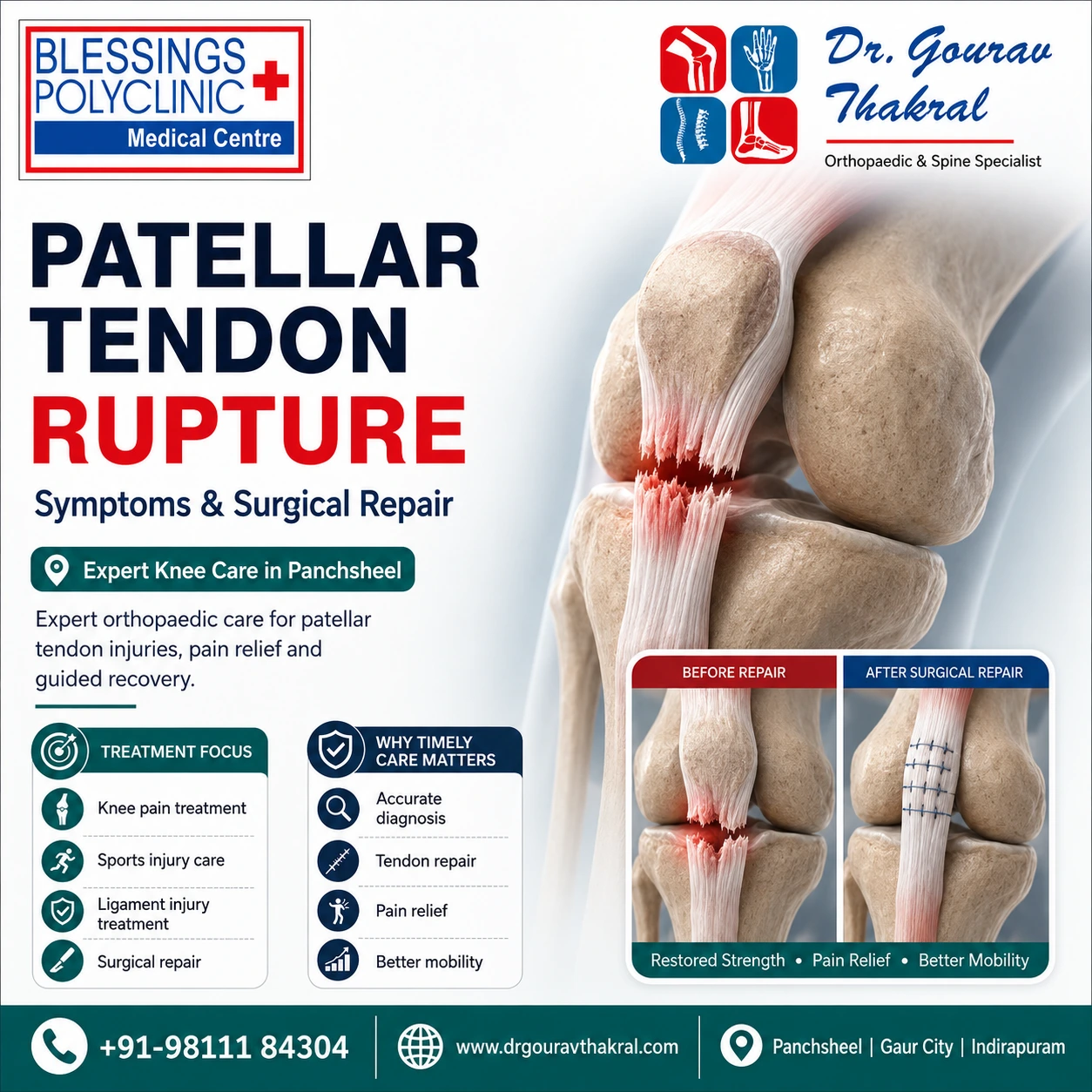
During surgical repair, the torn tendon is reattached to the kneecap or repaired end-to-end, depending on tear location. The surgeon may use strong sutures, anchors, or tunnels through the bone.
The goal is to restore the knee’s extensor mechanism. This helps the patient regain the ability to straighten the knee and walk better.
In selected cases, additional reinforcement may be used if the tendon quality is poor or the injury is complex.
Role of Arthroscopic Surgery
Patellar tendon rupture repair is usually an open repair. However, Arthroscopic surgery may be used in some knee conditions to check or treat associated joint problems. The final decision depends on injury type and MRI findings.
Dr. Gourav Thakral evaluates whether the injury is isolated or linked with other knee joint issues before planning surgery.
Recovery After Patellar Tendon Surgery
Recovery takes time because the tendon needs to heal strongly. The knee may need brace support after surgery. Walking and bending are increased gradually as advised.
Recovery may include:
- Knee brace
- Pain management
- Wound care
- Protected weight-bearing
- Physiotherapy
- Joint mobilization
- Muscle strengthening
- Balance training
- Sports rehabilitation
- Mobility improvement
AAOS notes that after surgery, protected weight-bearing is often started gradually, and recovery follows a structured plan.
Physiotherapy and Rehabilitation
Physiotherapy and Rehabilitation are very important after patellar tendon repair. Early rehab focuses on safe movement and swelling control. Later, strengthening and balance work begin.
Rehab may focus on:
- Knee range of motion
- Quadriceps activation
- Hamstring flexibility
- Joint mobilization
- Muscle pain treatment
- Walking pattern correction
- Sports rehabilitation
- Mobility improvement
- Faster recovery support
However, exercises should be done only under guidance. Too much stress too early can affect tendon healing.
Can Athletes Return to Sports?
Many athletes can return to sports after proper repair and rehabilitation. However, return timing depends on tendon healing, strength, movement, balance, and doctor clearance.
Sports rehabilitation should be gradual. It may include strength training, landing practice, running progression, and sports-specific drills.
Patients should not rush back to jumping sports because early overload can increase risk.
Patellar Tendon Rupture Treatment in Panchsheel by Dr. Gourav Thakral
If you have sudden knee pain, swelling, weakness, or difficulty straightening the knee after injury, consult Dr. Gourav Thakral.
He provides expert evaluation for Knee pain treatment, Sports injury treatment, Ligament injury treatment, Joint pain treatment, and tendon rupture care. Patients from Panchsheel, Gaur City, and Indirapuram can consult for proper diagnosis and treatment planning.
As an Orthopaedic Surgeon, Orthopaedic specialist, Spine & Pain Expert, and Joint Replacement Specialist, Dr. Gourav Thakral offers patient-focused Orthopaedic care, Pain management, and recovery guidance.
Final Thoughts
A patellar tendon rupture is a serious knee injury. It can affect walking, stair climbing, sports activity, and knee straightening. Partial tears may improve with brace and rehabilitation in selected cases. However, complete tears usually need surgical repair.
FAQs
1. What is patellar tendon rupture?
It is a tear of the tendon below the kneecap. This tendon helps straighten the knee.
2. What are the symptoms?
Common symptoms include sudden knee pain, swelling, weakness, difficulty walking, and inability to straighten the knee.
3. Does every patellar tendon rupture need surgery?
Partial tears may improve without surgery in selected cases. Complete tears usually need surgical repair.
4. How is patellar tendon rupture diagnosed?
Diagnosis may include physical examination, X-ray, ultrasound, or MRI.
5. How long does recovery take?
Recovery varies. Tendon healing and strength recovery can take several months with proper physiotherapy and rehabilitation.