Trigger Finger Surgery in Gaur City: Symptoms, Treatment and Recovery
Trigger Finger Surgery in Gaur City may become necessary when a finger or thumb gets stuck, locks while bending, causes pain, or does not move smoothly despite basic treatment. Many patients first notice finger stiffness in the morning. Over time, the finger may click, catch, or suddenly snap when they try to straighten it. This can make writing, gripping, typing, holding objects, cooking, and daily work difficult.
Trigger finger happens when the tendon that bends the finger cannot glide smoothly through its protective tunnel. The tendon may become swollen or irritated, which can create catching or locking during movement. Mayo Clinic explains that trigger finger may cause the finger to get stuck in a bent position and snap straight. It also notes that treatment may include splinting, steroid injections, or surgery.
For patients dealing with finger stiffness, hand discomfort, wrist-related pain, or related joint & Musculoskeletal disorders, Dr. Gourav Thakral provides expert orthopaedic evaluation and treatment guidance in Gaur City. His official website describes him as an orthopaedic specialist with expertise in orthopaedic care, joint replacements, sports injuries, arthroscopic surgery, and foot and ankle problems.
What Is Trigger Finger?
Trigger finger is a condition where the affected finger or thumb does not bend and straighten smoothly. The medical term is stenosing tenosynovitis. It usually affects the tendon sheath, which is the tunnel-like covering that allows the tendon to move.
When the tendon or sheath becomes thick, swollen, or irritated, the tendon starts rubbing inside the tunnel. This can cause pain, stiffness, clicking, catching, or locking. In early stages, the finger may only feel stiff. In advanced stages, it may get stuck in a bent position and may need help from the other hand to straighten.
Trigger finger can affect any finger, but it commonly affects the thumb, ring finger, or middle finger. It may affect one finger or multiple fingers.
Common Symptoms of Trigger Finger
Trigger finger symptoms may develop slowly. Many patients ignore the early signs because pain or stiffness may come and go. However, repeated locking or catching should not be ignored.
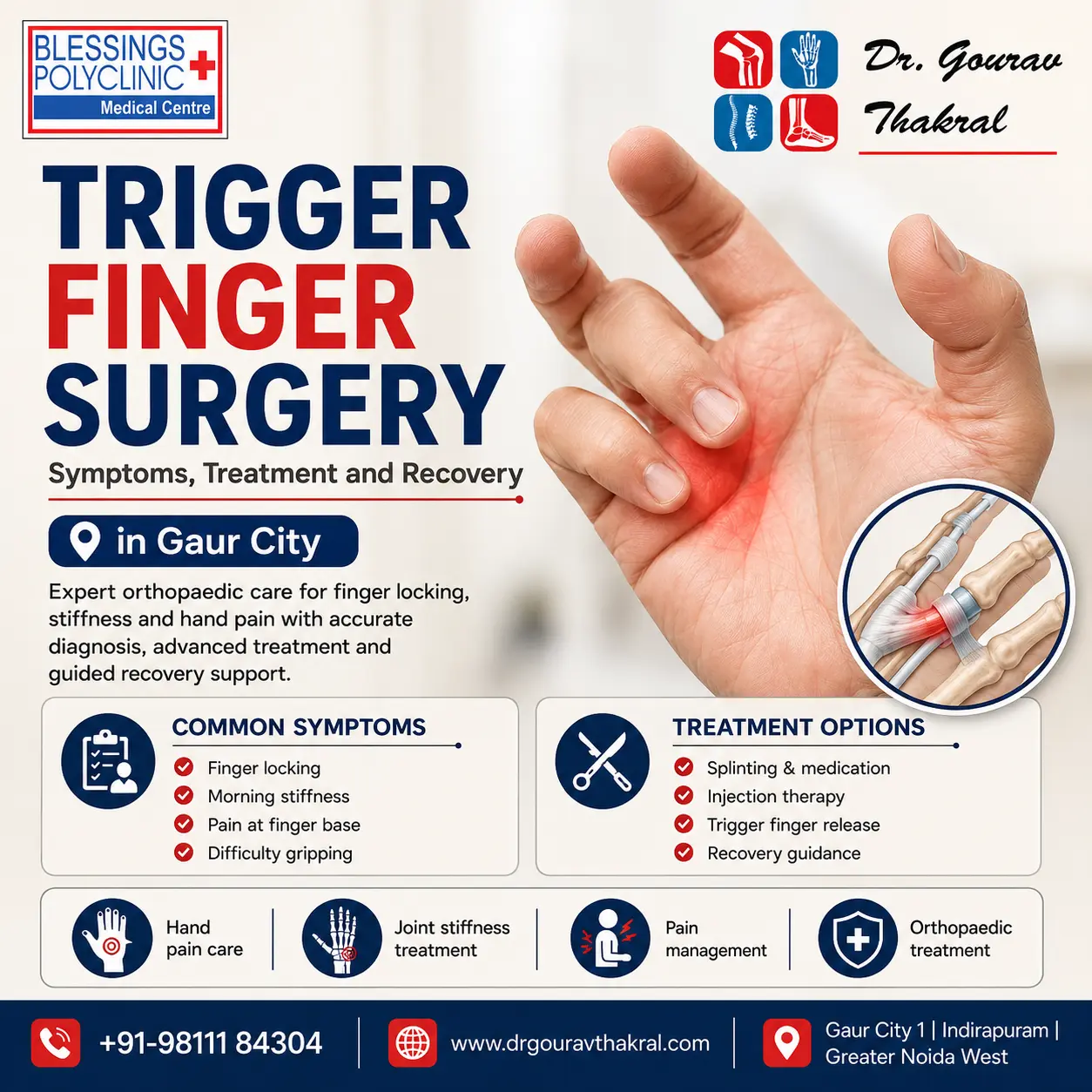
Common symptoms include finger stiffness, especially in the morning. The affected finger may click or pop during movement. Some patients feel pain at the base of the finger or thumb. Tenderness in the palm is also common. A small painful lump may develop near the base of the finger.
As the condition progresses, the finger may catch while bending or straightening. In severe cases, the finger may lock in a bent position. This can affect grip strength and make daily tasks difficult.
Causes of Trigger Finger
Trigger finger usually develops due to irritation, swelling, or thickening around the tendon sheath. Repeated gripping, forceful hand use, diabetes, rheumatoid arthritis, and inflammatory conditions may increase the risk. It can also happen without a clear cause.
People who use their hands repeatedly for work may notice symptoms more often. This may include people who do typing, tool work, household work, sports activity, lifting, or repetitive gripping.
Trigger finger is also part of hand-related Musculoskeletal disorders, so proper evaluation matters. Sometimes, patients may confuse it with arthritis, nerve pain, general finger stiffness, or wrist-related discomfort.
When Should You Consult an Orthopaedic Doctor?
You should consult an Orthopaedic doctor if finger stiffness, pain, clicking, or locking continues for more than a few days or keeps coming back. Early treatment may help reduce symptoms before the finger becomes severely locked.
Medical consultation becomes important when the finger locks frequently, pain affects daily work, or the finger does not straighten smoothly. Morning stiffness that keeps increasing should also be checked. If grip strength reduces or hand function becomes limited, a proper diagnosis can help plan the right treatment.
Patients should not forcefully pull the finger again and again. This can increase pain and irritation.
Diagnosis of Trigger Finger
Diagnosis usually starts with a clinical examination. The doctor checks finger movement, tenderness, swelling, locking, clicking, and pain at the base of the finger. In many cases, diagnosis does not need advanced tests.
The doctor may ask about work habits, diabetes, rheumatoid arthritis, previous hand injury, and duration of symptoms. If another condition is suspected, additional tests may be advised.
A Bone specialist or hand-focused orthopaedic expert can also check whether stiffness is due to trigger finger, arthritis, tendon injury, nerve compression, or another hand problem.
Non-Surgical Treatment for Trigger Finger
Not every patient needs surgery. Mild or early cases may improve with non-surgical care. The main goal is to reduce tendon irritation, improve movement, and control pain.
Non-surgical treatment may include rest, activity modification, splinting, anti-inflammatory medicines, hand exercises, and local injection in selected cases. Pain management may help reduce discomfort and improve hand use.
Splinting may keep the affected finger in a better position and reduce repeated catching. Activity modification can help avoid forceful gripping or repetitive stress. In some patients, steroid injection may reduce swelling around the tendon sheath.
For early symptoms, proper Orthopaedic treatment can help reduce discomfort and protect hand function.
When Is Trigger Finger Surgery Needed?
Trigger finger surgery may be considered when symptoms are severe, the finger locks repeatedly, or non-surgical treatment does not give enough relief. Surgery may also help when the finger remains stuck or daily hand function becomes limited.
AAOS states that surgery may be needed when trigger finger symptoms are severe, do not improve with other treatments, or when the finger remains stuck in a bent position and cannot straighten. The procedure is called trigger finger release.
Surgery may be needed when the patient cannot straighten the finger properly, pain affects work or daily life, the tendon does not glide smoothly, or repeated catching continues despite treatment. The final decision depends on symptom severity, duration, hand function, and response to previous treatment.
What Happens During Trigger Finger Surgery?
Trigger finger surgery is commonly done to release the tight pulley that blocks smooth tendon movement. Once the tight area is released, the tendon gets more space to glide. This helps reduce catching, clicking, and locking.
Mayo Clinic explains that surgery may involve a small incision near the base of the affected finger so the surgeon can cut open the narrowed section of tendon sheath.
The procedure is usually small, but it should still be done carefully because the hand has important tendons, nerves, and blood vessels. The doctor explains the surgical method, recovery plan, precautions, and expected outcome before treatment.
Recovery After Trigger Finger Surgery
Recovery depends on the severity of stiffness, number of fingers involved, patient health, and post-surgery care. Many patients notice improvement in catching and locking after release. However, swelling, soreness, or stiffness may take some time to settle.
Recovery may include wound care, pain control, gentle finger movement, avoiding heavy gripping initially, hand exercises, and follow-up visits. Patients usually return to normal work gradually, based on pain level and doctor advice.
Patients should avoid rushing back to heavy hand use too early. If stiffness remains, hand therapy or exercises may help.
Joint Stiffness Treatment After Trigger Finger
Some patients develop stiffness because the finger remained locked for a long time before treatment. In such cases, Joint stiffness treatment becomes important during recovery.
Gentle exercises, controlled movement, swelling care, and hand therapy may help restore flexibility. The earlier a patient seeks care, the easier it may be to manage stiffness and protect hand function.
Ignoring finger locking for months can make recovery slower. So, timely diagnosis can make a major difference.
Trigger Finger Surgery in Gaur City by Dr. Gourav Thakral
If you are dealing with finger locking, hand pain, wrist-related discomfort, or stiffness, Dr. Gourav Thakral can help with proper diagnosis and treatment planning in Gaur City. He evaluates symptoms, hand movement, pain level, daily activity limitations, and possible causes before suggesting treatment.
Patients may need medicines, splinting, injections, exercises, or surgery depending on the severity. As an experienced Orthopaedic specialist, Dr. Gourav Thakral focuses on patient-specific care and clear treatment guidance.
Patients searching for expert Orthopaedic treatment for hand and finger problems in Gaur City can consult Dr. Gourav Thakral for proper evaluation and recovery advice.
Final Thoughts
Trigger finger can start as mild stiffness but may progress to painful locking and movement difficulty. If your finger clicks, catches, locks, or becomes painful during daily work, do not ignore it.
Early consultation with an Orthopaedic doctor can help identify the problem and choose the right treatment. Surgery may help when symptoms are severe or conservative care does not provide enough relief.
For Trigger Finger Surgery in Gaur City, consult Dr. Gourav Thakral for diagnosis, treatment planning, and recovery guidance.
FAQs
1. What is trigger finger?
Trigger finger is a condition where a finger or thumb catches, clicks, locks, or gets stuck while bending or straightening.
2. What causes trigger finger?
It usually happens due to irritation or thickening around the tendon sheath. Repeated gripping, diabetes, arthritis, or inflammation may increase the risk.
3. Does trigger finger always need surgery?
No. Mild cases may improve with rest, splinting, medicines, exercises, or injection. Surgery may help when symptoms are severe or long-lasting.
4. When should I consult a doctor?
Consult a doctor if the finger locks repeatedly, pain affects daily work, or stiffness keeps increasing.
5. What is done in trigger finger surgery?
The surgeon releases the tight pulley that blocks tendon movement so the tendon can glide more smoothly.