Malunion Fracture Correction Surgery in Gaur City: Bone Healed Wrong?
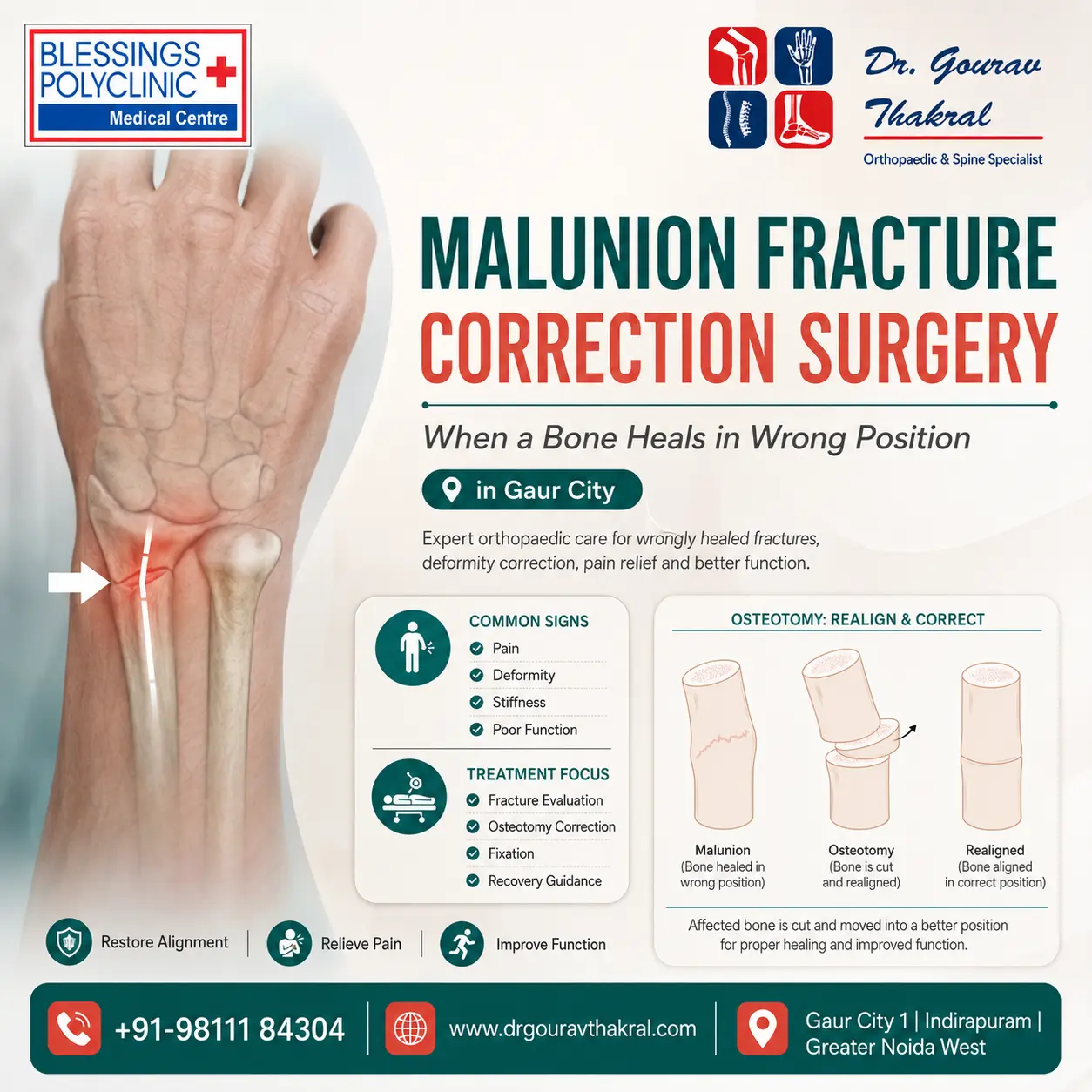
Malunion Fracture Correction Surgery in Gaur City may help when a broken bone heals in the wrong position. A fracture should heal in proper alignment. However, sometimes the bone joins at an angle, rotates, becomes short, or bends. This can cause pain, deformity, stiffness, weakness, walking problems, or poor movement.
A malunion fracture is different from a non-union fracture. In malunion, the bone heals, but it heals in a wrong position. In non-union, the bone does not heal properly. Both problems need careful diagnosis and proper Fracture treatment.
For patients in Gaur City, Dr. Gourav Thakral provides expert evaluation for wrongly healed fractures, fracture deformity, and trauma-related bone problems. As an experienced Orthopaedic doctor, Orthopaedic care, and Bone specialist, he helps patients understand whether they need correction surgery or another treatment plan.
What Is a Malunion Fracture?
A malunion fracture means the broken bone has joined, but not in the correct position. The bone may look bent, twisted, short, or uneven. Some patients can see the deformity clearly. Others only feel pain, stiffness, weakness, or movement difficulty after the fracture heals.
Malunion can affect the arm, wrist, forearm, leg, ankle, thigh, or other bones. The problem depends on the bone involved and the level of deformity. A small alignment issue may not create major trouble. A major deformity can affect walking, lifting, gripping, posture, or joint movement.
A Bone fracture specialist checks the old injury, current symptoms, X-rays, and movement before planning treatment.
Why Does a Bone Heal in the Wrong Position?
A bone may heal in the wrong position for many reasons. Sometimes the fracture shifts after the first treatment. Sometimes the bone does not get proper alignment at the start. Poor support, unstable fracture pattern, early weight-bearing, delayed treatment, infection, severe injury, or missed follow-up can also cause malunion.
Road accidents, falls, sports injuries, and high-impact trauma can create complex fractures. These injuries need proper Trauma care from the beginning. If the fracture does not stay stable during healing, the bone may join in a poor position.
That is why regular follow-up after fracture treatment is very important.
Common Symptoms of Malunion Fracture
Symptoms depend on the location of the fracture. Some patients feel constant pain. Others feel pain only during walking, lifting, bending, or daily activity.
Common symptoms include:
Pain after fracture healing
Crooked or twisted bone shape
Shortened limb
Difficulty walking or using the limb
Joint stiffness
Weakness during daily work
Reduced movement
Limping after leg fracture
Grip weakness after wrist or forearm fracture
Pain in nearby joints
If pain, deformity, or stiffness continues after fracture healing, consult an Orthopaedic specialist. Do not ignore these signs.
Malunion vs Non-Union: What Is the Difference?
Malunion and non-union are different fracture healing problems.
In malunion, the bone joins in the wrong position. In non-union, the bone does not join properly. This difference matters because both conditions need different treatment.
A malunion may need bone realignment. A non-union may need treatment to improve bone healing. Sometimes, patients may also have stiffness, implant problems, nerve irritation, or joint pain after fracture treatment. A proper diagnosis helps find the real cause.
How Does an Orthopaedic Doctor Diagnose Malunion?
Diagnosis starts with a detailed checkup. The doctor asks how the injury happened, what treatment the patient received, and when pain or deformity started.
The doctor checks alignment, movement, pain points, walking pattern, strength, and daily activity problems. X-rays help show the bone position. In complex cases, a CT scan may give better details.
Old X-rays can also help. They allow the Orthopaedic doctor to compare the old fracture position with the current bone alignment.
When Is Malunion Fracture Correction Surgery Needed?
Not every malunion needs surgery. If the bone has healed slightly unevenly but the patient has no pain or movement problem, the doctor may only observe it.
Correction surgery may help when the deformity affects daily life. Surgery may be needed when:
The bone healed at a major angle
The limb looks crooked or rotated
Walking becomes difficult
Pain continues after healing
Joint movement becomes limited
The limb becomes short
Nearby joints feel painful
Daily work becomes difficult
The patient has weakness or poor function
A Bone specialist decides the treatment after checking symptoms, X-rays, deformity, activity level, age, and health condition.
What Happens During Malunion Fracture Correction Surgery?
Malunion correction surgery aims to bring the bone into a better position. The exact method depends on the bone, deformity, and patient condition.
In many cases, the surgeon performs an osteotomy. During this procedure, the surgeon carefully cuts the bone and realigns it. Then plates, screws, rods, or external fixation hold the bone in the corrected position.
Some patients may need bone grafting, implant change, joint release, or soft tissue correction. Complex cases need advanced Orthopaedic trauma treatment because every malunion pattern is different.
Recovery After Malunion Correction Surgery
Recovery depends on the bone involved, surgery type, fixation method, bone quality, and patient health. Some patients may need a cast, splint, brace, walker, or crutches. Others may need physiotherapy to improve strength and movement.
Recovery may include:
Wound care
Pain control
Protected movement
Limited weight-bearing in leg fractures
Follow-up X-rays
Physiotherapy
Strength exercises
Joint movement exercises
Gradual return to work
Patients should follow the doctor’s advice carefully. Rushing the recovery can affect healing and alignment.
Why Early Evaluation Matters
A wrongly healed fracture can create long-term problems. It may affect joints above or below the fracture. For example, a leg malunion can affect walking, knee movement, hip comfort, and lower back posture. A wrist or forearm malunion can affect grip, rotation, lifting, and hand use.
Early evaluation helps the doctor plan treatment at the right time. Delay can lead to stiffness, joint stress, pain, weakness, and poor function.
For safe Fracture treatment, patients should never skip follow-up after injury. Follow-up X-rays help confirm whether the bone is healing in the right position.
Malunion Fracture Correction Surgery in Gaur City by Dr. Gourav Thakral
If your bone has healed in the wrong position and you have pain, stiffness, deformity, or movement difficulty, Dr. Gourav Thakral can help with proper diagnosis and treatment planning in Gaur City.
He checks the fracture history, current alignment, X-ray findings, joint movement, pain level, and daily activity problems. Based on the condition, he suggests the right treatment plan.
Patients searching for the Best orthopaedic doctor in Gaur City can consult Dr. Gourav Thakral for malunion fracture evaluation, trauma care, fracture correction, and recovery guidance.
Final Thoughts
A bone that heals in the wrong position can affect movement, strength, walking, posture, and daily life. Malunion fracture correction surgery may help when deformity, pain, or poor function becomes a problem.
If you have pain, crooked alignment, stiffness, limping, or weakness after fracture healing, consult Dr. Gourav Thakral in Gaur City for proper evaluation and treatment guidance.
FAQs
1. What is a malunion fracture?
A malunion fracture means a broken bone has healed in the wrong position. It may look crooked, rotated, short, or bent.
2. Is malunion different from non-union?
Yes. Malunion means the bone healed in the wrong position. Non-union means the bone did not heal properly.
3. Does every malunion fracture need surgery?
No. Surgery may not be needed if there is no pain, deformity, or movement problem. Surgery may help when symptoms affect daily life.
4. What surgery corrects a malunion fracture?
Many cases need an osteotomy. In this surgery, the surgeon cuts and realigns the bone. Plates, screws, rods, or external fixation may hold the correction.
5. Can malunion cause pain later?
Yes. A wrongly healed bone can affect joint alignment, movement, muscle function, and pressure on nearby joints.