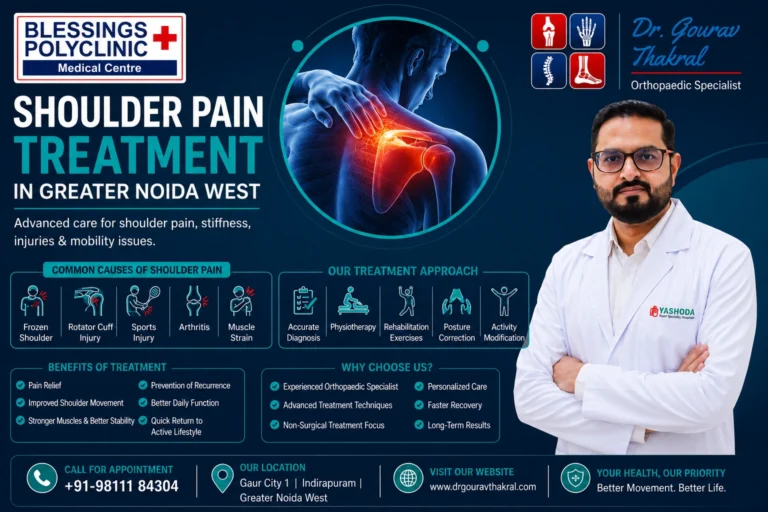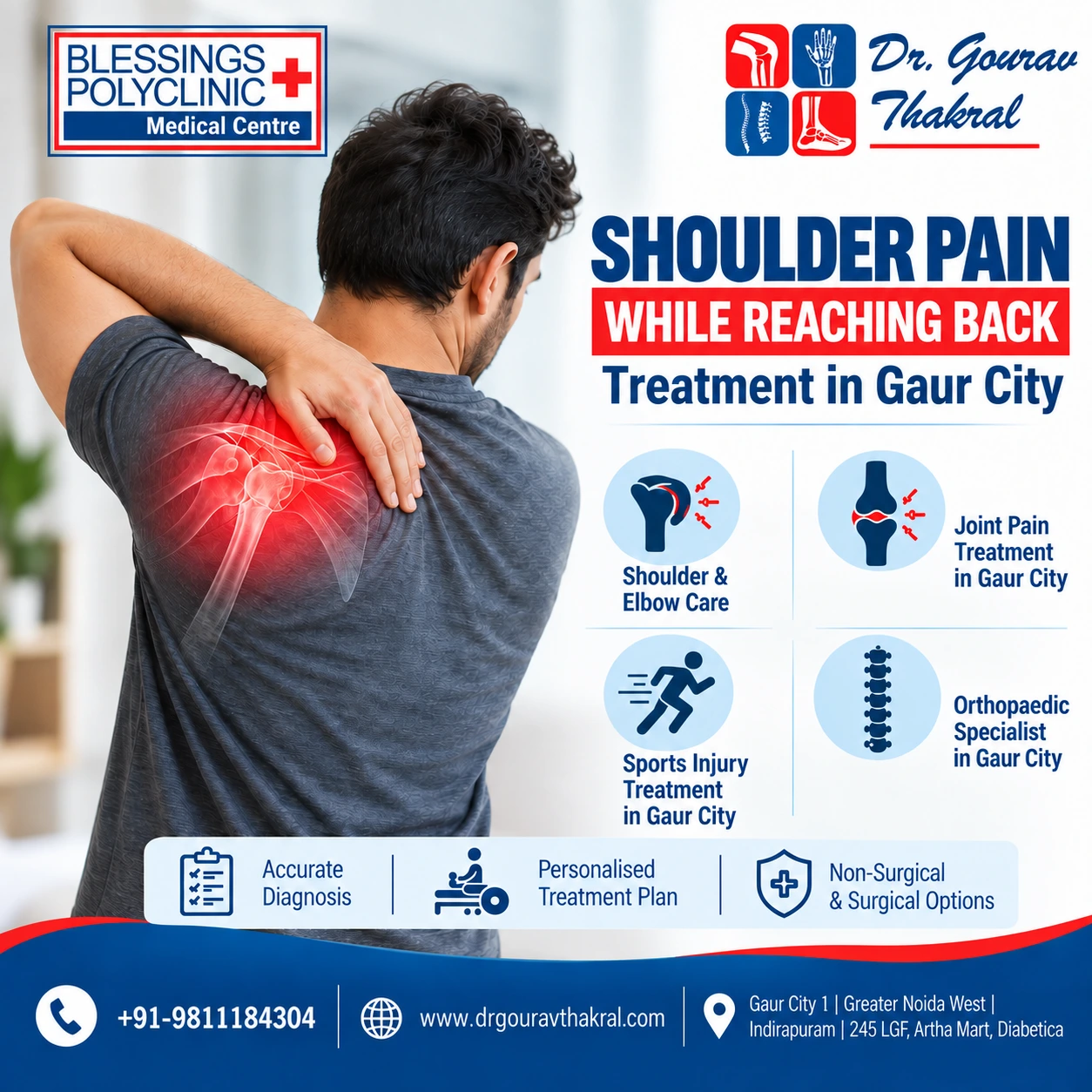
Shoulder Pain While Reaching Back Treatment in Gaur City: Causes & Care
Shoulder Pain While Reaching Back Treatment in Gaur City may be needed when reaching behind your back causes pain, stiffness, weakness, or difficulty moving the arm.
This movement is commonly used while wearing clothes, reaching for a back pocket, fastening garments, bathing, or performing daily activities. Therefore, pain while moving the arm backward can make routine tasks uncomfortable.
Several conditions may cause this problem, including shoulder stiffness, rotator cuff irritation, frozen shoulder, tendon problems, or sports-related injury.
People looking for an Orthopaedic specialist in Gaur City can consult Dr. Gourav Thakral for a detailed shoulder evaluation and personalised treatment guidance.
Early care can help reduce pain, restore shoulder movement, and prevent stiffness from becoming worse.
Why Does the Shoulder Hurt While Reaching Back?
Reaching behind the back requires several shoulder movements to work together.
The shoulder joint, rotator cuff, muscles, tendons, and surrounding tissues must move smoothly. However, irritation or stiffness in any of these structures can make this movement painful.
Common causes include:
- Rotator cuff irritation
- Frozen shoulder
- Shoulder impingement
- Tendon inflammation
- Muscle strain
- Sports injury
- Joint stiffness
- Arthritis
- Previous shoulder injury
- Poor shoulder mobility
Because different shoulder conditions can produce similar symptoms, proper diagnosis is important.
Common Symptoms
Symptoms may be mild initially. However, they can gradually affect normal arm movement.
Common signs include:
- Pain while reaching behind the back
- Shoulder stiffness
- Pain while dressing
- Difficulty reaching a back pocket
- Pain while lifting the arm
- Weakness
- Night pain
- Clicking or catching
- Reduced shoulder movement
- Pain after sports or exercise
If symptoms continue, Shoulder Pain While Reaching Back Treatment in Gaur City may help identify the cause.
Rotator Cuff Problems
The rotator cuff is a group of muscles and tendons that help stabilise and move the shoulder.
These tissues can become irritated because of overuse, sports activity, heavy lifting, or injury.
Symptoms may include:
- Pain during arm movement
- Weakness
- Pain while reaching backward
- Night discomfort
- Pain during overhead activity
Fortunately, many rotator cuff problems can be treated without surgery.
Frozen Shoulder
Frozen shoulder can cause progressive pain and stiffness.
As movement becomes limited, reaching behind the back may become especially difficult.
People may notice problems while:
- Dressing
- Bathing
- Reaching for objects
- Sleeping on the affected side
- Moving the arm backward
Treatment usually focuses on reducing pain and gradually restoring movement.
Shoulder Impingement
Shoulder impingement occurs when tissues around the shoulder become irritated during certain movements.
Symptoms may include:
- Pain while lifting the arm
- Pain while reaching backward
- Shoulder weakness
- Night pain
- Reduced movement
Activity modification and physiotherapy may help in many cases.
Tendon Irritation
Repeated shoulder movement can irritate the tendons.
For example, this may occur after:
- Gym workouts
- Swimming
- Badminton
- Cricket
- Repeated lifting
- Overhead work
As a result, the shoulder may become painful during specific movements.
Shoulder Pain After Sports
Sports can place repeated stress on the shoulder.
Activities involving throwing, lifting, reaching, or overhead movement may increase the risk of strain.
People looking for sports injury treatment in Gaur City may have shoulder pain after:
- Cricket
- Badminton
- Gym training
- Swimming
- Tennis
- Contact sports
Therefore, sports-related shoulder pain should be assessed if it keeps returning.
Sports Injury Treatment in Gaur City
Sports injury treatment in Gaur City may include evaluation of the shoulder muscles, tendons, joints, and movement pattern.
Treatment may involve:
- Activity modification
- Physiotherapy
- Strengthening
- Stretching
- Pain management
- Sports rehabilitation
In addition, return to sports should be gradual.
Shoulder & Elbow Care
The shoulder and elbow work together during lifting, reaching, pushing, and pulling.
Therefore, Shoulder & elbow care may be useful when pain affects more than one part of the arm.
A complete upper-limb assessment may include:
- Shoulder movement
- Elbow movement
- Arm strength
- Grip strength
- Joint stability
As a result, the treatment plan can address the complete movement pattern rather than only one painful area.
Shoulder Pain While Reaching Back Treatment in Gaur City
Shoulder Pain While Reaching Back Treatment in Gaur City starts with understanding when and how the pain occurs.
First, the doctor may ask:
- When did the pain begin?
- Does reaching behind the back cause pain?
- Is stiffness present?
- Can you lift the arm overhead?
- Does pain disturb sleep?
- Was there a sports injury?
- Is weakness present?
- Is clicking present?
Next, shoulder movement, muscle strength, joint stability, and tenderness may be checked.
Diagnosis of Shoulder Pain
A physical examination may include:
- Forward arm movement
- Sideways movement
- Internal rotation
- External rotation
- Shoulder strength
- Tenderness
- Joint stability
- Pain during specific movements
If needed, imaging may also be advised.
X-Ray
An X-ray may help identify:
- Arthritis
- Bone changes
- Previous fracture
- Joint alignment
- Other bone-related problems
However, X-rays do not clearly show tendons and muscles.
MRI Scan
MRI may be advised when the doctor suspects:
- Rotator cuff tear
- Tendon injury
- Labral problem
- Other soft-tissue injury
The need for MRI depends on symptoms and examination findings.
Non-Surgical Shoulder Treatment
Many shoulder problems improve without surgery.
Treatment may include:
- Activity modification
- Medicines
- Physiotherapy
- Stretching
- Shoulder strengthening
- Posture correction
- Ice or heat
- Injection treatment in selected cases
Most importantly, treatment should match the exact cause.
Physiotherapy for Shoulder Pain
Physiotherapy can help improve movement and strength.
A programme may include:
- Shoulder mobility exercises
- Rotator cuff strengthening
- Shoulder blade strengthening
- Stretching
- Posture correction
- Movement training
Furthermore, exercise intensity can be increased gradually as pain improves.
Shoulder Mobility Exercises
Reduced shoulder movement can make reaching backward difficult.
Guided mobility exercises may help restore:
- Internal rotation
- External rotation
- Overhead movement
- Backward reaching
However, exercises should not be forced through severe pain.
Joint Pain Treatment in Gaur City
Joint pain treatment in Gaur City may be needed when shoulder pain occurs with stiffness or discomfort in other joints.
For example, pain may also affect the:
- Elbow
- Wrist
- Neck
- Upper back
A complete evaluation can help identify whether the problem is related to overuse, arthritis, sports injury, or another condition.
Can Shoulder Stiffness Cause Pain While Dressing?
Yes. Dressing often requires the arm to move behind the body.
Therefore, shoulder stiffness can make putting on a shirt, jacket, or other clothing difficult.
Improving shoulder mobility may make these daily activities easier.
Can Sleeping Position Affect Shoulder Pain?
Yes. Sleeping directly on a painful shoulder may increase discomfort.
Night pain may also occur with rotator cuff problems or shoulder inflammation.
Changing sleeping position may reduce pressure, although persistent night pain should be evaluated.
Can Gym Workouts Cause This Pain?
Yes. Certain gym exercises may overload the shoulder.
Common triggers include:
- Heavy shoulder press
- Bench press
- Push-ups
- Pull-ups
- Lateral raises
- Heavy chest workouts
Poor technique or sudden increases in weight may increase strain.
Orthopaedic Specialist in Gaur City
An Orthopaedic specialist in Gaur City can assess shoulder pain involving bones, joints, muscles, tendons, and sports injuries.
During the consultation, the specialist may:
- Check shoulder movement
- Assess muscle strength
- Identify painful movements
- Review X-rays or MRI
- Plan physiotherapy
- Guide return to sports
- Recommend further treatment if required
Proper diagnosis helps avoid unnecessary treatment.
Can Shoulder Pain Improve Without Surgery?
Yes. Many shoulder problems improve with non-surgical care.
For example, treatment may include physiotherapy, activity changes, medicines, and strengthening.
However, recovery time depends on the exact condition.
When Is Surgery Needed?
Surgery is not required for most patients.
However, it may be considered when:
- A major tendon tear is present
- Severe joint damage is present
- Shoulder instability continues
- Pain does not improve with proper treatment
- Movement remains significantly limited
The final decision depends on symptoms, examination findings, and imaging.
Warning Signs You Should Not Ignore
Seek medical care if you have:
- Sudden severe shoulder pain
- Inability to move the arm
- Major weakness
- Visible deformity
- Severe swelling
- Pain after a serious fall
- Increasing numbness
- Pain that keeps getting worse
These symptoms may need early assessment.
When Should You Visit a Doctor?
Consider an orthopaedic consultation if:
- Pain continues for several days
- Reaching behind becomes difficult
- Shoulder stiffness increases
- Night pain continues
- Weakness develops
- Sports activity is affected
- Daily tasks become difficult
Early evaluation may help prevent further loss of movement.
Tips to Protect Your Shoulder
Helpful habits include:
- Warm up before exercise
- Avoid sudden heavy lifting
- Improve shoulder mobility
- Strengthen shoulder muscles
- Maintain good posture
- Increase exercise gradually
- Avoid training through sharp pain
- Take recovery days
- Treat sports injuries early
In addition, balanced shoulder strength may reduce repeated strain.
Why Choose Dr. Gourav Thakral?
Dr. Gourav Thakral provides orthopaedic care for shoulder pain, elbow problems, joint stiffness, sports injuries, and movement-related conditions.
Patients looking for Shoulder Pain While Reaching Back Treatment in Gaur City can consult him for a detailed evaluation and personalised treatment plan.
The approach focuses on:
- Finding the cause of pain
- Reducing stiffness
- Improving shoulder movement
- Restoring strength
- Supporting shoulder & elbow care
- Guiding sports recovery
- Preventing repeat injury
- Considering surgery only when required
Conclusion
Shoulder pain while reaching behind the back may develop because of rotator cuff irritation, frozen shoulder, impingement, tendon problems, sports injury, or joint stiffness.
For Shoulder Pain While Reaching Back Treatment in Gaur City, consult Dr. Gourav Thakral for shoulder evaluation, physiotherapy guidance, joint pain care, and sports injury management.
Early diagnosis can help reduce pain, improve mobility, and make everyday shoulder movements more comfortable.
FAQs
1. Why does my shoulder hurt when I reach behind my back?
Common causes include shoulder stiffness, rotator cuff irritation, frozen shoulder, tendon problems, and impingement.
2. Can frozen shoulder cause difficulty reaching backward?
Yes. Frozen shoulder can significantly reduce shoulder movement, including reaching behind the back.
3. Can physiotherapy help?
Yes. Physiotherapy may improve shoulder mobility, strength, posture, and movement control.
4. Can sports injuries cause this type of shoulder pain?
Yes. Throwing, lifting, gym workouts, and overhead sports can strain shoulder muscles and tendons.
5. When is an MRI needed?
MRI may be advised when a rotator cuff tear, tendon injury, labral problem, or another soft-tissue injury is suspected.
6. Does shoulder pain always require surgery?
No. Many shoulder problems improve with physiotherapy, activity changes, strengthening, and medicines.