Proximal Humerus Fracture Surgery in Gaur City: Shoulder Fracture Treatment
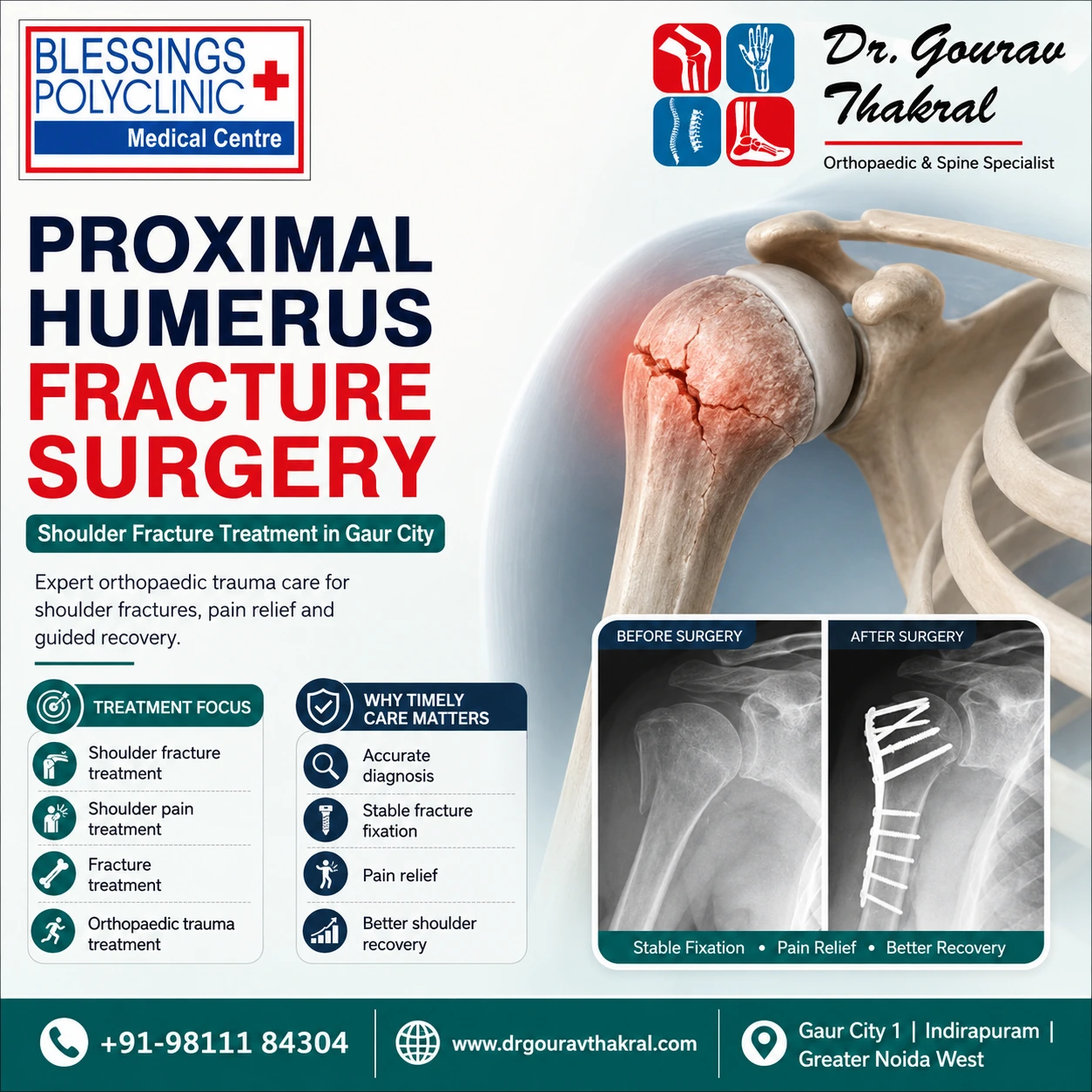
Proximal Humerus Fracture Surgery in Gaur City may be needed when a shoulder fracture is displaced, unstable, or affects shoulder movement. The proximal humerus is the upper part of the arm bone near the shoulder joint. A fracture in this area can cause severe shoulder pain, swelling, bruising, weakness, and difficulty lifting the arm.
This injury can happen after a fall, road accident, sports injury, or direct hit to the shoulder. In elderly patients, weak bones or osteoporosis can increase the risk even after a minor fall.
For patients looking for Shoulder fracture treatment, Shoulder pain treatment, Fracture treatment, and Orthopaedic trauma treatment in Gaur City, Dr. Gourav Thakral provides expert evaluation and treatment guidance. As an experienced Orthopaedic specialist and Bone fracture specialist, he helps patients understand whether sling support, medicines, physiotherapy, plate fixation, pin fixation, or shoulder replacement may be suitable.
AAOS explains that most proximal humerus fractures can be treated without surgery if bone fragments are not severely displaced. However, if surgery is needed, it may involve fixation with plates, screws, pins, or shoulder replacement.
What Is a Proximal Humerus Fracture?
A proximal humerus fracture is a break near the top part of the upper arm bone. This part forms an important section of the shoulder joint. Because of this, the fracture can affect shoulder movement and arm function.
Some fractures are simple and stable. Others may involve several bone pieces. If the broken parts shift too much, the shoulder may not heal in the right position.
Therefore, proper diagnosis is important before choosing treatment.
Common Symptoms of Proximal Humerus Fracture
Symptoms usually start after an injury or fall. Pain may become worse when the patient tries to move the arm.
Common symptoms include:
Shoulder pain
Swelling around the shoulder
Bruising on the upper arm
Difficulty lifting the arm
Pain while moving the shoulder
Weakness in the arm
Tenderness near the shoulder
Limited shoulder movement
Arm hanging close to the body
Numbness or tingling in rare cases
If shoulder pain starts after a fall or accident, early Shoulder pain treatment can help avoid delay.
Common Causes of Shoulder Fracture
A proximal humerus fracture may happen due to high-energy trauma or low-energy falls.
Common causes include:
Fall on the shoulder
Fall on an outstretched hand
Road accident
Sports injury
Direct blow to the shoulder
Fall in elderly patients
Osteoporosis
Workplace injury
Cleveland Clinic notes that some humerus fractures can recover without surgery using a splint, cast, or sling, while some patients may need surgery and physiotherapy to regain arm movement.
When Should You Consult an Orthopaedic Specialist?
You should consult an Orthopaedic specialist if shoulder pain appears after a fall, accident, or injury. Also, seek care if the shoulder is swollen, bruised, painful, or hard to move.
Consultation becomes important when:
Pain is severe
Swelling increases
Arm movement is difficult
Bruising spreads down the arm
The shoulder looks deformed
Pain does not improve
The patient is elderly
There is numbness or weakness
Patients searching for the Best orthopaedic doctor in Gaur City can consult Dr. Gourav Thakral for proper fracture evaluation and treatment planning.
Diagnosis of Proximal Humerus Fracture
Diagnosis starts with a clinical examination. The doctor checks pain, swelling, bruising, shoulder movement, arm position, nerve function, and blood supply.
X-rays usually confirm the fracture. They also show the position of broken bone pieces. In complex fractures, CT scan may help understand the fracture pattern better.
A correct diagnosis helps the doctor decide whether conservative care or surgery is better.
Non-Surgical Shoulder Fracture Treatment
Not every proximal humerus fracture needs surgery. Stable and minimally displaced fractures may heal with non-surgical treatment.
Non-surgical care may include:
Sling support
Pain medicines
Ice therapy
Rest
Follow-up X-rays
Gentle movement when advised
Physiotherapy
Gradual strengthening
The Orthopaedic Trauma Association also notes that most broken shoulders can be treated without surgery, while some fractures need plates, screws, or shoulder replacement depending on severity.
When Is Proximal Humerus Fracture Surgery Needed?
Proximal humerus fracture surgery may be needed when the broken bone pieces are badly displaced, unstable, or unlikely to heal in a good position. Surgery may also be considered when the fracture affects the joint surface or shoulder function.
Surgery may be advised when:
Bone pieces are severely displaced
The fracture has multiple fragments
The shoulder joint is affected
The fracture is unstable
The bone does not stay aligned
There is fracture-dislocation
The patient needs better shoulder function
Non-surgical care is not suitable
A medical review explains that non-operative treatment is common for elderly patients with minimal displacement, while operative fixation may be considered for more complex fractures.
Surgical Options for Proximal Humerus Fracture
The best surgery depends on fracture type, bone quality, patient age, shoulder function, and medical condition.
Common surgical options include:
Plate and Screw Fixation
The surgeon realigns the broken bone and fixes it using a plate and screws. This may be used when bone quality is suitable and the fracture can be reconstructed.
Pin or Screw Fixation
Some selected fractures may be fixed with pins or screws. This depends on fracture pattern and stability.
Intramedullary Nail
A rod may be placed inside the bone in selected cases to stabilize the fracture.
Shoulder Replacement
In complex fractures, elderly patients, poor bone quality, or badly damaged joint surfaces, shoulder replacement may be considered.
Studies describe several fixation options for displaced proximal humerus fractures, including locking plate fixation, percutaneous pinning, intramedullary nailing, and shoulder replacement in selected cases.
Recovery After Shoulder Fracture Surgery
Recovery takes time because bone healing and shoulder movement both matter. The patient may need sling support for some time. Physiotherapy is usually started step by step as advised by the doctor.
Recovery may include:
Pain control
Sling support
Wound care
Follow-up X-rays
Gentle shoulder movement
Physiotherapy
Strengthening exercises
Gradual return to daily work
Avoiding heavy lifting early
Physiotherapy helps restore shoulder motion, strength, and daily function after healing. Non-operative care also commonly includes immobilization followed by physiotherapy to restore arm function and mobility.
Why Physiotherapy Is Important
Shoulder stiffness is common after a fracture. Therefore, physiotherapy plays a key role in recovery.
At first, exercises are gentle. Later, therapy may focus on range of motion, shoulder blade control, strength, and function. However, exercises should be started only as advised.
Doing too much too early can affect healing. On the other hand, avoiding movement for too long can increase stiffness.
Possible Complications If Treatment Is Delayed
Delayed treatment can lead to poor alignment, stiffness, chronic shoulder pain, weakness, reduced movement, non-union, or shoulder arthritis.
In older patients, long immobilization can also reduce shoulder function. So, timely Fracture treatment and follow-up are important.
Proximal Humerus Fracture Surgery in Gaur City by Dr. Gourav Thakral
If you have shoulder pain, swelling, bruising, or difficulty lifting the arm after a fall or injury, consult Dr. Gourav Thakral in Gaur City.
He evaluates X-rays, fracture pattern, bone quality, shoulder function, age, and activity needs before suggesting treatment. Patients searching for Proximal humerus fracture surgery, Shoulder fracture treatment, Orthopaedic trauma treatment, or a trusted Bone specialist can consult Dr. Gourav Thakral for expert care.
Final Thoughts
A proximal humerus fracture can affect shoulder movement and daily activity. Some fractures heal well with sling support and physiotherapy. However, displaced, unstable, or complex fractures may need surgery.
For Proximal Humerus Fracture Surgery in Gaur City, consult Dr. Gourav Thakral, an experienced Orthopaedic specialist, Bone fracture specialist, and Bone specialist, for proper diagnosis and recovery guidance.
FAQs
1. What is a proximal humerus fracture?
It is a fracture near the upper part of the arm bone close to the shoulder joint.
2. Does every proximal humerus fracture need surgery?
No. Stable and minimally displaced fractures often heal with sling support, medicines, and physiotherapy.
3. When is surgery needed?
Surgery may be needed when the fracture is displaced, unstable, joint-involving, or unlikely to heal in a good position.
4. What are the symptoms of shoulder fracture?
Common symptoms include shoulder pain, swelling, bruising, difficulty lifting the arm, tenderness, and limited movement.
5. What surgery is done for proximal humerus fracture?
Treatment may include plate fixation, screw fixation, pin fixation, intramedullary nail, or shoulder replacement in selected cases.