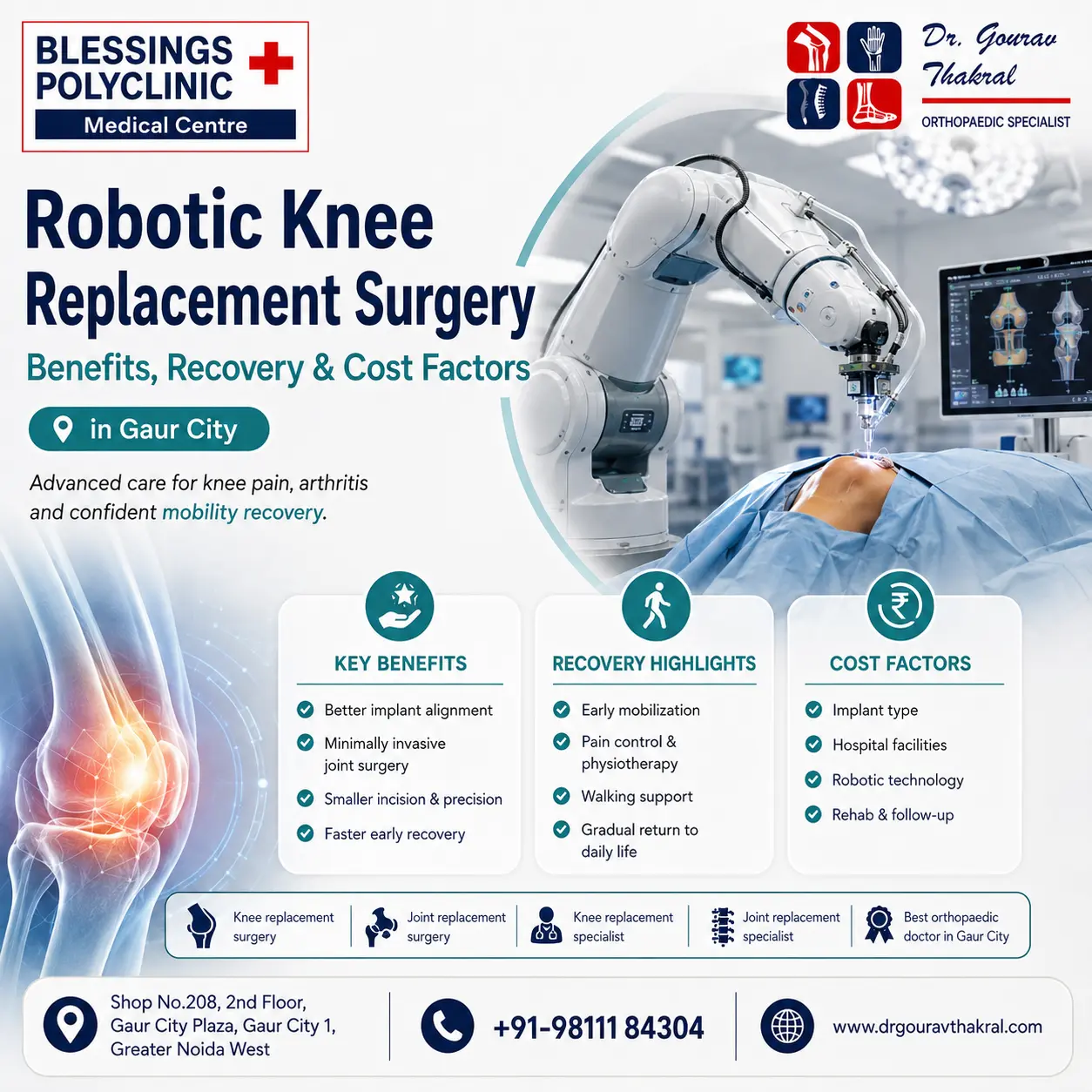
Robotic Knee Replacement Surgery: Benefits, Recovery and Cost Factors in Gaur City
Robotic Knee Replacement Surgery in Gaur City is an advanced option for patients with severe knee pain, arthritis, stiffness, walking difficulty, and reduced mobility. When medicines, exercises, injections, lifestyle changes, or physiotherapy no longer provide enough relief, Knee replacement surgery may help restore movement and improve daily comfort.
In robotic-assisted knee replacement, the surgeon uses advanced computer guidance and robotic technology to plan and perform the surgery with greater precision. The robot does not operate independently. It assists the surgeon in accurate bone preparation, implant positioning, and alignment. AAOS explains that robotic instruments provide sensory feedback to help the surgeon remove damaged bone and cartilage and place artificial components accurately.
For patients looking for Knee replacement and Joint replacement surgery in Gaur City, Dr. Gourav Thakral provides expert orthopaedic evaluation and treatment guidance. As an experienced Orthopaedic specialist, he helps patients understand whether robotic-assisted surgery is suitable for their knee condition, age, activity level, and overall health.
What Is Robotic Knee Replacement Surgery?
Robotic knee replacement surgery is an advanced form of knee replacement where the surgeon uses robotic assistance during the procedure. The system helps in planning the surgery according to the patient’s knee anatomy. This can support more accurate implant alignment and soft tissue balancing.
In a damaged knee joint, cartilage wears down and bones may rub against each other. This causes pain, swelling, stiffness, deformity, and difficulty in walking. In knee replacement surgery, the damaged joint surfaces are removed and replaced with artificial implants.
AAOS describes total knee replacement as a safe and effective procedure that may relieve pain, correct leg deformity, and help patients resume normal activities when nonsurgical treatments are no longer helpful.
Who May Need Robotic Knee Replacement?
Robotic knee replacement may help patients with advanced knee arthritis or joint damage. The decision depends on symptoms, X-ray findings, physical examination, walking ability, pain severity, and response to non-surgical treatment.
A patient may need evaluation if they have:
Severe knee pain during walking or standing
Pain that affects sleep or daily activity
Knee stiffness and reduced movement
Difficulty climbing stairs
Bow-leg or knock-knee deformity
Swelling that keeps coming back
Pain despite medicines and physiotherapy
Advanced arthritis on X-ray
A Knee replacement specialist can examine the joint and explain whether the patient needs non-surgical treatment, conventional knee replacement, or robotic-assisted surgery.
Benefits of Robotic Knee Replacement Surgery
Robotic assistance helps the surgeon plan and perform surgery with improved accuracy. It may support better implant positioning, controlled bone cuts, and patient-specific alignment. This can be helpful because every patient’s knee anatomy is different.
Possible benefits include:
More accurate surgical planning
Better implant positioning
Improved joint alignment
Less unnecessary bone removal
Better soft tissue balancing
Potentially smoother early recovery
Patient-specific surgical planning
A 2024 review notes that robotic total knee replacement can improve radiological outcomes, precision of implant placement, and overall joint alignment, though complication rates may not differ significantly from conventional surgery.
Is Robotic Surgery Better Than Traditional Knee Replacement?
Robotic surgery offers advanced planning and precision, but the final result still depends on many factors. These include the surgeon’s experience, patient health, bone quality, implant selection, physiotherapy, and post-surgery care.
It is also important to understand that robotic surgery is not magic. It is a tool that helps the surgeon. Some patients may benefit from robotic assistance, while others may do well with conventional knee replacement.
A Joint replacement specialist can explain the pros and limitations after reviewing the patient’s condition. The aim should always be safe surgery, proper alignment, pain relief, and long-term function.
Recovery After Robotic Knee Replacement
Recovery after robotic knee replacement needs proper planning and patient effort. The early recovery phase focuses on pain control, swelling reduction, wound care, walking support, knee bending, and muscle activation.
Patients usually start walking with support as advised by the surgical team. Physiotherapy plays a very important role after surgery. Exercises help restore knee movement, strength, balance, and walking confidence.
Recovery may vary from patient to patient. Age, fitness, weight, diabetes control, bone quality, muscle strength, and rehabilitation routine can affect recovery speed. Patients should follow the doctor’s instructions and avoid rushing activity.
Role of Physiotherapy in Recovery
Physiotherapy is essential after Knee replacement surgery. It helps reduce stiffness, improve knee bending, strengthen muscles, and support better walking.
A typical recovery plan may include:
Walking training
Knee bending exercises
Quadriceps strengthening
Ankle pump exercises
Balance training
Stair training
Gradual return to daily activity
Regular exercises can help patients regain confidence. However, exercises should be done according to the doctor’s and physiotherapist’s advice.
Cost Factors of Robotic Knee Replacement Surgery
The cost of robotic knee replacement surgery can vary from patient to patient. It depends on multiple medical and hospital-related factors. Patients should avoid choosing surgery only by comparing price because implant quality, surgeon experience, hospital setup, safety, and post-surgery care also matter.
Common cost factors include:
Type of knee implant
Robotic technology used
Hospital facilities
Surgery complexity
Patient’s medical condition
Length of hospital stay
Pre-surgery tests
Medicines and consumables
Physiotherapy and follow-up care
Single knee or both knees surgery
Robotic-assisted surgery may cost more than conventional surgery because it involves advanced technology, planning systems, and specialized equipment. However, the patient should discuss the complete estimate, inclusions, implant type, hospital stay, and recovery plan before surgery.
Minimally Invasive Joint Surgery and Robotic Assistance
Many patients ask whether robotic knee replacement is the same as Minimally invasive joint surgery. Robotic assistance can help with precision and planning, while minimally invasive techniques focus on reducing tissue disruption. The exact surgical method depends on the patient’s knee condition and surgeon’s approach.
Not every patient is suitable for every technique. The doctor will recommend the best option after checking knee deformity, bone quality, arthritis severity, weight, muscle condition, and overall health.
Robotic Knee Replacement Surgery in Gaur City by Dr. Gourav Thakral
If you are suffering from long-term knee pain, stiffness, arthritis, or walking difficulty, Dr. Gourav Thakral can help with proper diagnosis and treatment planning. He evaluates symptoms, X-rays, joint condition, activity needs, and overall health before suggesting surgery.
As an experienced Orthopaedic specialist and Joint replacement specialist, Dr. Gourav Thakral focuses on patient-specific care. Some patients may improve with medicines, physiotherapy, injections, weight management, or lifestyle changes. Others may need Joint replacement surgery when joint damage is advanced.
Patients searching for the Best orthopaedic doctor in Gaur City can consult Dr. Gourav Thakral for knee pain, arthritis, robotic-assisted knee replacement guidance, and recovery planning.
Final Thoughts
Robotic knee replacement surgery can be a helpful option for selected patients with advanced knee arthritis and severe pain. It allows patient-specific planning and may improve implant alignment and surgical precision. However, the best outcome depends on proper diagnosis, surgeon expertise, implant choice, physiotherapy, and patient commitment during recovery.
If knee pain is affecting walking, sleep, stairs, or daily life, consult Dr. Gourav Thakral in Gaur City for expert evaluation and treatment guidance. Timely care can help you understand the right treatment option and plan recovery with confidence.
FAQs
1. What is robotic knee replacement surgery?
Robotic knee replacement surgery uses robotic assistance and computer guidance to help the surgeon plan and perform knee replacement with improved accuracy.
2. Does the robot perform the surgery?
No. The surgeon performs the surgery. The robotic system assists with planning, precision, alignment, and controlled bone preparation.
3. Who needs robotic knee replacement?
Patients with advanced knee arthritis, severe pain, stiffness, deformity, or difficulty walking may need evaluation for robotic knee replacement.
4. Is robotic knee replacement less painful?
Many patients may experience smoother early recovery, but pain and recovery vary from person to person. Proper rehabilitation is important.
5. How long does recovery take?
Recovery varies depending on age, health, muscle strength, surgery type, and physiotherapy. Many patients gradually return to daily activities over weeks to months.