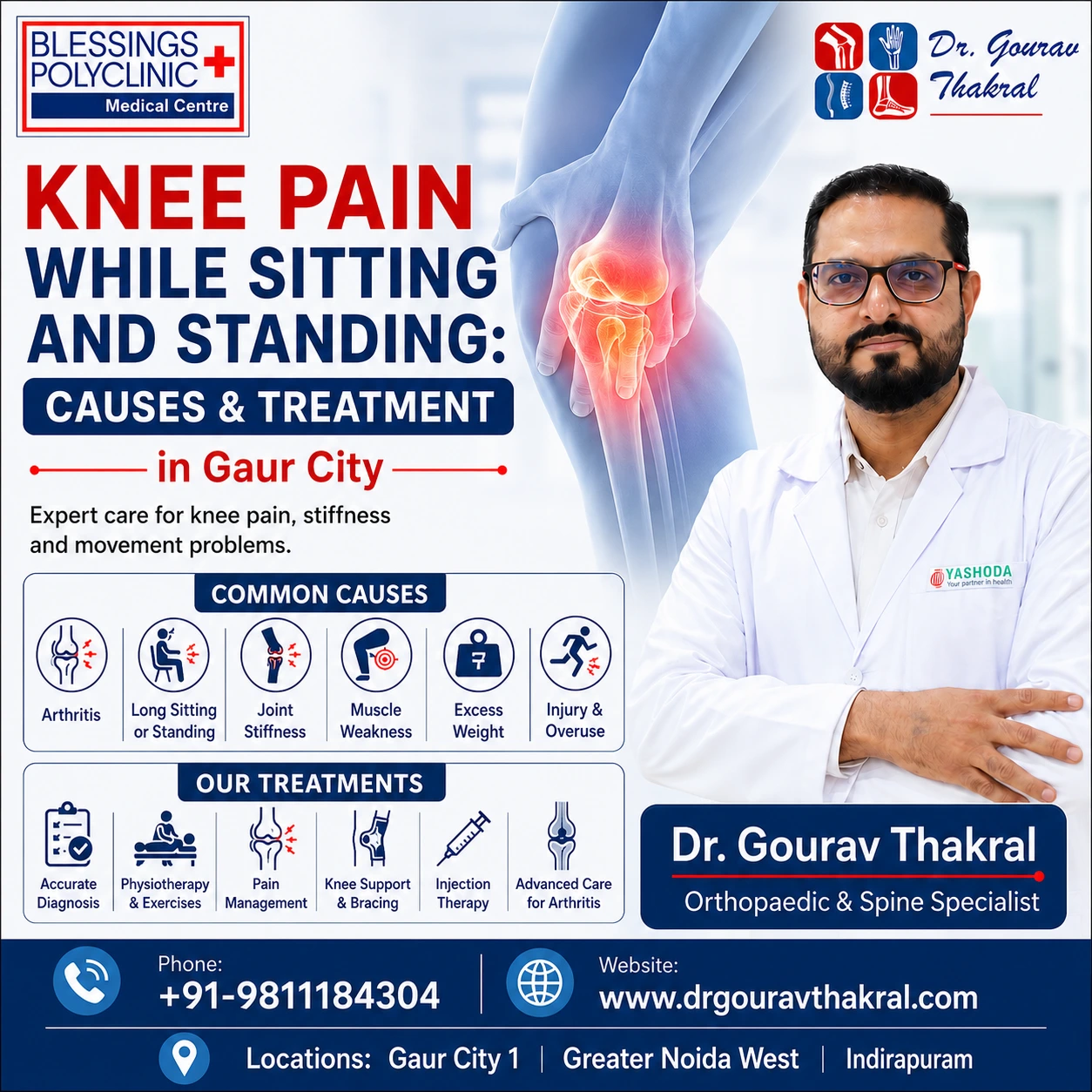
Knee Pain While Sitting and Standing: Causes and Treatment in Gaur City
Knee pain while sitting and standing can make office work, travelling, climbing stairs, and normal daily movement difficult. Some people feel pain after sitting for a long time. Others experience discomfort while getting up from a chair or standing for several minutes.
Although mild knee pain may improve with rest, repeated pain should not be ignored. It may be linked to joint stiffness, arthritis, muscle weakness, cartilage problems, or a previous injury.
People looking for knee pain treatment in Gaur City can consult Dr. Gourav Thakral for a detailed orthopaedic evaluation and personalised treatment guidance.
Early care can help reduce pain, improve knee movement, strengthen the supporting muscles, and prevent the problem from becoming worse.
Why Does the Knee Hurt While Sitting?
The knee remains bent while sitting. Therefore, sitting for a long time can increase pressure around the kneecap and other parts of the joint.
Pain while sitting may happen due to:
- Kneecap-related pain
- Knee arthritis
- Joint stiffness
- Weak thigh muscles
- Cartilage damage
- Meniscus problems
- Poor sitting posture
- Previous knee injury
- Swelling inside the joint
- Long periods of inactivity
In some cases, the pain improves after stretching the leg. However, persistent discomfort may need a proper check-up.
Why Does the Knee Hurt While Standing?
Standing places body weight on the knee joint. As a result, pain may increase when the cartilage, muscles, ligaments, or bones are affected.
Common causes include:
- Osteoarthritis
- Weak knee muscles
- Poor leg alignment
- Excess body weight
- Meniscus injury
- Ligament damage
- Kneecap problems
- Old fracture
- Joint inflammation
- Overuse
Pain while standing may also become worse after walking, climbing stairs, or working for long hours.
Common Symptoms
Knee problems may cause more than pain.
Common symptoms include:
- Pain after sitting
- Pain while standing up
- Pain during long standing
- Joint stiffness
- Swelling
- Weakness
- Clicking or cracking sounds
- Reduced knee movement
- Difficulty climbing stairs
- Pain while bending the knee
- Knee locking
- A feeling that the knee may give way
- Morning stiffness
- Limping
- Pain that affects sleep
If these symptoms continue, timely knee care in Gaur City can help identify the underlying problem.
Common Causes of Knee Pain While Sitting and Standing
Several conditions may cause pain during sitting or standing.
Knee Osteoarthritis
Knee osteoarthritis develops when the protective cartilage inside the joint gradually wears down.
It commonly causes:
- Pain while standing
- Pain after sitting
- Morning stiffness
- Swelling
- Cracking sounds
- Reduced movement
- Difficulty climbing stairs
The pain may be mild in the early stage. However, it can increase as joint damage progresses.
Treatment may include medicines, physiotherapy, weight management, exercises, injections, or surgery in advanced cases.
Patellofemoral Pain Syndrome
Patellofemoral pain syndrome causes discomfort around or behind the kneecap.
It may become worse during:
- Long sitting
- Climbing stairs
- Squatting
- Running
- Getting up from a chair
- Sitting with bent knees
This condition may develop because of muscle weakness, poor kneecap movement, overuse, or leg-alignment problems.
Physiotherapy and muscle-strengthening exercises often play an important role in treatment.
Joint Stiffness
Joint stiffness can make it difficult to bend or straighten the knee.
It may happen due to:
- Arthritis
- Swelling
- Previous injury
- Lack of movement
- Surgery
- Muscle tightness
- Long sitting
Joint stiffness treatment in Gaur City may include medicines, physiotherapy, stretching, strengthening, and movement exercises.
Regular guided movement can help improve flexibility. Still, painful exercises should be avoided.
Meniscus Injury
The meniscus is a cushion-like cartilage inside the knee. It helps absorb pressure and supports smooth movement.
A meniscus injury may cause:
- Pain while bending
- Joint-line tenderness
- Clicking
- Locking
- Swelling
- Difficulty standing
- Pain while getting up
The injury may happen after a twist, sports activity, or age-related cartilage wear.
Treatment depends on the type and severity of the tear.
Weak Thigh Muscles
The quadriceps muscles at the front of the thigh support the knee during sitting, standing, and walking.
When these muscles are weak, extra pressure may fall on the knee joint.
Weakness may develop because of:
- Lack of exercise
- Previous injury
- Long bed rest
- Arthritis
- Age-related muscle loss
- Poor rehabilitation
Strengthening exercises may improve knee support and reduce discomfort.
Ligament Injury
The knee ligaments provide stability during movement.
An injury may cause:
- Pain
- Swelling
- Instability
- Difficulty standing
- Knee giving way
- Reduced confidence while walking
Ligament injuries commonly happen during sports, falls, road accidents, or sudden twisting movements.
A proper examination helps determine whether the ligament is stretched, partly torn, or completely torn.
Poor Sitting Posture
Sitting with the knees bent for long periods can increase stiffness.
Poor posture may include:
- Sitting too low
- Keeping the legs folded
- Crossing the legs for long periods
- Working without movement breaks
- Sitting on a soft sofa
- Keeping the feet unsupported
Simple posture changes may reduce discomfort. However, ongoing pain should still be evaluated.
Excess Body Weight
Extra body weight increases pressure on the knee joints during standing and walking.
Over time, this may increase pain and joint wear.
Weight management may help:
- Reduce joint pressure
- Improve movement
- Support exercise
- Slow arthritis-related symptoms
- Improve treatment results
Even small changes in body weight may support better knee comfort.
Knee Pain Treatment in Gaur City
Knee pain treatment in Gaur City begins with identifying the exact cause of pain.
The doctor may ask:
- When did the pain start?
- Is pain worse while sitting or standing?
- Is swelling present?
- Does the knee lock?
- Does the knee give way?
- Was there a previous injury?
- Does pain affect stairs or walking?
- Is morning stiffness present?
After that, the knee is examined for movement, swelling, tenderness, strength, and stability.
Treatment is then planned according to the diagnosis.
Diagnosis of Knee Pain
A detailed examination is important because different knee conditions can cause similar symptoms.
The evaluation may include:
- Knee movement
- Joint tenderness
- Swelling
- Muscle strength
- Kneecap movement
- Ligament stability
- Walking pattern
- Leg alignment
- Meniscus tests
- Balance
Depending on the symptoms, imaging may also be advised.
Digital X-Ray
An X-ray may help identify:
- Arthritis
- Joint-space narrowing
- Fracture
- Bone spurs
- Knee alignment problems
- Old injury changes
X-rays are especially useful when arthritis or bone damage is suspected.
MRI Scan
An MRI may help detect:
- Meniscus tears
- Ligament injuries
- Cartilage damage
- Tendon problems
- Bone bruising
- Hidden fractures
- Joint swelling
However, an MRI is not required for every patient.
Non-Surgical Knee Pain Treatment
Many causes of knee pain can improve without surgery.
Non-surgical care may include the following options.
Activity Modification
Activities that increase pain may need to be reduced for a short period.
These may include:
- Deep squatting
- Running
- Jumping
- Long standing
- Repeated stair climbing
- Sitting with folded legs
However, complete rest for too long may increase weakness and stiffness.
Medicines
Pain-relief or anti-inflammatory medicines may be prescribed when required.
Patients should avoid long-term self-medication because painkillers do not treat every underlying cause.
Ice or Heat
Ice may help after an injury or when swelling is present.
Heat may reduce stiffness in some long-term conditions.
The correct option depends on the cause of pain.
Physiotherapy
Physiotherapy may help:
- Reduce stiffness
- Improve knee movement
- Strengthen the thigh muscles
- Improve balance
- Correct walking
- Support the kneecap
- Prevent repeated pain
- Improve standing tolerance
Exercises should match the diagnosis and current pain level.
Knee Brace
A knee brace may provide support in selected cases.
It can be useful for ligament weakness, arthritis, or instability. However, a brace should not replace muscle strengthening.
Weight Management
Weight management may reduce pressure on the knee joint and improve movement.
A balanced diet and low-impact exercise may support long-term knee health.
Injection Treatment
Injection treatment may be considered for selected joint conditions.
However, it is not suitable for every patient. The decision depends on the diagnosis, age, joint condition, and symptoms.
Joint Stiffness Treatment in Gaur City
Joint stiffness treatment in Gaur City focuses on restoring movement and reducing discomfort.
Treatment may include:
- Gentle stretching
- Range-of-motion exercises
- Physiotherapy
- Swelling control
- Medicines
- Muscle strengthening
- Heat therapy
- Activity guidance
Stiffness may improve gradually. Therefore, regular exercises and proper follow-up are important.
Knee Care in Gaur City
Complete knee care in Gaur City should focus on diagnosis, pain relief, movement, strength, and prevention.
A knee-care plan may include:
- Clinical examination
- X-ray or MRI guidance
- Medicines
- Physiotherapy
- Exercise planning
- Posture advice
- Weight management
- Bracing
- Injection treatment
- Surgery when required
The aim is not only to reduce pain. Instead, treatment should also help patients return to normal activities safely.
Role of a Joint Specialist in Gaur City
A joint specialist in Gaur City evaluates pain, stiffness, swelling, instability, and movement problems.
During the consultation, the specialist may:
- Check knee movement
- Assess joint swelling
- Test ligament stability
- Examine muscle strength
- Review X-rays or MRI
- Check leg alignment
- Plan physiotherapy
- Guide pain management
- Recommend surgery when needed
Correct diagnosis can help avoid delayed recovery and unnecessary treatment.
Role of an Orthopaedic Specialist in Gaur City
An orthopaedic specialist in Gaur City treats problems related to bones, joints, muscles, ligaments, tendons, and cartilage.
For knee pain, the specialist may manage:
- Arthritis
- Meniscus injury
- Ligament injury
- Kneecap pain
- Fracture
- Sports injury
- Joint stiffness
- Cartilage damage
- Knee replacement planning
Early orthopaedic care can help protect movement and reduce long-term joint problems.
Exercises for Knee Pain
The right exercises can improve knee support. However, they should be selected according to the diagnosis.
Commonly advised exercises may include:
- Quadriceps tightening
- Straight-leg raises
- Hamstring stretching
- Calf stretching
- Hip strengthening
- Supported knee bending
- Balance exercises
- Walking when comfortable
Patients should stop an exercise if pain, swelling, or instability becomes worse.
Sitting Tips for Knee Pain
Simple changes may reduce pain while sitting.
Helpful tips include:
- Use a chair with proper height
- Keep both feet on the floor
- Avoid sitting with folded legs
- Straighten the knee regularly
- Take movement breaks
- Avoid very low sofas
- Use arm support while standing up
- Do not sit in one position for too long
These habits can reduce stiffness during office work or travel.
Standing Tips for Knee Pain
Patients with pain while standing may benefit from:
- Avoiding long standing
- Changing position regularly
- Using supportive footwear
- Keeping body weight balanced
- Avoiding locked knees
- Taking short sitting breaks
- Strengthening the thigh muscles
- Using support when advised
However, severe or repeated pain still needs medical evaluation.
When Is Knee Surgery Required?
Most knee-pain cases do not require surgery.
However, surgery may be considered when:
- Arthritis is advanced
- A ligament is completely torn
- A meniscus tear causes locking
- A fracture is displaced
- Joint damage is severe
- Pain affects daily activities
- Non-surgical treatment does not help
- Knee movement is badly restricted
The decision depends on symptoms, examination, imaging, age, and activity needs.
When Should You Visit a Doctor?
Consult a doctor if knee pain continues or affects normal movement.
Seek early care if you have:
- Severe swelling
- Inability to stand
- Knee locking
- Repeated giving way
- Pain after an injury
- Increasing stiffness
- Difficulty climbing stairs
- Pain that affects sleep
- Visible deformity
- Inability to put weight on the leg
Urgent care may be needed after a major fall or accident.
Tips to Prevent Knee Pain
Simple habits can support knee health.
Helpful tips include:
- Maintain a healthy body weight
- Strengthen the thigh muscles
- Warm up before exercise
- Avoid sudden increases in activity
- Wear supportive footwear
- Use proper lifting techniques
- Take breaks from long sitting
- Avoid deep squatting when painful
- Treat injuries early
- Follow physiotherapy properly
These steps may reduce joint stress and improve movement.
Why Choose Dr. Gourav Thakral?
Dr. Gourav Thakral provides orthopaedic care for knee pain, joint stiffness, arthritis, ligament injuries, meniscus problems, fractures, and movement-related conditions.
Patients looking for knee pain treatment in Gaur City can consult him for diagnosis and personalised treatment guidance.
His approach focuses on:
- Correct diagnosis
- Pain relief
- Improved knee movement
- Better muscle strength
- Reduced stiffness
- Safer sitting and standing
- Joint protection
- Surgery only when required
Conclusion
Knee pain while sitting and standing can affect office work, travel, walking, exercise, and normal daily activities. Therefore, repeated pain, stiffness, swelling, or weakness should not be ignored.
For knee pain treatment in Gaur City, consult Dr. Gourav Thakral for knee evaluation, joint stiffness treatment, physiotherapy guidance, arthritis care, and complete orthopaedic management.
Early treatment can help reduce pain, improve movement, and support better long-term knee health.
FAQs
Why does my knee hurt after sitting for a long time?
Pain after sitting may be caused by kneecap problems, arthritis, joint stiffness, cartilage damage, or muscle weakness.
Why does my knee hurt when I stand up?
Pain while standing may happen due to arthritis, weak thigh muscles, meniscus injury, kneecap problems, or joint inflammation.
Can knee pain improve without surgery?
Yes. Many knee problems improve with medicines, physiotherapy, exercises, weight management, and activity changes.
Is stiffness after sitting a sign of arthritis?
It can be a sign of arthritis, but stiffness may also occur because of swelling, muscle tightness, inactivity, or a previous injury.
Is physiotherapy helpful for knee pain?
Yes. Physiotherapy can improve movement, muscle strength, balance, and knee stability.
When is an MRI required for knee pain?
An MRI may be advised when ligament injury, meniscus damage, cartilage problems, or persistent symptoms are suspected.
When should I consult a joint specialist?
Consult a specialist when pain continues, swelling increases, the knee locks, or daily movement becomes difficult.
Where can I get knee pain treatment in Gaur City?
You can consult Dr. Gourav Thakral for knee pain treatment in Gaur City, joint stiffness, arthritis care, physiotherapy guidance, and orthopaedic evaluation.
Medical Disclaimer: This article is for general information only. It does not replace personal medical consultation, diagnosis, or treatment.