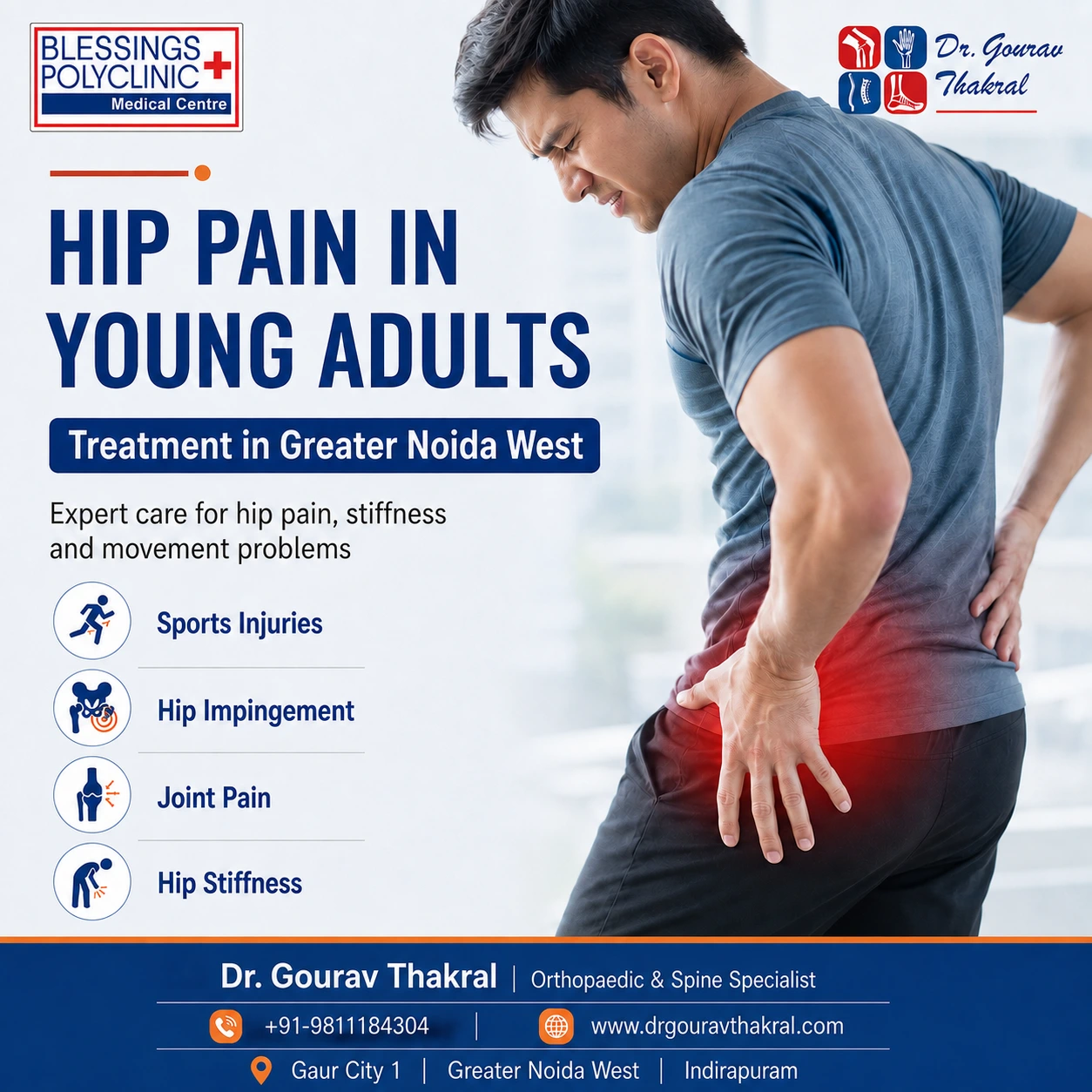
Hip Pain in Young Adults Treatment in Greater Noida West
Hip Pain in Young Adults Treatment in Greater Noida West is important for young people who have groin pain, outer hip pain, stiffness, clicking, weakness, or difficulty during walking, running, sitting, gym workouts, or sports.
Hip pain at a young age should not always be treated as simple muscle soreness. It may be linked to muscle strain, tendon irritation, hip impingement, sports injuries, joint problems, or changes in the shape and movement of the hip.
People looking for hip pain treatment in Greater Noida West can consult Dr. Gourav Thakral for a detailed orthopaedic check-up and personalised treatment guidance.
Early diagnosis can help reduce pain, improve hip movement, restore muscle strength, and support a safer return to work, gym activity, and sports.
Why Do Young Adults Get Hip Pain?
Hip pain can develop at any age. In younger adults, however, the causes may be different from those seen in older people.
Common causes include:
- Sports injuries
- Gym overuse
- Muscle strain
- Tendon problems
- Hip impingement
- Hip dysplasia
- Labral problems
- Reduced blood supply to the hip bone
- Old injuries
- Poor movement patterns
- Early joint damage
Because several conditions can cause similar symptoms, proper diagnosis is important before starting treatment.
Common Symptoms of Hip Problems in Young Adults
Hip pain may be felt in different areas.
Common symptoms include:
- Groin pain
- Outer hip pain
- Buttock pain
- Pain while walking
- Pain during running
- Pain after gym workouts
- Pain while climbing stairs
- Pain while sitting for long periods
- Hip stiffness
- Clicking or catching
- Weakness
- Reduced movement
- Limping
- Pain during squats
- Pain after sports activity
If these symptoms continue, timely Hip Pain in Young Adults Treatment in Greater Noida West can help identify the cause.
Muscle Strain
Muscle strain is one of the common reasons for hip pain in active young adults.
It may happen after:
- Running
- Heavy gym workouts
- Football
- Cricket
- Sudden twisting
- Heavy lifting
- Sprinting
- Overstretching
Symptoms may include:
- Pain
- Tightness
- Tenderness
- Weakness
- Pain during movement
Mild muscle strain often improves with rest from painful activity, physiotherapy, and gradual strengthening.
Tendon Problems
Tendons connect muscles to bones. Repeated movement or heavy exercise can irritate the tendons around the hip.
Symptoms may include:
- Pain while walking
- Pain after exercise
- Tenderness
- Weakness
- Pain while climbing stairs
- Pain while lying on one side
A guided exercise programme can help improve strength and reduce repeated stress on the tendon.
Hip Impingement
Hip impingement is an important cause of hip pain in young and active adults.
It happens when the shape of the hip bones causes extra contact during certain movements.
Symptoms may include:
- Groin pain
- Hip stiffness
- Pain during squats
- Pain while sitting
- Pain during sports
- Reduced hip movement
- Clicking
Deep bending or twisting may make the pain worse.
Treatment may include activity changes, physiotherapy, strengthening, and surgery in selected cases.
Hip Dysplasia
Hip dysplasia means the hip socket does not fully cover the ball of the hip joint.
Some people may have this condition from childhood but notice symptoms only later.
Common symptoms include:
- Groin pain
- Pain after activity
- Clicking
- Weakness
- Limping
- Reduced movement
- Difficulty during sports
Treatment depends on the shape of the hip and the amount of joint damage.
Labral Problems
The labrum is a ring of cartilage around the hip socket.
It helps support the joint during movement.
A labral problem may cause:
- Deep groin pain
- Clicking
- Catching
- Locking
- Pain while twisting
- Pain while sitting
- Reduced sports performance
However, not every labral change seen on MRI causes symptoms. Therefore, the scan should always be matched with the patient’s pain and physical examination.
Reduced Blood Supply to the Hip Bone
Avascular necrosis is a condition in which blood supply to part of the hip bone becomes reduced.
Over time, this may weaken the bone.
Symptoms can include:
- Groin pain
- Pain while walking
- Hip stiffness
- Limping
- Reduced movement
- Pain that gradually becomes worse
Early diagnosis is important because treatment depends on the stage of the problem.
Early Hip Arthritis
Although hip arthritis is more common with age, young adults can also develop it.
Possible causes include:
- Previous fracture
- Hip dysplasia
- Childhood hip problems
- Old joint injury
- Inflammatory arthritis
- Severe hip impingement
Symptoms may include:
- Hip stiffness
- Pain during walking
- Groin pain
- Reduced movement
- Difficulty climbing stairs
- Pain after activity
Early treatment may help protect the joint and maintain movement.
Sports-Related Hip Pain
Sports can put repeated pressure on the hip joint and nearby muscles.
Young adults involved in football, cricket, running, badminton, gym training, and other sports may experience hip pain due to:
- Muscle strain
- Tendon overload
- Hip impingement
- Labral irritation
- Repeated overuse
- Poor movement control
Ignoring pain and continuing heavy activity may delay recovery.
Hip Pain Treatment in Greater Noida West
Hip pain treatment in Greater Noida West begins with finding the exact source of pain.
During the consultation, Dr. Gourav Thakral may ask:
- When did the pain start?
- Is the pain in the groin or outer hip?
- Does exercise increase the pain?
- Does sitting cause discomfort?
- Is clicking present?
- Is movement restricted?
- Was there a previous injury?
- Does pain come from the lower back?
After this discussion, the hip, lower back, muscles, and walking pattern are examined.
Diagnosis of Hip Pain in Young Adults
A clinical assessment may include:
- Hip movement
- Muscle strength
- Tenderness
- Walking pattern
- Hip rotation
- Balance
- Lower-back movement
- Pain during specific movements
These checks help determine whether the problem comes from the joint, muscles, tendons, or spine.
Digital X-Ray
An X-ray may help identify:
- Hip impingement
- Hip dysplasia
- Arthritis
- Changes in bone shape
- Alignment problems
- Old fractures
It is often the first imaging test used when a structural hip problem is suspected.
MRI Scan
An MRI may help assess:
- Labrum
- Cartilage
- Tendons
- Muscles
- Avascular necrosis
- Other soft-tissue problems
However, an MRI is not needed in every case.
The decision depends on symptoms, examination findings, and the suspected condition.
Hip Treatment in Greater Noida West
Hip treatment in Greater Noida West depends on the diagnosis, age, activity level, and severity of symptoms.
Treatment may include:
- Activity modification
- Medicines
- Physiotherapy
- Hip strengthening
- Core strengthening
- Mobility exercises
- Sports rehabilitation
- Weight management
- Injection treatment in selected cases
- Surgery when required
The same treatment is not suitable for every patient.
Non-Surgical Hip Pain Treatment
Many young adults improve without surgery.
Activity Modification
Activities that increase pain may need to be reduced temporarily.
These can include:
- Deep squats
- Heavy leg press
- Lunges
- Running
- Jumping
- Repeated high-impact exercise
However, complete rest for a long time can cause weakness and stiffness.
Physiotherapy
Physiotherapy may help:
- Improve hip movement
- Strengthen hip muscles
- Improve core strength
- Correct movement patterns
- Improve walking
- Support sports recovery
- Reduce repeated overload
Regular exercise under guidance can support long-term hip health.
Medicines
Pain-relief or anti-inflammatory medicines may be prescribed when required.
However, medicines should not be used as the only treatment when hip pain keeps returning.
Ice or Heat
Ice may help after a recent strain or when pain increases after exercise.
Heat may help reduce stiffness in some long-term conditions.
The suitable option depends on the cause of pain.
Joint Pain Treatment in Greater Noida West
Joint pain treatment in Greater Noida West may be needed when hip pain occurs along with pain in the knee, ankle, shoulder, or spine.
Treatment may include:
- Clinical examination
- Imaging
- Medicines
- Physiotherapy
- Strengthening
- Activity modification
- Joint protection
- Injection treatment
- Surgery in selected cases
The aim is to reduce pain and protect normal movement.
When Is Surgery Considered?
Surgery is not needed for every young adult with hip pain.
It may be considered when:
- A clear structural problem is present
- Pain continues despite physiotherapy
- Hip movement remains restricted
- Joint instability is present
- Hip impingement does not improve
- Severe joint damage affects daily life
The decision depends on symptoms, examination findings, imaging, and activity needs.
Hip Arthroscopy
Hip arthroscopy is a keyhole procedure used for selected hip problems.
It may be considered for:
- Certain hip impingement problems
- Some labral conditions
- Cartilage problems
However, not every labral tear or hip problem requires surgery.
A proper clinical evaluation is important before deciding on the procedure.
Role of an Orthopaedic Specialist in Greater Noida West
An Orthopaedic specialist in Greater Noida West can assess hip pain related to bones, joints, muscles, tendons, cartilage, and sports injuries.
During the examination, hip movement and muscle strength are checked. Walking and balance may also be assessed.
If needed, X-rays or MRI scans can help identify hip impingement, joint damage, or other problems.
Based on the findings, treatment may include physiotherapy, exercise guidance, activity changes, medicines, or surgery in selected cases.
Role of a Joint Replacement Specialist in Greater Noida West
A Joint Replacement specialist in Greater Noida West may be consulted when severe joint damage causes constant pain and major difficulty with daily activities.
Hip replacement is not usually the first treatment for young adults.
Instead, the aim is often to protect the natural hip joint for as long as possible.
Joint replacement may be considered only when:
- Arthritis is advanced
- Pain is severe
- Walking is badly affected
- Hip movement is very limited
- Daily activities are difficult
- Other suitable treatments have not helped
Warning Signs You Should Not Ignore
Seek medical evaluation if you experience:
- Severe hip pain
- Inability to put weight on the leg
- Increasing limp
- Major loss of movement
- Redness or swelling
- Fever
- Severe pain after an injury
- Rapidly worsening symptoms
- Persistent night pain
- Numbness or weakness
These symptoms may need early medical attention.
When Should You Visit an Orthopaedic Doctor?
Consult an orthopaedic doctor when:
- Hip pain continues for several days
- Pain keeps returning
- Walking becomes difficult
- Sports activity is affected
- Hip clicking becomes painful
- Movement becomes restricted
- Pain affects sleep
- Weakness develops
- A previous injury is causing new symptoms
Early diagnosis can prevent a small problem from becoming harder to manage.
Tips for Young Adults With Hip Pain
Helpful habits include:
- Avoid exercising through sharp pain
- Warm up before sports
- Increase gym intensity gradually
- Improve hip strength
- Strengthen core muscles
- Avoid repeated painful deep movements
- Maintain a healthy body weight
- Wear suitable footwear
- Treat sports injuries early
- Take enough recovery time
- Follow physiotherapy guidance
These habits can support better hip movement.
Why Choose Dr. Gourav Thakral?
Dr. Gourav Thakral provides orthopaedic care for hip pain, sports injuries, joint problems, stiffness, and movement difficulty in young adults.
Patients looking for Hip Pain in Young Adults Treatment in Greater Noida West can consult him for a detailed check-up and personalised treatment plan.
Treatment focuses on finding the cause of pain first. Depending on the condition, care may include pain relief, physiotherapy, muscle strengthening, joint protection, and a safe return to normal activity or sports.
Conclusion
Hip pain in young adults may develop because of muscle strain, tendon problems, sports injuries, hip impingement, hip dysplasia, labral problems, reduced blood supply to the hip bone, or early joint damage.
For Hip Pain in Young Adults Treatment in Greater Noida West, consult Dr. Gourav Thakral for hip evaluation, joint pain treatment, physiotherapy guidance, sports rehabilitation, and personalised orthopaedic care.
Early diagnosis can help reduce pain, restore movement, and protect long-term hip function.
FAQs
Why do young adults develop hip pain?
Common causes include sports injuries, muscle strain, tendon problems, hip impingement, hip dysplasia, labral problems, and previous joint damage.
Can gym workouts cause hip pain?
Yes. Heavy squats, lunges, running, leg presses, and sudden increases in training can irritate the muscles, tendons, or hip joint.
What is hip impingement?
Hip impingement happens when the shape of the hip bones causes extra contact during certain movements, leading to pain or stiffness.
Can hip pain in young adults improve without surgery?
Yes. Many conditions improve with activity changes, physiotherapy, strengthening, and appropriate pain management.
Is an MRI always required for hip pain?
No. MRI may be advised when the doctor suspects a labral problem, tendon injury, cartilage damage, or reduced blood supply to the hip bone.
When should I consult an orthopaedic specialist?
Consult a specialist when pain keeps returning, affects walking or sports, causes stiffness or clicking, or does not improve with basic care.
Do young adults ever need hip replacement?
Yes, but it is usually considered only when joint damage is severe and other suitable treatments have not helped.
Where can I get hip pain treatment in Greater Noida West?
You can consult Dr. Gourav Thakral for Hip Pain in Young Adults Treatment in Greater Noida West, joint pain treatment, sports injury evaluation, and hip-related movement problems.