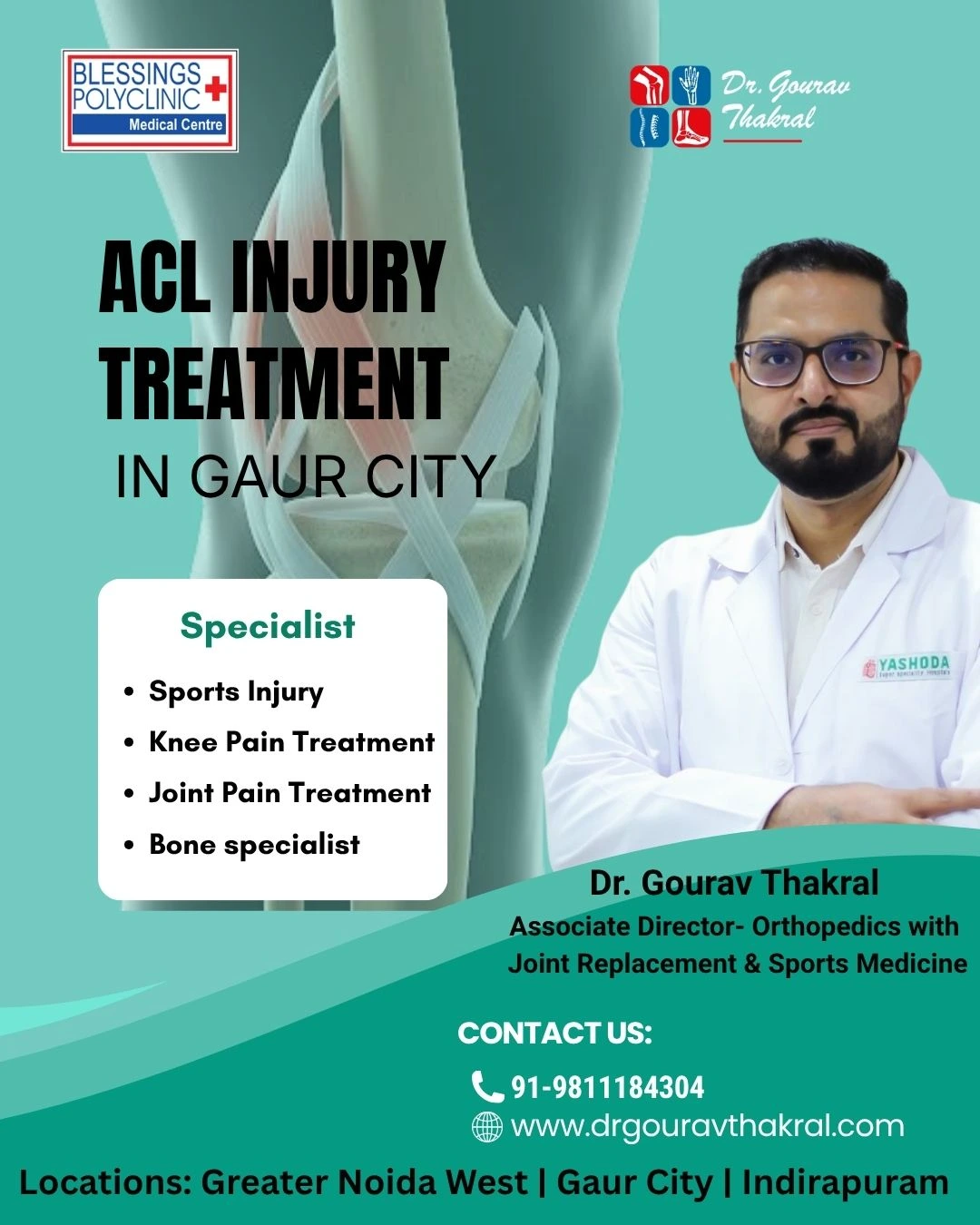
ACL injury treatment in Gaur City
ACL Injury Treatment in Gaur City is important for people who experience knee pain, swelling, instability, or difficulty walking after a sports injury, fall, or sudden twisting movement.
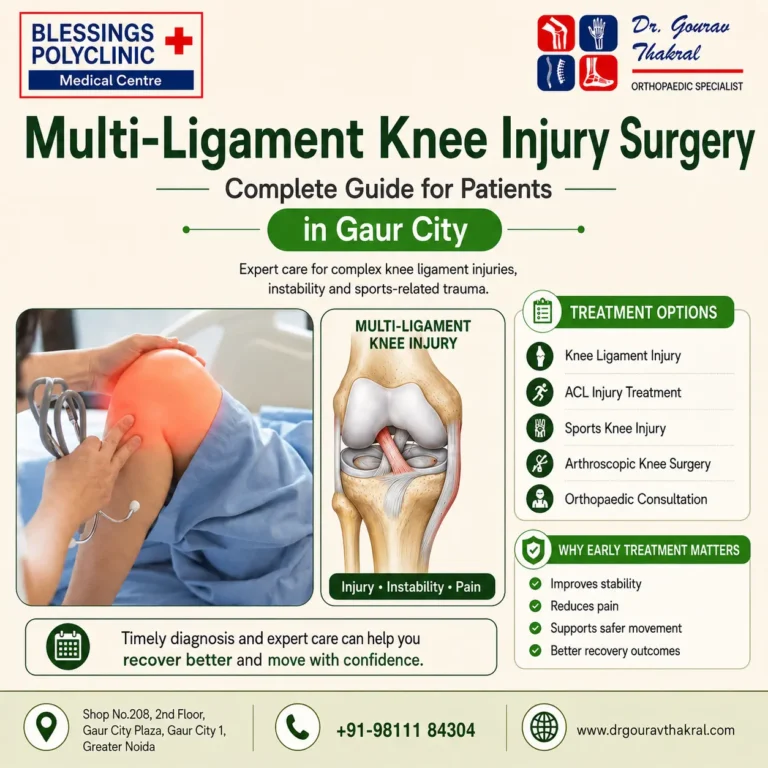
The ACL, also known as the anterior cruciate ligament, is one of the main ligaments inside the knee. It helps control movement and keeps the knee stable during walking, running, jumping, and changing direction.
At first, an ACL injury may seem like normal knee pain. However, untreated ligament damage can cause repeated knee instability and increase the risk of meniscus or cartilage injury.
Therefore, early consultation with an Orthopaedic specialist is important. Dr. Gourav Thakral provides diagnosis, non-surgical care, physiotherapy guidance, and surgical treatment for ACL injuries and other knee problems in Gaur City.
What Is an ACL Injury?
The anterior cruciate ligament connects the thigh bone to the shin bone. It is located inside the knee joint and plays an important role in controlling forward and rotational movement.
An ACL injury happens when this ligament becomes overstretched, partially torn, or completely torn.
These injuries are common among people who play football, cricket, basketball, badminton, kabaddi, or other sports that involve sudden turns and rapid direction changes.
However, an ACL injury can also happen after a fall, road accident, or sudden twisting movement during daily activities.
Common Symptoms of an ACL Injury
ACL injury symptoms may start immediately after the incident. In some cases, swelling and instability develop within a few hours.
Common symptoms include:
- A popping sound at the time of injury
- Sudden knee pain
- Rapid swelling
- Difficulty walking
- Reduced knee movement
- Knee instability
- Feeling that the knee may give way
- Pain while climbing stairs
- Difficulty running or changing direction
- Weakness around the knee
- Difficulty returning to sports
If these symptoms continue, proper knee pain treatment in Gaur City can help identify whether the problem is related to the ACL, meniscus, cartilage, or another ligament.
Common Causes of ACL Injury
An ACL injury may happen because of a direct impact or sudden movement.
Common causes include:
- Sudden change in direction while running
- Incorrect landing after a jump
- Twisting the knee while the foot remains fixed
- Sudden stopping during sports
- Direct blow to the knee
- Falling from stairs
- Road traffic accident
- Contact during football or basketball
- Poor landing technique
- Weak muscles around the knee
Athletes and active individuals may have a higher risk because their knees face repeated stress during training and competition.
Grades of ACL Injury
ACL injuries are commonly divided into three grades.
Grade 1 ACL Sprain
In a Grade 1 injury, the ligament is mildly stretched. It remains stable, but the patient may experience pain, swelling, or discomfort.
Grade 2 ACL Injury
A Grade 2 injury means the ligament is partially torn. The knee may feel loose or unstable during activity.
Grade 3 ACL Tear
A Grade 3 injury is a complete ACL tear. The ligament can no longer provide normal knee stability.
Patients with a complete tear may need advanced rehabilitation or ACL reconstruction surgery, depending on their age, activity level, symptoms, and lifestyle.
ACL Injury Treatment in Gaur City
ACL Injury Treatment in Gaur City focuses on reducing pain, improving movement, restoring knee stability, and preventing further joint damage.
Treatment depends on:
- Type of ACL injury
- Severity of the tear
- Age of the patient
- Activity level
- Knee stability
- Sports participation
- Associated meniscus injury
- Cartilage damage
- Daily movement needs
Some patients improve with medicines, physiotherapy, and activity modification. However, others may need surgery.
Diagnosis of ACL Injury
Diagnosis begins with a detailed examination. Dr. Gourav Thakral may ask how the injury happened and when the symptoms started.
The knee is then checked for:
- Swelling
- Tenderness
- Movement
- Stability
- Muscle strength
- Pain points
- Walking difficulty
- Locking or clicking
Special tests may also be used to assess ACL stability.
Physical Examination
During the clinical examination, the injured knee may be compared with the healthy knee.
Tests may include:
- Lachman test
- Anterior drawer test
- Pivot shift test
- Knee range-of-motion test
These tests help assess whether the ACL is stretched, partially torn, or completely torn.
Digital X-Ray
A digital X-ray does not show the ACL directly. However, it can help identify fractures, bone damage, or other injuries.
MRI Scan
An MRI scan gives detailed images of the ACL, meniscus, cartilage, and surrounding ligaments.
It may help confirm:
- Partial ACL tear
- Complete ACL tear
- Meniscus injury
- Cartilage damage
- Bone bruising
- Other ligament injuries
Therefore, MRI may be advised when the diagnosis is unclear or surgery is being considered.
Non-Surgical ACL Injury Treatment
Non-surgical treatment may be suitable for patients with mild sprains, partial tears, lower activity levels, or stable knees.
Rest and Activity Modification
The patient may be advised to avoid running, jumping, twisting, and other activities that increase pain.
However, complete bed rest is usually not needed. Controlled movement can help prevent stiffness.
Ice Application
Ice can help reduce pain and swelling during the early stage.
An ice pack may be applied for 15 to 20 minutes at a time. It should not be placed directly on the skin.
Compression and Elevation
A compression bandage may help control swelling. Also, keeping the leg elevated can reduce fluid accumulation around the knee.
Medicines
Pain-relieving or anti-inflammatory medicines may be prescribed when needed.
Patients should avoid taking medicines for a long time without medical advice.
Knee Brace
A knee brace may provide temporary support during walking and rehabilitation.
However, a brace cannot repair a completely torn ACL. Its purpose is to improve support and confidence during movement.
Physiotherapy for ACL Injury
Physiotherapy is an important part of ACL recovery. It may be used before surgery, after surgery, or as the main treatment in selected cases.
Physiotherapy may include:
- Swelling control
- Range-of-motion exercises
- Quadriceps strengthening
- Hamstring strengthening
- Balance exercises
- Walking correction
- Stability training
- Coordination exercises
- Hip and core strengthening
- Sports-specific rehabilitation
A structured programme helps improve knee control. Moreover, it reduces the risk of repeated instability.
Patients receiving joint pain treatment may also benefit from guided exercises when muscle weakness or poor movement is contributing to their symptoms.
When Is ACL Surgery Required?
ACL surgery may be considered when:
- The ACL is completely torn
- The knee repeatedly gives way
- The patient wants to return to sports
- Daily activities are affected
- The injury includes a meniscus tear
- Other knee ligaments are damaged
- Physiotherapy does not provide enough stability
- The patient has a physically demanding job
- Repeated instability increases the risk of joint damage
Not every ACL tear requires surgery. Therefore, the decision should be based on symptoms, knee stability, activity level, and long-term goals.
ACL Reconstruction Surgery
ACL reconstruction is performed to replace the torn ligament with a tissue graft.
The graft may be taken from:
- Hamstring tendon
- Patellar tendon
- Quadriceps tendon
- Another suitable graft source
The procedure is usually performed through knee arthroscopy. Small incisions and a camera are used to examine the joint and position the graft.
The main steps may include:
- Examining the knee joint
- Identifying associated injuries
- Preparing bone tunnels
- Positioning the new graft
- Fixing the graft securely
- Checking movement and stability
If a meniscus or cartilage injury is present, it may also be treated during the same procedure.
Recovery After ACL Surgery
Recovery after ACL surgery happens gradually. The rehabilitation plan depends on the patient’s age, strength, graft type, associated injuries, and daily activity needs.
Early Recovery Stage
During the first few weeks, the focus is on:
- Reducing swelling
- Controlling pain
- Restoring knee straightening
- Improving knee bending
- Activating the thigh muscles
- Walking safely
- Protecting the graft
Strengthening Stage
As movement improves, strengthening exercises are introduced.
These exercises may focus on:
- Quadriceps
- Hamstrings
- Hip muscles
- Calf muscles
- Core muscles
Balance and coordination exercises are also included.
Return to Sports
Running, jumping, agility drills, and direction changes are introduced gradually.
The patient should return to sports only after:
- Knee movement is restored
- Strength is improved
- Balance is normal
- Stability is good
- Functional tests are completed
- Medical clearance is given
Returning too early may increase the risk of another injury.
Sports Injury Treatment in Gaur City
ACL tears are common sports injuries. They often happen during quick turns, sudden stops, jumps, or contact with another player.
Effective sports injury treatment in Gaur City should focus on both recovery and prevention.
Treatment may include:
- Injury assessment
- MRI guidance
- Pain management
- Physiotherapy
- Muscle strengthening
- Balance training
- Running analysis
- Landing correction
- Sport-specific exercises
- Return-to-play testing
Therefore, athletes should not ignore swelling, instability, or repeated knee pain after an injury.
Role of an Orthopaedic Specialist
An Orthopaedic specialist helps diagnose and treat ligament injuries, joint pain, fractures, sports injuries, and movement problems.
During an ACL evaluation, the specialist checks:
- Knee stability
- Swelling
- Range of motion
- Muscle strength
- Walking pattern
- Associated injuries
- Sports and activity needs
Based on the findings, the specialist may recommend medicines, physiotherapy, bracing, activity changes, or surgery.
Correct diagnosis helps prevent unnecessary treatment and supports safer recovery.
Knee Pain Treatment in Gaur City
Knee pain can happen due to many conditions. An ACL injury is only one possible cause.
Other causes may include:
- Meniscus injury
- Arthritis
- Cartilage damage
- Patellar tendon injury
- Ligament sprain
- Fracture
- Muscle weakness
- Kneecap problems
- Sports overuse
Therefore, knee pain treatment in Gaur City begins with identifying the exact source of pain.
Treatment may include examination, X-ray, MRI, medicines, physiotherapy, exercise guidance, bracing, injection therapy, or surgical treatment in selected cases.
The goal is to reduce pain, restore movement, and protect long-term knee health.
Joint Pain Treatment and ACL Injuries
An ACL injury may cause pain, swelling, and weakness around the knee joint.
However, repeated knee instability can also damage the meniscus and cartilage. Over time, this may lead to long-term joint pain.
Effective joint pain treatment should not focus only on temporary pain relief. Instead, it should identify and treat the underlying problem.
Early care may help reduce further damage and improve long-term movement.
Can an ACL Tear Heal Without Surgery?
A mild ACL sprain may improve with rest and rehabilitation.
Some patients with partial tears may also recover without surgery if the knee remains stable.
Non-surgical care may be suitable when:
- The tear is partial
- The patient has low activity needs
- The knee does not give way
- Daily movement is comfortable
- Physiotherapy improves strength
- The patient does not play pivoting sports
However, a complete ACL tear usually does not reconnect naturally.
Still, some patients may manage well without surgery if the knee remains stable and their lifestyle does not involve demanding activities.
Risks of Ignoring an ACL Injury
Ignoring an ACL injury may lead to:
- Repeated knee instability
- Meniscus injury
- Cartilage damage
- Muscle weakness
- Reduced sports performance
- Difficulty walking
- Long-term knee pain
- Early joint wear
- Fear during movement
Therefore, persistent pain or instability should not be treated only with home remedies.
When Should You Visit a Doctor?
Visit a doctor if knee pain continues or affects your daily routine.
Seek early care if you have:
- Sudden knee swelling
- A popping sound during injury
- Difficulty walking
- Knee instability
- Repeated giving way
- Pain after sports activity
- Reduced movement
- Locking or clicking
- Pain while climbing stairs
- Inability to return to exercise
Early treatment can help prevent long-term problems.
Prevention Tips for ACL Injuries
Some ACL injuries can be reduced with proper training and conditioning.
Helpful tips include:
- Warm up before exercise
- Strengthen thigh muscles
- Strengthen hip and core muscles
- Improve balance
- Learn correct landing technique
- Avoid sudden increases in training
- Wear proper sports shoes
- Rest when muscles are tired
- Use safe playing surfaces
- Follow sport-specific training
A guided injury-prevention programme can be especially useful for athletes and people with a previous knee injury.
Why Choose Dr. Gourav Thakral?
Dr. Gourav Thakral provides expert orthopaedic care for ACL injuries, knee pain, joint pain, ligament damage, sports injuries, fractures, and movement-related conditions.
Patients looking for ACL Injury Treatment in Gaur City can consult him for proper diagnosis, MRI guidance, physiotherapy planning, non-surgical care, and ACL reconstruction when required.
His treatment approach focuses on:
- Correct diagnosis
- Pain relief
- Better knee movement
- Improved stability
- Safe rehabilitation
- Return to sports
- Long-term joint protection
Conclusion
An ACL injury can affect walking, sports, exercise, and daily movement. Pain, swelling, instability, and repeated giving way should not be ignored.
For expert ACL Injury Treatment in Gaur City, consult Dr. Gourav Thakral for knee evaluation, joint pain treatment, physiotherapy guidance, and complete sports injury treatment.
Timely care can help restore knee strength, improve stability, prevent further damage, and support a safe return to normal activities.
FAQs
What is an ACL injury?
An ACL injury is damage to the anterior cruciate ligament inside the knee. It may be a mild sprain, partial tear, or complete tear.
What are the main symptoms of an ACL tear?
Common symptoms include a popping sound, sudden pain, swelling, difficulty walking, and knee instability.
Does every ACL tear need surgery?
No. Mild sprains and some partial tears may improve with physiotherapy. Surgery may be needed for complete tears, repeated instability, or return to sports.
Can I walk with an ACL tear?
Some patients can walk with an ACL tear. However, the knee may feel unstable during turning, running, or climbing stairs.
How is an ACL injury diagnosed?
Diagnosis may include physical examination, stability tests, digital X-ray, and MRI.
How long does ACL recovery take?
Recovery depends on the injury and treatment. Rehabilitation may take several months, especially after ACL reconstruction surgery.
Where can I get ACL Injury Treatment in Gaur City?
You can consult Dr. Gourav Thakral for ACL Injury Treatment in Gaur City, knee pain treatment, sports injury care, physiotherapy guidance, and ligament reconstruction.