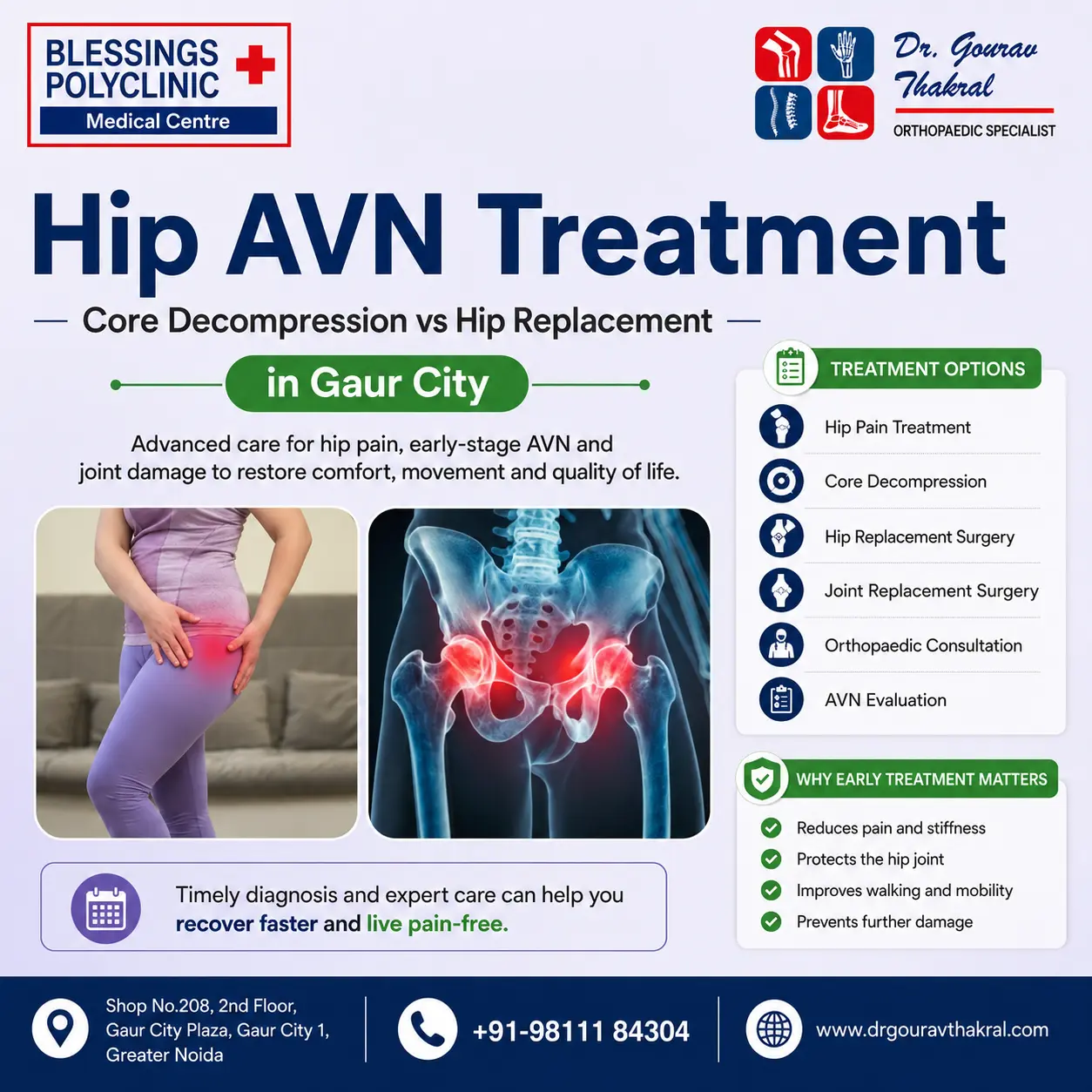
Hip AVN Treatment: Core Decompression vs Hip Replacement in Gaur City
Hip pain can disturb walking, sitting, sleeping, stair climbing, and daily movement. One serious cause of long-term hip pain is Hip AVN, also known as Avascular Necrosis of the hip. This condition develops when the blood supply to the femoral head becomes poor. The femoral head is the ball-shaped part of the hip joint. When this bone does not receive enough blood, it slowly becomes weak and painful.
Many people ignore early hip pain because they think it may be muscle strain, tiredness, or normal joint pain. However, Hip AVN can progress slowly and damage the hip joint over time. Early diagnosis helps patients choose the right treatment before the joint becomes badly damaged. Avascular necrosis means bone tissue damage due to lack of blood supply, and it can lead to small breaks in the bone and joint collapse over time.
For patients looking for Hip pain treatment in Gaur City, Dr. Gourav Thakral provides expert orthopaedic care for Hip AVN, core decompression, and Hip replacement surgery. He is an orthopaedic surgeon, joint replacement specialist, and spine and pain expert offering care for bone, joint, spine, and sports-related problems.
What Is Hip AVN?
Hip AVN happens when the blood supply to the hip bone reduces or stops. Due to poor blood supply, the bone tissue starts losing strength. In the early stage, the hip joint may still look normal. As the condition progresses, the femoral head can collapse and cause severe pain, stiffness, limping, and difficulty in walking.
Patients may feel pain in the groin, hip, thigh, or buttock area. The pain may increase while walking, standing, climbing stairs, or sitting cross-legged. Some people also notice stiffness in the hip joint and reduced movement. In advanced cases, even basic daily activities can become difficult.
An experienced Orthopaedic doctor can examine the hip and suggest proper tests. X-rays may help in advanced cases, but MRI can detect Hip AVN at an earlier stage. Yale Medicine notes that doctors use physical examination, medical history, X-rays, and MRI scans to confirm AVN and understand its stage.
Why the Stage of Hip AVN Matters
The stage of Hip AVN plays the most important role in treatment planning. In early-stage AVN, the hip joint surface usually remains preserved. At this stage, doctors may suggest core decompression to protect the natural hip joint. In advanced-stage AVN, the femoral head may collapse, and the joint may develop arthritis-like damage.
Once the hip joint becomes severely damaged, joint-saving treatment may not give enough relief. In such cases, Hip replacement surgery may become a better option. A proper diagnosis helps the Orthopaedic specialist decide whether the patient needs core decompression or replacement.
Dr. Gourav Thakral evaluates the patient’s pain level, MRI findings, walking ability, age, lifestyle, and hip joint condition before suggesting the right treatment plan.
What Is Core Decompression?
Core decompression is a joint-saving surgery for early-stage Hip AVN. During this procedure, the surgeon creates a small channel in the affected bone area. This channel reduces pressure inside the bone and may help improve blood flow. The main aim is to reduce pain, slow AVN progression, and preserve the natural hip joint.
Doctors usually consider core decompression when the femoral head has not collapsed. This treatment may suit young patients or patients who want to delay hip replacement. It may also help those who have moderate pain but still have a maintained hip joint structure.
Mayo Clinic explains that core decompression removes part of the inner bone layer, which may reduce pain and encourage healthy bone tissue and new blood vessel growth.
Benefits of Core Decompression
Core decompression helps preserve the natural hip joint in selected early-stage patients. It is less extensive than hip replacement and may delay the need for major surgery. Many patients choose this option because it focuses on saving the original joint.
This treatment may help reduce hip pain, improve comfort, and support better movement. It can also help patients continue their daily activities with less discomfort. However, results depend on the stage of AVN and the size of the damaged area.
AAOS states that core decompression may prevent osteonecrosis from progressing to severe arthritis and the need for hip replacement in some cases, depending on the stage and size of the affected area.
Limitations of Core Decompression
Core decompression does not suit every patient. If the femoral head has already collapsed, this procedure may not provide long-term relief. Advanced AVN usually needs a different approach because the joint surface has already lost its shape.
Some patients may still need Hip replacement surgery later, even after core decompression. Recovery also needs proper follow-up, rest, medicines, lifestyle changes, and limited weight-bearing for some time.
That is why patients should not choose treatment only by reading online information. A detailed consultation with an experienced Bone specialist gives better clarity about the right treatment.
What Is Hip Replacement Surgery?
Hip replacement surgery helps patients with advanced Hip AVN. In this procedure, the surgeon removes the damaged parts of the hip joint and replaces them with artificial implants. The main goal is to reduce pain, improve hip movement, and restore walking ability.
Doctors usually suggest hip replacement when the femoral head has collapsed or the joint has developed severe damage. Patients with constant pain, stiffness, limping, and difficulty in daily activities may benefit from this surgery.
A Joint replacement specialist evaluates the condition and decides the correct surgical plan. The decision depends on age, bone quality, activity level, pain severity, and overall health.
Benefits of Hip Replacement Surgery
Hip replacement surgery can give strong pain relief in advanced Hip AVN. It can help patients walk better, move more comfortably, and return to daily life with improved confidence. Many patients who struggle with severe hip pain experience better mobility after surgery.
This treatment also helps when core decompression cannot protect the joint anymore. Once the hip joint collapses, joint-saving procedures usually do not provide enough relief. In such cases, Joint replacement surgery can become the more reliable option.
Patients should discuss recovery, implant life, precautions, and rehabilitation with Dr. Gourav Thakral before making a final decision.
Core Decompression vs Hip Replacement: Main Difference
Core decompression saves the natural hip joint. Hip replacement replaces the damaged hip joint. This is the biggest difference between both treatments.
Core decompression works mainly in early-stage Hip AVN before collapse. It tries to improve blood flow and reduce pressure inside the bone. Hip replacement works better in advanced-stage AVN when the joint has already collapsed or developed severe damage.
The right treatment depends on the patient’s AVN stage. A person with early AVN may not need replacement immediately. On the other hand, a person with advanced AVN may not get enough relief from core decompression.
Which Treatment Is Better?
No single treatment suits every Hip AVN patient. Core decompression may work better in early-stage AVN. Hip replacement may work better in advanced-stage AVN. The best choice depends on MRI findings, X-ray results, pain level, hip movement, and walking ability.
A patient should visit an Orthopaedic specialist early instead of waiting for severe pain. Early treatment can protect the joint and delay major surgery in many cases. Delayed treatment can increase bone damage and reduce treatment options.
For patients in Gaur City, consulting Dr. Gourav Thakral can help in choosing the right treatment at the right stage.
When Should You Consult an Orthopaedic Doctor?
You should consult an Orthopaedic doctor if hip pain continues for more than a few weeks. Pain in the groin, thigh, buttock, or hip area should not be ignored. Limping, stiffness, and difficulty sitting cross-legged may also indicate a hip joint problem.
People with a history of steroid use, alcohol intake, hip injury, or long-term joint pain should stay more alert. These factors can increase the risk of Hip AVN in some patients. Mayo Clinic lists long-term use of high-dose steroid medicines, heavy alcohol use, broken bones, and dislocated joints among factors linked with avascular necrosis.
A Bone specialist can diagnose the condition early and guide you toward the right treatment. Early consultation can make a major difference in the final outcome.
Hip AVN Treatment in Gaur City by Dr. Gourav Thakral
If you are looking for Hip AVN treatment in Gaur City, Dr. Gourav Thakral can help you understand the right treatment option based on your condition. The treatment should focus on pain relief, joint preservation, mobility, and long-term hip function.
As an experienced Orthopaedic specialist and Joint replacement specialist, Dr. Gourav Thakral evaluates the stage of Hip AVN through clinical examination, X-ray, and MRI. Early-stage patients may benefit from core decompression, while advanced-stage patients may need Hip replacement surgery for better pain relief and movement.
For proper Hip pain treatment, always get a complete diagnosis before starting any treatment plan. This helps avoid delays and gives the patient a better chance of choosing the right treatment at the right time.
Why Choose Dr. Gourav Thakral for Hip AVN Treatment?
Dr. Gourav Thakral focuses on accurate diagnosis, patient education, and stage-wise treatment planning. Hip AVN treatment requires careful decision-making because every patient does not need the same procedure.
Some patients may need core decompression to preserve the natural joint. Others may need Joint replacement surgery because the joint damage has already progressed. A complete evaluation helps the patient understand the benefits, risks, recovery process, and expected outcome of each treatment.
Patients searching for the Best orthopaedic doctor in Gaur City can consult Dr. Gourav Thakral for expert guidance on Hip AVN, hip pain, core decompression, and hip replacement.
Final Thoughts
Hip AVN needs timely diagnosis and proper treatment. Core decompression may help in early-stage AVN when the hip joint has not collapsed. Hip replacement surgery may help in advanced-stage AVN when the joint has severe damage.
Patients should not ignore long-term hip pain, stiffness, or limping. Early consultation with Dr. Gourav Thakral, an experienced Orthopaedic doctor and Joint replacement specialist in Gaur City, can help prevent further damage and improve quality of life.
If you are searching for the Best orthopaedic doctor in Gaur City, consult Dr. Gourav Thakral for expert guidance on Hip AVN, core decompression, and hip replacement treatment.
FAQs
1. What is Hip AVN?
Hip AVN is a condition where poor blood supply weakens the hip bone. It can cause hip pain, stiffness, limping, and difficulty in walking.
2. Which treatment is better for early-stage Hip AVN?
Core decompression may work better for early-stage Hip AVN when the femoral head has not collapsed.
3. When do doctors suggest hip replacement surgery?
Doctors may suggest hip replacement surgery when Hip AVN reaches an advanced stage and the hip joint becomes badly damaged.
4. Can core decompression avoid hip replacement?
Core decompression may delay or reduce the need for hip replacement in selected early-stage cases, but it may not work for every patient.
5. Which doctor should I consult for Hip AVN in Gaur City?
You can consult Dr. Gourav Thakral, an experienced orthopaedic doctor, orthopaedic specialist, bon