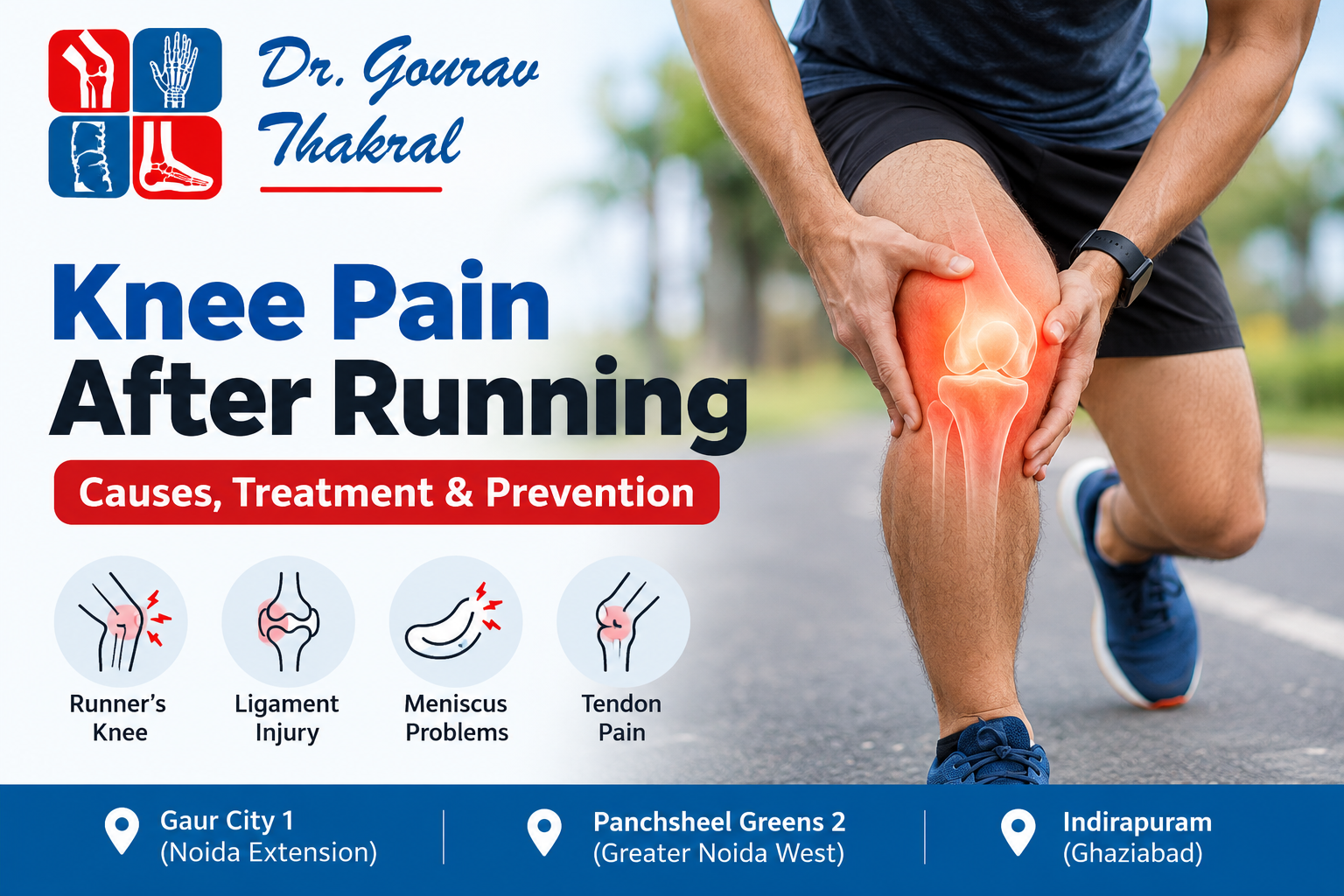
Knee Pain After Running Treatment in Gaur City
Knee Pain After Running Treatment in Gaur City may be needed when running causes pain around the kneecap, inside or outside of the knee, stiffness, swelling, or weakness.
Running places repeated load on the knee joint. Therefore, pain can develop because of overtraining, poor running technique, muscle weakness, tendon irritation, ligament strain, or an existing joint problem.
People looking for knee pain treatment in Gaur City can consult Dr. Gourav Thakral for a detailed orthopaedic and sports injury evaluation.
Early assessment can help identify the cause, reduce pain, improve knee strength, and support a safer return to running.
Why Does Knee Pain Start After Running?
The knee absorbs significant force during every running step.
Normally, muscles around the hip, thigh, knee, and ankle help control this force. However, weakness, poor movement, or sudden increases in training can place extra stress on the knee.
Common causes include:
- Runner’s knee
- Patellofemoral pain
- Tendon irritation
- Muscle weakness
- Ligament strain
- Meniscus irritation
- Poor running technique
- Sudden increase in distance
- Running on hard surfaces
- Unsuitable footwear
- Previous knee injury
Because several conditions can cause similar symptoms, proper diagnosis is important.
Common Symptoms of Knee Pain After Running
Symptoms may begin during the run or appear several hours later.
Common signs include:
- Pain around the kneecap
- Pain below the kneecap
- Inner knee pain
- Outer knee pain
- Swelling
- Stiffness
- Clicking
- Weakness
- Pain while climbing stairs
- Pain while squatting
- Pain after sitting
- Difficulty running
If symptoms keep returning, Knee Pain After Running Treatment in Gaur City may help identify the cause.
Runner’s Knee
Runner’s knee commonly causes pain around or behind the kneecap.
Pain may become worse during:
- Running
- Stairs
- Squatting
- Lunges
- Sitting for long periods
Muscle weakness or poor kneecap control can contribute to the problem.
Therefore, treatment may focus on improving strength and movement.
Patellofemoral Pain
The kneecap moves along the front of the knee during bending and straightening.
If movement becomes irritated, pain may develop during running.
Symptoms may include:
- Front knee pain
- Pain during stairs
- Pain while squatting
- Clicking
- Stiffness after activity
In many cases, physiotherapy can help improve muscle control.
Patellar Tendon Pain
The patellar tendon connects the kneecap to the shin bone.
Repeated running or jumping may irritate this tendon.
Common symptoms include:
- Pain below the kneecap
- Tenderness
- Pain during running
- Pain while jumping
- Stiffness after exercise
Reducing excessive training load may be an important part of recovery.
Knee Ligament Injury
A sudden twist, fall, or change of direction can strain the knee ligaments.
Symptoms may include:
- Pain
- Swelling
- Instability
- Weakness
- Difficulty running
People looking for knee ligament injury treatment in Gaur City may need a detailed stability examination.
If the knee repeatedly gives way, early evaluation is important.
Meniscus Problems
The meniscus acts as a cushion inside the knee.
Twisting or repetitive stress may cause irritation or injury.
Possible symptoms include:
- Joint-line pain
- Clicking
- Swelling
- Catching
- Difficulty bending
- Pain during running
However, not every click indicates a meniscus tear.
Therefore, clinical examination is important.
Sports Injury Treatment in Gaur City
Sports injury treatment in Gaur City may be needed when knee pain develops after running, football, cricket, gym workouts, badminton, or other physical activity.
Sports injuries may involve:
- Ligaments
- Tendons
- Meniscus
- Muscles
- Cartilage
- Joint structures
Treatment depends on the exact injury and activity level.
Knee Pain Treatment in Gaur City
Knee pain treatment in Gaur City begins with identifying why running causes discomfort.
First, the doctor may ask:
- When does pain start?
- Is pain present during or after running?
- Is swelling present?
- Does the knee click?
- Has the running distance recently increased?
- Does the knee feel unstable?
- Was there a previous injury?
- Does stair climbing cause pain?
Next, knee movement, strength, stability, and walking pattern may be examined.
Diagnosis of Running-Related Knee Pain
A physical examination may include:
- Knee movement
- Muscle strength
- Kneecap movement
- Ligament stability
- Tenderness
- Swelling
- Hip strength
- Walking pattern
In addition, running mechanics may be discussed when relevant.
X-Ray
An X-ray may help identify:
- Bone alignment
- Arthritis
- Previous fracture
- Joint-space changes
- Other bone-related problems
However, X-rays do not clearly show ligaments, tendons, or meniscus tissue.
MRI Scan
MRI may be advised when the doctor suspects:
- Ligament injury
- Meniscus tear
- Cartilage damage
- Tendon injury
- Other soft-tissue problems
Therefore, MRI is usually recommended only when clinically required.
Non-Surgical Knee Pain Treatment
Many running-related knee problems improve without surgery.
Treatment may include:
- Temporary activity modification
- Medicines
- Ice
- Physiotherapy
- Muscle strengthening
- Stretching
- Running technique correction
- Weight management
- Sports rehabilitation
Most importantly, treatment should match the exact cause of pain.
Physiotherapy for Knee Pain After Running
Physiotherapy may help improve movement and strength.
A rehabilitation programme may include:
- Quadriceps strengthening
- Hamstring strengthening
- Hip strengthening
- Calf strengthening
- Balance exercises
- Knee mobility exercises
- Running control exercises
As strength improves, training can be increased gradually.
Hip Strength and Knee Pain
Weak hip muscles can affect knee movement during running.
As a result, the knee may move inward or become less stable.
Hip strengthening can improve:
- Running control
- Knee alignment
- Balance
- Lower-limb stability
Therefore, knee rehabilitation may include exercises beyond the knee itself.
Running Technique
Running style can also affect knee load.
Possible problems include:
- Sudden increase in pace
- Overstriding
- Poor lower-limb control
- Excessive training volume
A gradual training programme can reduce repeated stress.
Footwear and Running Surface
Unsuitable footwear may increase discomfort in some runners.
Similarly, repeatedly running on very hard or uneven surfaces may increase stress.
Helpful steps include:
- Use comfortable running shoes
- Replace worn-out footwear
- Increase distance gradually
- Mix running surfaces when suitable
- Take recovery days
These changes can support better knee care.
Joint Pain Treatment in Gaur City
Joint pain treatment in Gaur City may be useful when knee pain occurs with swelling, stiffness, or discomfort in other joints.
For example, pain may also affect the:
- Hip
- Ankle
- Other knee
- Lower back
A complete orthopaedic evaluation can help identify movement problems affecting several areas.
Can You Continue Running With Knee Pain?
It depends on the severity and cause.
Mild discomfort may improve after reducing training load. However, sharp pain, swelling, instability, or pain that changes your running style should not be ignored.
In such cases, running may need to be reduced temporarily.
When Can You Return to Running?
Return to running should be gradual.
You may be ready when:
- Normal walking is comfortable
- Knee movement is pain-free
- Swelling has settled
- Strength has improved
- Stairs are comfortable
- Light jogging does not increase symptoms
Start with shorter distances and lower intensity.
Orthopaedic Specialist in Gaur City
An Orthopaedic specialist in Gaur City can evaluate knee pain involving bones, joints, muscles, ligaments, tendons, and cartilage.
During consultation, the specialist may:
- Check knee movement
- Assess swelling
- Test ligament stability
- Evaluate muscle strength
- Review X-rays or MRI
- Plan physiotherapy
- Guide sports rehabilitation
- Recommend further treatment when needed
Proper diagnosis can help avoid unnecessary treatment.
When Is Surgery Needed?
Most cases of knee pain after running do not need surgery.
However, surgery may be considered when:
- A major ligament injury is present
- A significant meniscus injury causes locking
- Severe cartilage damage is present
- Knee instability continues
- Symptoms do not improve with appropriate treatment
The final decision depends on symptoms, examination findings, and imaging.
Warning Signs You Should Not Ignore
Seek medical evaluation if you have:
- Severe swelling
- Inability to put weight on the knee
- Knee locking
- Repeated giving way
- Severe pain after twisting
- Significant weakness
- Visible deformity
- Increasing pain
These signs may need early assessment.
How to Prevent Knee Pain While Running
Helpful habits include:
- Warm up before running
- Increase distance gradually
- Avoid sudden training changes
- Strengthen thigh muscles
- Strengthen hip muscles
- Wear suitable footwear
- Take recovery days
- Avoid running through sharp pain
- Maintain healthy body weight
- Treat recurring pain early
Regular strength training may also help improve running control.
Dr. Gourav Thakral Clinic Locations
Dr. Gourav Thakral is available at three clinic locations, making orthopaedic consultation accessible to patients from Gaur City, Greater Noida West, Panchsheel Greens, Noida Extension, and Indirapuram.
Clinic 1 – Blessings Polyclinic, Gaur City 1
Patients looking for Knee Pain After Running Treatment in Gaur City can visit Dr. Gourav Thakral at:
Blessings Polyclinic
Shop No. 208, 2nd Floor
Gaur City Plaza, Noida Extension
Gaur City 1, Greater Noida
Uttar Pradesh – 201016
This location is convenient for residents of Gaur City 1, Gaur City 2, Noida Extension, and nearby Greater Noida West areas.
Clinic 2 – Yashoda Medicity, Indirapuram
Dr. Gourav Thakral also consults at:
Yashoda Medicity
Cabin No. 10, Orthopedic Department
OPD 2, Niti Khand 3, Shakti Khand 2
Indirapuram, Uttar Pradesh – 201014
This clinic provides another consultation option for patients coming from Indirapuram and nearby Ghaziabad areas.
Clinic 3 – Aspire Plaza, Panchsheel Greens 2
Patients from Greater Noida West can also consult at:
Aspire Plaza Market
UG-22, Aspire Plaza Market
Sector 16B Road, Panchsheel Greens 2
Greater Noida, Uttar Pradesh – 201318
This location is convenient for patients living around Panchsheel Greens and surrounding Greater Noida West areas.
Why Choose Dr. Gourav Thakral for Knee Pain After Running Treatment in Gaur City?
Dr. Gourav Thakral provides orthopaedic care for knee pain, ligament injuries, sports injuries, fractures, joint problems, and movement-related conditions.
Patients seeking Knee Pain After Running Treatment in Gaur City can consult him for a detailed evaluation and personalised treatment plan.
The treatment approach focuses on:
- Identifying the cause of knee pain
- Reducing swelling and discomfort
- Improving knee movement
- Restoring muscle strength
- Improving joint stability
- Supporting sports rehabilitation
- Guiding a safe return to running
- Considering surgery only when required
Conclusion
Knee pain after running may develop because of runner’s knee, kneecap irritation, tendon strain, ligament injury, meniscus problems, muscle weakness, or excessive training.
For Knee Pain After Running Treatment in Gaur City, consult Dr. Gourav Thakral for knee evaluation, physiotherapy guidance, sports injury care, and personalised orthopaedic treatment.
With three consultation locations at Blessings Polyclinic – Gaur City 1, Yashoda Medicity – Indirapuram, and Aspire Plaza – Panchsheel Greens 2, patients can choose a clinic according to their convenience.
FAQs
1. Why does my knee hurt after running?
Common causes include runner’s knee, kneecap irritation, tendon problems, ligament strain, muscle weakness, or overtraining.
2. Should I stop running if my knee hurts?
Reduce running if it causes sharp pain, swelling, or instability. A gradual return is safer after the cause has been identified.
3. Can physiotherapy help knee pain after running?
Yes. Physiotherapy may improve muscle strength, knee stability, flexibility, and running control.
4. Can weak hip muscles cause knee pain?
Yes. Weak hip muscles can affect knee alignment and movement while running.
5. When is an MRI needed?
MRI may be advised when a ligament injury, meniscus tear, cartilage problem, or other soft-tissue injury is suspected.
6. Does knee pain after running always need surgery?
No. Many running-related knee problems improve with physiotherapy, activity changes, strengthening, and rehabilitation.
7. When should I see an orthopaedic specialist?
Consult an Orthopaedic specialist in Gaur City if pain keeps returning, swelling develops, the knee locks, or instability occurs.
8. Where can I consult Dr. Gourav Thakral?
Dr. Gourav Thakral currently lists consultation locations at Blessings Polyclinic in Gaur City 1, Yashoda Medicity in Indirapuram, and Aspire Plaza in Panchsheel Greens 2.
Contact: +91-9811184304
Website: www.drgouravthakral.com
Medical Disclaimer: This article is for general information only and does not replace personal medical consultation, diagnosis, or treatment.