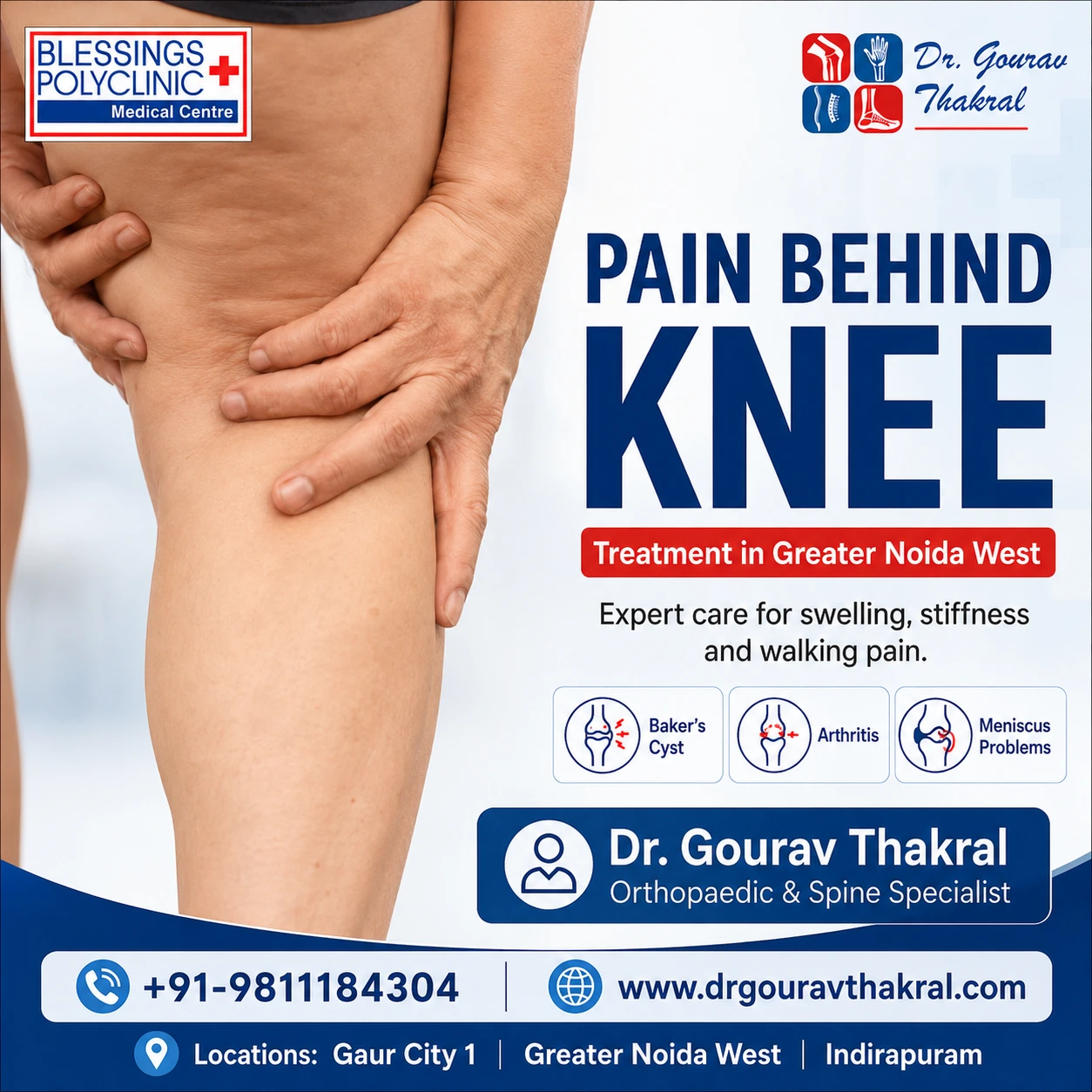
Pain Behind Knee Treatment in Greater Noida West
Pain Behind Knee Treatment in Greater Noida West is important for people who experience aching, tightness, swelling, stiffness, or discomfort at the back of the knee.
Pain may become worse while walking, bending the knee, climbing stairs, standing for long periods, or getting up from a chair. In some cases, a person may also notice a lump or feeling of fullness behind the knee.
One common cause is a Baker’s cyst, which is a fluid-filled swelling behind the knee. However, arthritis, meniscus problems, muscle or tendon strain, and other knee conditions may also cause pain in this area.
People looking for pain behind knee treatment in Greater Noida West can consult Dr. Gourav Thakral for orthopaedic evaluation and personalised treatment guidance.
Early diagnosis can help reduce pain, improve movement, and identify conditions that may require further treatment.
What Causes Pain Behind the Knee?
The back of the knee contains muscles, tendons, nerves, blood vessels, and soft tissues. Problems involving any of these structures may lead to discomfort.
Common causes include:
- Baker’s cyst
- Knee arthritis
- Meniscus problems
- Muscle strain
- Tendon irritation
- Overuse
- Joint swelling
- Previous knee injury
- Hamstring problems
- Calf muscle strain
Because different conditions can produce similar symptoms, a proper examination is important.
Common Symptoms
Pain behind the knee may occur alone or with other symptoms.
Common signs include:
- Pain behind the knee
- Tightness
- Stiffness
- Swelling
- A lump behind the knee
- Difficulty bending the knee
- Pain while straightening the leg
- Pain during walking
- Pain after standing
- Difficulty climbing stairs
- Clicking or locking
- Knee weakness
- Reduced range of movement
A Baker’s cyst may cause a feeling of fullness, stiffness, pain, and swelling behind the knee, especially when the leg is straightened or after activity.
Common Causes Requiring Pain Behind Knee Treatment in Greater Noida West
Baker’s Cyst
A Baker’s cyst, also called a popliteal cyst, is one of the most common causes of swelling or pressure behind the knee.
It develops when excess joint fluid collects at the back of the knee.
Common symptoms include:
- A lump behind the knee
- Tightness
- Knee pain
- Stiffness
- Difficulty bending
- Swelling extending into the lower leg
In adults, Baker’s cysts are often associated with another knee problem, such as osteoarthritis or a meniscus tear.
Therefore, treatment should usually focus on both the cyst and the underlying knee condition.
Knee Arthritis
Arthritis can cause inflammation inside the knee joint.
Common symptoms include:
- Knee pain
- Stiffness
- Swelling
- Reduced movement
- Difficulty walking
- Pain during stairs
- Pain after sitting
Arthritis commonly causes pain, swelling, and stiffness in weight-bearing joints such as the knee.
Extra fluid produced inside an arthritic knee may sometimes contribute to a Baker’s cyst behind the joint.
Meniscus Problems
The meniscus is cartilage inside the knee that helps absorb pressure and support joint movement.
A meniscus tear may happen after a twist or develop gradually as the tissue becomes worn with age.
Symptoms may include:
- Knee pain
- Swelling
- Stiffness
- Clicking
- Catching
- Locking
- Knee giving way
- Reduced movement
Degenerative meniscus tears may occur after relatively minor movements, and swelling and stiffness can develop after the tear.
Muscle or Tendon Strain
Muscles and tendons around the back of the knee may become painful after:
- Running
- Gym workouts
- Sudden stretching
- Long walking
- Sports activity
- Heavy lifting
- Overuse
The pain may increase when bending or straightening the knee.
Mild problems often improve with activity modification and guided rehabilitation. However, persistent pain should be assessed.
Hamstring Problems
The hamstring muscles run down the back of the thigh and connect near the knee.
Strain or tightness may cause pain around the back or side of the knee.
Symptoms may include:
- Pain after running
- Tightness
- Tenderness
- Weakness
- Pain while bending the knee
Proper stretching and strengthening may be advised depending on the diagnosis.
Joint Swelling
Swelling inside the knee joint can create pressure at the back of the knee.
Possible causes include:
- Arthritis
- Meniscus problems
- Inflammation
- Gout
- Overuse
- Previous injury
Therefore, repeated swelling should not simply be treated as muscle pain.
Pain Behind Knee Treatment in Greater Noida West
Pain Behind Knee Treatment in Greater Noida West begins by identifying the structure causing the symptoms.
During consultation, the doctor may ask:
- When did the pain begin?
- Is there a lump behind the knee?
- Does walking increase the pain?
- Is swelling present?
- Does the knee lock or click?
- Was there a previous injury?
- Is the pain worse while bending?
- Does the calf feel swollen?
- Is the knee stiff in the morning?
The knee may then be examined for swelling, tenderness, range of movement, stability, and muscle strength.
Diagnosis of Pain Behind the Knee
A clinical examination may include:
- Comparing both knees
- Checking swelling
- Feeling for a lump behind the knee
- Assessing bending and straightening
- Testing joint stability
- Checking muscle strength
- Assessing walking
- Checking for meniscus signs
- Examining the calf
Further investigations may be advised when required.
Digital X-Ray
An X-ray may help identify:
- Knee arthritis
- Joint-space narrowing
- Bone spurs
- Previous fracture
- Alignment problems
- Age-related joint changes
A Baker’s cyst itself is not usually visible on a standard X-ray, but an X-ray can help identify arthritis or other underlying bone and joint problems.
Ultrasound
An ultrasound may be useful when a lump or fluid-filled swelling is present behind the knee.
It can help determine whether the swelling is:
- Fluid-filled
- Solid
- Related to a Baker’s cyst
Ultrasound is one of the imaging tests that may be used to examine a suspected Baker’s cyst.
MRI Scan
An MRI may help identify soft-tissue problems such as:
- Meniscus tear
- Cartilage damage
- Baker’s cyst
- Ligament injury
- Tendon problems
- Other internal knee conditions
MRI may be especially useful when symptoms continue or the underlying cause remains unclear.
Knee Pain Treatment in Greater Noida West
Knee pain treatment in Greater Noida West should focus on the exact cause of pain rather than only the location.
Treatment may include:
- Activity modification
- Medicines
- Physiotherapy
- Knee exercises
- Ice application
- Weight management
- Joint support
- Injection treatment
- Fluid drainage in selected cases
- Surgery when required
The aim is to reduce pain while improving knee movement and long-term function.
Non-Surgical Pain Behind Knee Treatment
Many causes of pain behind the knee can be managed without surgery.
Activity Modification
Activities that increase symptoms may need to be reduced temporarily.
These may include:
- Long-distance walking
- Running
- Deep squatting
- Repeated stairs
- Heavy gym exercises
- Prolonged standing
However, complete rest for long periods may cause additional stiffness and weakness.
Ice Application
Ice may help reduce knee pain and swelling.
A wrapped ice pack can be applied for short periods rather than directly against the skin. NHS knee-pain guidance recommends using a wrapped ice pack for up to about 20 minutes at a time.
Leg Elevation
If swelling is present, raising the leg while resting may improve comfort.
This may be especially useful when a Baker’s cyst or knee effusion is present.
Medicines
Pain-relief or anti-inflammatory medicines may be prescribed when suitable.
However, patients should avoid repeated self-medication without knowing the actual cause of the pain.
Physiotherapy
Physiotherapy may help:
- Improve knee movement
- Reduce stiffness
- Strengthen thigh muscles
- Improve flexibility
- Support walking
- Correct movement patterns
- Reduce repeated strain
For a Baker’s cyst, physiotherapy may be part of treatment, especially when the underlying knee condition needs rehabilitation.
Baker’s Cyst Treatment
A Baker’s cyst does not always need a procedure.
Many improve with conservative treatment or when the underlying knee problem is treated.
Treatment may include:
- Activity modification
- Pain management
- Physiotherapy
- Treating arthritis
- Treating meniscus problems
- Injection treatment in selected cases
- Fluid drainage when appropriate
Surgery to remove a Baker’s cyst itself is uncommon. Instead, surgery may sometimes be needed to repair the problem inside the knee that is causing excess fluid.
Joint Pain Treatment in Greater Noida West
Joint pain treatment in Greater Noida West may be needed when the pain behind the knee is related to arthritis, inflammation, cartilage wear, or another joint condition.
Treatment may include:
- Clinical evaluation
- X-ray or MRI
- Medicines
- Physiotherapy
- Joint exercises
- Weight management
- Activity guidance
- Injection treatment
- Surgical evaluation
The goal is to improve joint function rather than only provide temporary pain relief.
Joint Pain Treatment and Knee Stiffness
Joint pain treatment is especially important when knee pain occurs with repeated stiffness or swelling.
A personalised care plan may focus on:
- Reducing inflammation
- Restoring movement
- Strengthening muscles
- Improving balance
- Protecting the knee joint
- Managing arthritis
- Preventing repeated symptoms
Early management can support better long-term mobility.
When Is Surgery Required?
Most cases of pain behind the knee do not require surgery.
However, surgical evaluation may be considered when:
- A meniscus tear causes persistent locking
- Advanced arthritis affects daily activities
- Structural damage is significant
- Pain continues despite proper treatment
- Knee movement remains severely restricted
- The underlying knee condition requires repair
The treatment decision depends on the diagnosis, symptoms, imaging, age, and activity level.
Role of an Orthopaedic Surgeon in Greater Noida West
An orthopaedic surgeon in Greater Noida West can evaluate problems affecting the knee bones, cartilage, meniscus, ligaments, tendons, and surrounding soft tissues.
During consultation, the orthopaedic surgeon may:
- Examine the painful area
- Check for swelling behind the knee
- Assess knee movement
- Test joint stability
- Review X-rays or MRI
- Identify arthritis or meniscus problems
- Plan physiotherapy
- Guide pain management
- Recommend surgery only when necessary
Correct diagnosis helps prevent unnecessary treatment.
Warning Signs You Should Not Ignore
Seek early medical evaluation if you experience:
- Sudden increase in pain
- Rapidly increasing swelling
- Significant calf swelling
- Redness or warmth
- Difficulty walking
- Inability to bend the knee
- Severe knee pain
- Fever with swelling
- Numbness
- A rapidly enlarging lump behind the knee
A Baker’s cyst can occasionally rupture and cause pain and swelling in the calf. These symptoms can resemble a blood clot, so sudden or increasing calf pain and swelling needs prompt medical assessment.
When Should You Consult a Doctor?
Consult a doctor if pain behind the knee:
- Continues for several days
- Keeps returning
- Affects walking
- Causes swelling
- Causes stiffness
- Makes stairs difficult
- Causes knee locking
- Is associated with a lump
- Does not improve with basic care
If the knee becomes extremely painful, badly swollen, or you cannot put weight on it, urgent medical advice is appropriate.
Tips to Protect Your Knee
Helpful habits include:
- Maintain a healthy body weight
- Strengthen thigh muscles
- Warm up before sports
- Increase activity gradually
- Avoid deep squatting when painful
- Wear supportive footwear
- Take breaks from prolonged standing
- Treat repeated knee swelling early
- Avoid exercising through severe pain
- Follow physiotherapy guidance
These measures can help reduce strain on the knee.
Why Choose Dr. Gourav Thakral?
Dr. Gourav Thakral provides orthopaedic care for knee pain, swelling, arthritis, meniscus problems, sports injuries, joint stiffness, and movement-related conditions.
Patients looking for Pain Behind Knee Treatment in Greater Noida West can consult him for detailed evaluation and personalised treatment guidance.
His approach focuses on:
- Correct diagnosis
- Pain relief
- Reduced swelling and stiffness
- Better knee movement
- Improved muscle strength
- Joint protection
- Safe rehabilitation
- Surgery only when required
Conclusion
Pain behind the knee may develop because of a Baker’s cyst, arthritis, meniscus problem, muscle strain, tendon irritation, or swelling inside the joint.
Therefore, repeated pain, tightness, swelling, or difficulty bending the knee should not be ignored.
For Pain Behind Knee Treatment in Greater Noida West, consult Dr. Gourav Thakral for knee evaluation, joint pain treatment, physiotherapy guidance, arthritis care, and personalised orthopaedic management.
Early diagnosis can help reduce pain, restore knee movement, and prevent the underlying condition from becoming worse.
FAQs
What causes pain behind the knee?
Common causes include a Baker’s cyst, arthritis, meniscus problems, muscle strain, tendon irritation, and joint swelling.
Can a Baker’s cyst cause pain behind the knee?
Yes. A Baker’s cyst can cause a lump, tightness, stiffness, swelling, and pain behind the knee.
Can arthritis cause pain behind the knee?
Yes. Arthritis can cause pain, stiffness, inflammation, and excess joint fluid, which may also contribute to a Baker’s cyst.
Is physiotherapy useful for pain behind the knee?
Yes. Physiotherapy may help improve movement, strength, flexibility, and knee function depending on the underlying cause.
Do I need an MRI for pain behind the knee?
Not always. MRI may be advised when a meniscus tear, internal knee problem, or persistent Baker’s cyst needs further assessment.
Can pain behind the knee improve without surgery?
Yes. Many causes can improve with activity changes, medicines, physiotherapy, and treatment of the underlying knee problem.
When should pain behind the knee be checked urgently?
Sudden calf swelling, increasing pain, severe knee swelling, inability to walk, or redness and warmth should be assessed promptly.
Where can I get pain behind knee treatment in Greater Noida West?
You can consult Dr. Gourav Thakral for Pain Behind Knee Treatment in Greater Noida West, knee pain, joint stiffness, swelling, and orthopaedic evaluation.