Patella Dislocation Surgery in Gaur City: MPFL Reconstruction Explained
Patella Dislocation Surgery in Gaur City may become necessary when the kneecap slips out of place again and again, causes pain, or creates knee instability during walking, running, stair climbing, or sports activity. The patella, commonly called the kneecap, normally moves in a smooth groove at the front of the knee. When it shifts out of this groove, the knee may feel painful, swollen, unstable, or unsafe.
A patella dislocation can happen after a sudden twist, fall, direct hit, sports injury, or awkward landing. It is common in active people and athletes, especially during activities that involve quick direction changes. Mayo Clinic Sports Medicine notes that patella instability may feel like the kneecap moves or slides, and people may not fully trust their knee during planting, pivoting, squatting, and jumping movements.
For patients looking for Knee pain treatment, Sports injury treatment, and patella dislocation care in Gaur City, Dr. Gourav Thakral provides expert orthopaedic evaluation and treatment guidance. As an experienced Orthopaedic specialist and Bone specialist, he helps patients understand whether they need physiotherapy, bracing, medicines, Ligament injury treatment, or surgery.
What Is Patella Dislocation?
Patella dislocation means the kneecap moves out of its normal position. Most commonly, it moves toward the outer side of the knee. This can stretch or tear the soft tissues that help keep the kneecap stable.
The medial patellofemoral ligament, also called MPFL, plays a major role in preventing the kneecap from moving outward. When the kneecap dislocates, the MPFL may tear or become weak. If the ligament does not support the kneecap properly, the patient may develop repeated instability.
A first-time dislocation may improve with rest, bracing, medicines, and physiotherapy in selected cases. However, repeated dislocation or ongoing instability may need surgical evaluation.
Common Causes of Patella Dislocation
A patella dislocation can occur due to sports injury, twisting movement, weak thigh muscles, abnormal kneecap tracking, shallow knee groove, loose ligaments, previous dislocation, or direct trauma. Some patients are more prone to dislocation because of their knee structure.
A Sports knee injury can happen when the foot stays fixed and the body turns suddenly. This type of movement can push the kneecap out of place. Athletes involved in football, basketball, badminton, running, gym training, dance, or contact sports may face this problem.
Patella instability may also occur with other knee problems. Therefore, the doctor checks for cartilage injury, loose bone fragments, Knee ligament injury, and alignment problems before planning treatment.
Symptoms of Patella Dislocation
Patella dislocation usually causes sudden pain and swelling. Some patients feel the kneecap slip out and then come back into place. Others may need medical help to put the kneecap back in position.
Common symptoms include:
Sudden front knee pain
Kneecap shifting or slipping sensation
Swelling around the knee
Difficulty walking
Knee giving way
Pain while bending or straightening the knee
Tenderness around the kneecap
Fear of twisting or running
Repeated instability during sports
Cleveland Clinic explains that a patella dislocation may need rest, ice, pain relief, and medical treatment, and patients should avoid walking or regular activity immediately after the injury.
What Is MPFL Reconstruction?
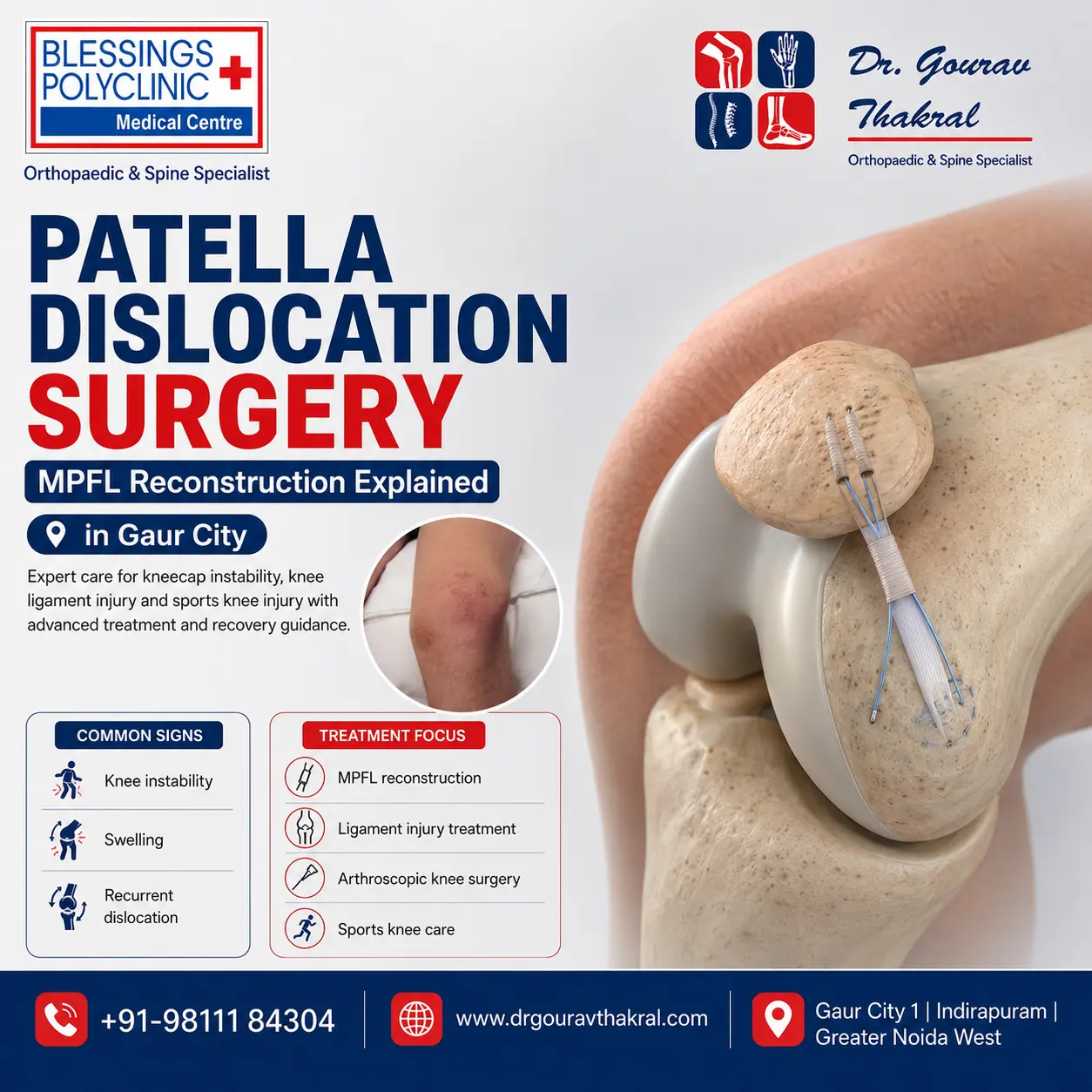
MPFL reconstruction is a surgery that restores stability to the kneecap by reconstructing the medial patellofemoral ligament. This ligament helps hold the kneecap in its correct position and prevents it from moving too far outward.
During MPFL reconstruction, the surgeon creates a new ligament using a graft. The graft may come from the patient’s own tissue or another suitable source. The surgeon fixes the graft between the kneecap and thigh bone to help guide kneecap movement and reduce repeated dislocation.
MPFL reconstruction does not mean the full knee joint gets replaced. It is different from partial knee replacement or total knee replacement. Knee replacement treats damaged joint surfaces, while MPFL reconstruction treats kneecap instability caused by ligament injury.
When Is MPFL Reconstruction Needed?
MPFL reconstruction may be considered when the kneecap dislocates repeatedly or when instability continues despite proper non-surgical treatment. It may also help when the MPFL has torn and the knee remains unstable.
Surgery may be needed when:
The kneecap dislocates again and again
The knee feels unstable during sports
Physiotherapy and bracing do not help enough
The MPFL has torn badly
The patient has repeated giving-way episodes
Cartilage damage or loose fragments exist
Daily movement becomes difficult
The patient wants to return safely to sports
Mayo Clinic lists MPFL ligament reconstruction among treatment options for patella instability, along with physical therapy, patellofemoral realignment, tibial tubercle osteotomy, and other procedures in selected cases.
Non-Surgical Treatment Before Surgery
Not every patella dislocation needs surgery. In first-time dislocation or mild instability, the doctor may suggest non-surgical care. The goal is to reduce pain, control swelling, restore movement, and strengthen the muscles that support the kneecap.
Non-surgical treatment may include rest, ice, compression, elevation, medicines, knee brace, physiotherapy, activity modification, and strengthening exercises. Cleveland Clinic lists rest, ice, compression, elevation, NSAIDs, immobilization, mobility aids, and functional bracing among treatment options for patellar subluxation and related instability.
Physiotherapy focuses on quadriceps strength, hip strength, balance, movement control, and safe return to activity. However, if instability keeps returning, the patient should consult an Orthopaedic specialist for further evaluation.
Role of Arthroscopic Knee Surgery
Doctors may use Arthroscopic knee surgery when they need to check or treat damage inside the knee. Arthroscopy uses a small camera and instruments to view the joint through small cuts.
In patella dislocation cases, arthroscopy may help identify cartilage injury, loose bodies, or joint damage. The surgeon may combine arthroscopy with MPFL reconstruction when needed. The final plan depends on MRI findings, instability pattern, cartilage condition, and kneecap alignment.
Recovery After MPFL Reconstruction
Recovery after MPFL reconstruction takes time and proper rehabilitation. Surgery helps restore stability, but physiotherapy helps restore strength, balance, movement, and confidence.
The early recovery phase focuses on swelling control, pain relief, wound care, brace use, and gentle movement. The doctor may advise protected walking in the beginning. Physiotherapy gradually improves knee bending, straightening, muscle activation, and walking pattern.
Later recovery focuses on strengthening, balance training, controlled squats, stair training, and sports-specific drills. Return to sports depends on healing, strength, stability, and doctor guidance.
Patients should not rush recovery. Early return to intense activity can increase the risk of pain, stiffness, or re-injury.
Why Early Treatment Matters
Repeated patella dislocation can damage cartilage and reduce confidence in movement. Each dislocation episode may increase swelling, pain, and instability. Over time, the patient may start avoiding sports, stairs, squatting, or fast walking.
Early diagnosis helps identify whether the problem is due to MPFL injury, abnormal tracking, shallow groove, weak muscles, or alignment issues. This allows the doctor to choose the right Ligament injury treatment plan.
For athletes and active people, timely Sports injury treatment can support safer return to activity and reduce repeated instability episodes.
Patella Dislocation Surgery in Gaur City by Dr. Gourav Thakral
If you are dealing with repeated kneecap slipping, knee instability, swelling, pain, or difficulty returning to sports, Dr. Gourav Thakral can help with proper diagnosis and treatment planning in Gaur City. He evaluates symptoms, knee stability, MRI findings, kneecap tracking, cartilage condition, and activity goals before suggesting treatment.
Patients searching for Knee pain treatment, Sports knee injury care, or Arthroscopic knee surgery guidance can consult Dr. Gourav Thakral for expert orthopaedic care. His approach focuses on accurate diagnosis, stable knee movement, pain relief, and safe recovery.
Final Thoughts
Patella dislocation can make the knee painful, unstable, and difficult to trust during daily activity or sports. First-time dislocation may improve with non-surgical care in selected cases. However, repeated dislocation or ongoing instability may need MPFL reconstruction.
For Patella Dislocation Surgery in Gaur City, consult Dr. Gourav Thakral, an experienced Orthopaedic specialist and Bone specialist, for proper evaluation and treatment guidance.
FAQs
1. What is patella dislocation?
Patella dislocation happens when the kneecap moves out of its normal groove, usually toward the outer side of the knee.
2. What is MPFL reconstruction?
MPFL reconstruction is a surgery that rebuilds the ligament that helps keep the kneecap stable and prevents repeated dislocation.
3. Does every patella dislocation need surgery?
No. First-time or mild cases may improve with bracing, physiotherapy, medicines, and activity changes. Repeated instability may need surgery.
4. Is MPFL reconstruction the same as knee replacement?
No. MPFL reconstruction treats kneecap instability. Partial knee replacement treats damaged knee joint surfaces in selected arthritis cases.
5. Can sports injury cause patella dislocation?
Yes. Sudden twisting, jumping, landing, or direction change during sports can cause kneecap dislocation.