Sacroiliac Joint Pain Treatment in Indirapuram
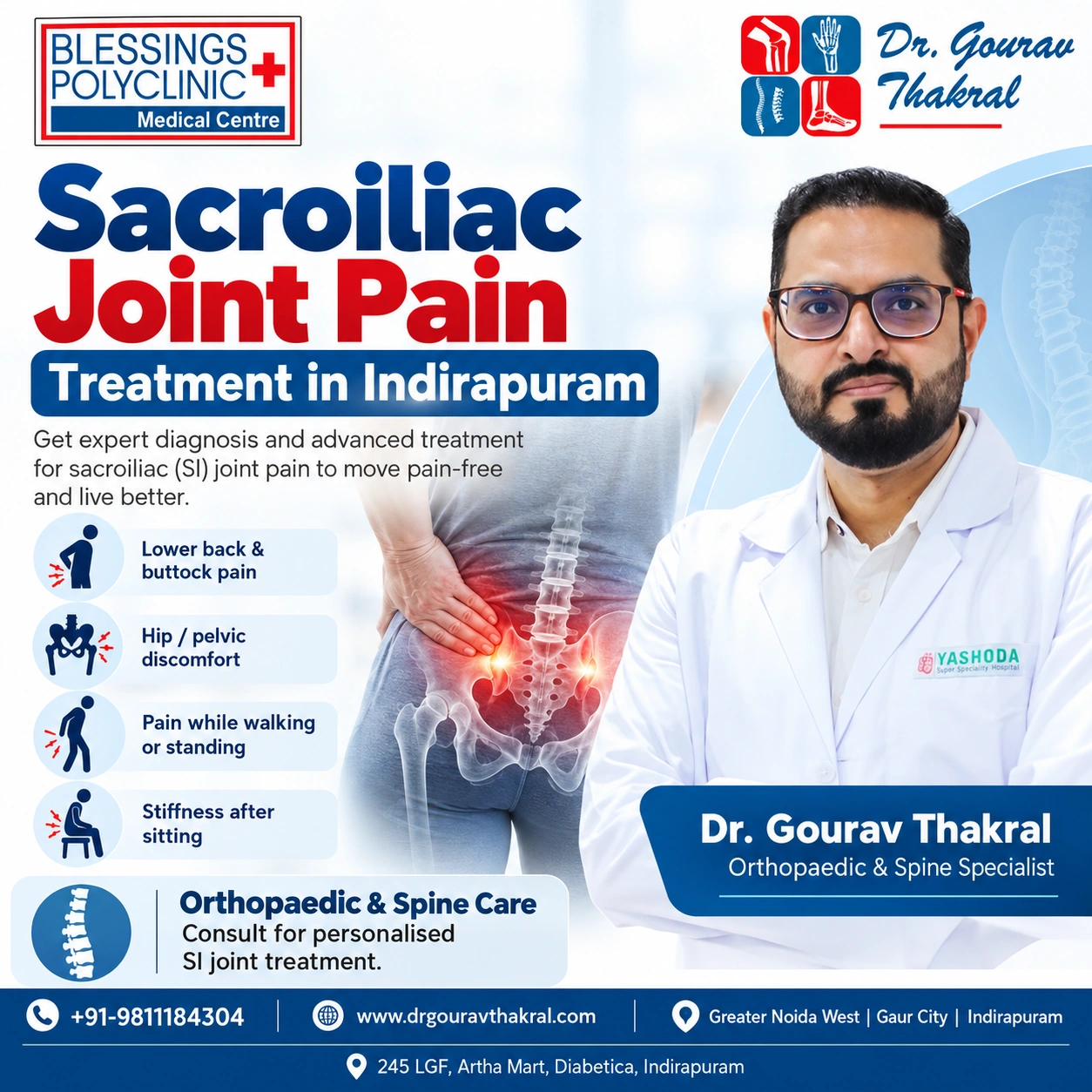
Sacroiliac Joint Pain Treatment in Indirapuram may be needed when pain develops around the lower back, buttock, hip, or pelvic area and becomes worse while walking, standing, climbing stairs, sitting for long periods, or changing position.
The sacroiliac joints, commonly called SI joints, connect the lower part of the spine to the pelvis. These joints help transfer body weight between the spine and legs.
When an SI joint becomes irritated, inflamed, or mechanically stressed, it may cause pain that can sometimes resemble lower back pain, hip pain, or even nerve-related discomfort.
Dr. Gourav Thakral provides orthopaedic and spine evaluation for SI joint pain and related lower-back and pelvic problems in Indirapuram.
What Is Sacroiliac Joint Pain?
There are two sacroiliac joints, one on each side of the pelvis.
They sit between the sacrum and the pelvic bones.
Although these joints have limited movement, they play an important role in:
- Weight transfer
- Walking
- Standing
- Bending
- Turning
- Maintaining pelvic stability
Pain may occur when the joint becomes irritated or when surrounding muscles and ligaments are overloaded.
Common Symptoms of SI Joint Pain
Symptoms may include:
- Pain on one side of the lower back
- Buttock pain
- Pain near the hip
- Pelvic discomfort
- Pain while standing from a chair
- Pain while climbing stairs
- Discomfort after prolonged sitting
- Pain while turning in bed
- Stiffness after rest
- Difficulty walking long distances
In some cases, pain may extend into the thigh.
However, pain usually does not follow the same pattern as classic sciatica.
What Causes Sacroiliac Joint Pain?
Several factors may contribute, including:
- Repetitive strain
- Poor posture
- Uneven walking pattern
- Previous fall or trauma
- Pregnancy-related pelvic changes
- Arthritis
- Leg-length difference
- Sports activity
- Heavy lifting
- Weak core muscles
- Hip stiffness
- Previous spine problems
Therefore, correct diagnosis is important before beginning treatment.
Sacroiliac Joint Pain Treatment in Indirapuram
Sacroiliac Joint Pain Treatment in Indirapuram starts with a detailed assessment of the lower back, pelvis, hips, and walking pattern.
The doctor may ask:
- Where exactly is the pain located?
- Is pain on one side or both sides?
- Does walking increase pain?
- Does sitting for long periods worsen symptoms?
- Is there a history of injury?
- Does pain spread into the leg?
- Is there numbness or tingling?
These details help distinguish SI joint pain from other conditions.
SI Joint Pain vs Lower Back Pain
SI joint pain can feel similar to lower back pain.
However, SI joint discomfort is often felt around the lower back and buttock, usually on one side.
Pain may worsen with:
- Standing on one leg
- Climbing stairs
- Long walks
- Turning in bed
- Getting out of a car
- Moving from sitting to standing
A physical examination can help identify the likely source.
SI Joint Pain vs Sciatica
Sciatica usually results from irritation of a nerve in the lower spine.
It may cause:
- Shooting leg pain
- Tingling
- Numbness
- Weakness
SI joint pain may cause buttock and thigh discomfort but may not follow the same nerve pattern.
Because symptoms can overlap, proper evaluation is important.
Lower Back Pain Treatment in Indirapuram
People looking for lower back pain treatment in Indirapuram may sometimes actually have pain arising from the SI joint.
An orthopaedic or spine evaluation may include assessment of:
- Lower back movement
- Hip movement
- Pelvic alignment
- SI joint tenderness
- Muscle strength
- Walking pattern
- Nerve function
This helps identify the most likely cause of pain.
How Is SI Joint Pain Diagnosed?
Diagnosis is usually based on:
- Medical history
- Physical examination
- Pain location
- Movement testing
- SI joint stress tests
- Hip examination
- Spine examination
Imaging may sometimes be recommended.
X-Ray for SI Joint Pain
X-rays may help assess:
- Arthritis
- Bone changes
- Pelvic alignment
- Other structural problems
However, not all SI joint pain is visible on an X-ray.
MRI Scan
MRI may be advised when the doctor suspects:
- Inflammation
- Significant joint changes
- Disc problems
- Nerve compression
- Another cause of lower-back pain
Imaging is selected according to symptoms and examination findings.
Non-Surgical Treatment
Many cases of SI joint pain can be treated without surgery.
Treatment may include:
- Activity modification
- Medicines when appropriate
- Physiotherapy
- Core strengthening
- Hip strengthening
- Stretching
- Posture correction
- Movement training
- Pain management
The goal is to reduce pain and improve pelvic stability and movement.
Physiotherapy for SI Joint Pain
Physiotherapy may help strengthen the muscles that support the pelvis and lower back.
Treatment may include:
- Core strengthening
- Glute strengthening
- Hip mobility exercises
- Pelvic stability exercises
- Postural correction
- Controlled stretching
The programme should be tailored to the patient’s condition.
Can Walking Make SI Joint Pain Worse?
Yes, prolonged walking may increase symptoms in some people, especially when the joint is irritated or pelvic stability is reduced.
However, complete rest is not always recommended.
A gradual return to activity may be more helpful once the cause has been evaluated.
Can Sitting Cause SI Joint Pain?
Long periods of sitting may increase pressure around the lower back and pelvis.
Symptoms may become worse when:
- Sitting on one side
- Sitting with poor posture
- Sitting for long periods without breaks
- Driving for extended periods
Frequent movement breaks may help reduce stiffness.
When Should You See an Orthopaedic Specialist?
Consult an Orthopaedic specialist in Indirapuram if:
- Pain lasts several days or keeps returning
- Walking becomes difficult
- Pain affects sleep
- Standing from a chair is painful
- Pain follows a fall
- Lower-back pain does not improve
- Symptoms interfere with work or exercise
When Should You See a Spine Specialist?
A Spine specialist in Indirapuram may be helpful when SI joint pain is difficult to distinguish from lumbar disc, nerve, or other spine conditions.
This is particularly important if pain is accompanied by:
- Leg weakness
- Numbness
- Tingling
- Severe radiating pain
- Balance problems
Is Injection Treatment Used for SI Joint Pain?
In selected cases, a doctor may consider image-guided injection treatment when pain remains persistent despite appropriate conservative care.
Such procedures are not required for every patient.
The decision depends on diagnosis, symptoms, and response to treatment.
Is Surgery Required?
Surgery is uncommon for most SI joint pain.
It may only be considered in carefully selected cases when severe symptoms continue despite comprehensive non-surgical treatment.
Tips to Reduce SI Joint Stress
Helpful measures may include:
- Avoid prolonged sitting
- Maintain good posture
- Strengthen core and hip muscles
- Avoid sudden heavy lifting
- Increase activity gradually
- Use proper lifting technique
- Take breaks during long drives
- Seek treatment for persistent pain
Clinic Locations
Patients can consult Dr. Gourav Thakral at:
Yashoda Medicity – Indirapuram
Convenient for Indirapuram and nearby Ghaziabad areas.
Blessings Polyclinic – Gaur City 1
Convenient for Gaur City and Noida Extension.
Aspire Plaza – Panchsheel Greens 2
Convenient for Greater Noida West.
Why Consult Dr. Gourav Thakral?
Dr. Gourav Thakral provides orthopaedic and spine care for lower-back pain, SI joint pain, hip-related discomfort, nerve symptoms, and other musculoskeletal problems.
For Sacroiliac Joint Pain Treatment in Indirapuram, the evaluation focuses on identifying the exact source of pain and creating a personalised treatment plan.
The treatment approach may focus on:
- Reducing pain
- Improving pelvic stability
- Restoring mobility
- Strengthening supporting muscles
- Correcting movement patterns
- Preventing recurring symptoms
Conclusion
Sacroiliac joint pain can cause discomfort around the lower back, buttock, hip, and pelvic region and may interfere with walking, sitting, standing, and daily movement.
For Sacroiliac Joint Pain Treatment in Indirapuram, consult Dr. Gourav Thakral for a detailed orthopaedic and spine evaluation.
Correct diagnosis and timely treatment can help improve mobility, reduce pain, and support a return to normal daily activity.
FAQs
1. Where is sacroiliac joint pain usually felt?
It is commonly felt around the lower back, buttock, hip, or pelvic area, often more on one side.
2. Can SI joint pain feel like sciatica?
Yes, symptoms can sometimes overlap, but sciatica usually follows a nerve-related pattern down the leg.
3. Can long sitting worsen SI joint pain?
Yes. Prolonged sitting and poor posture may increase discomfort in some patients.
4. Can physiotherapy help SI joint pain?
Yes. Physiotherapy may improve core strength, pelvic stability, hip mobility, and movement control.
5. Does SI joint pain require MRI?
Not always. MRI is usually considered when the diagnosis is uncertain or another spine or joint problem is suspected.
6. Does SI joint pain require surgery?
Most cases are managed without surgery.
7. When should I consult a doctor?
Consult a doctor when pain keeps returning, affects walking or sleep, follows an injury, or does not improve with basic care.
8. Where can I get SI joint pain treatment in Indirapuram?
You can consult Dr. Gourav Thakral for Sacroiliac Joint Pain Treatment in Indirapuram and related lower-back, hip, pelvic, and spine problems.
Medical Disclaimer: This article is for general information only and does not replace personal medical consultation, diagnosis, or treatment.