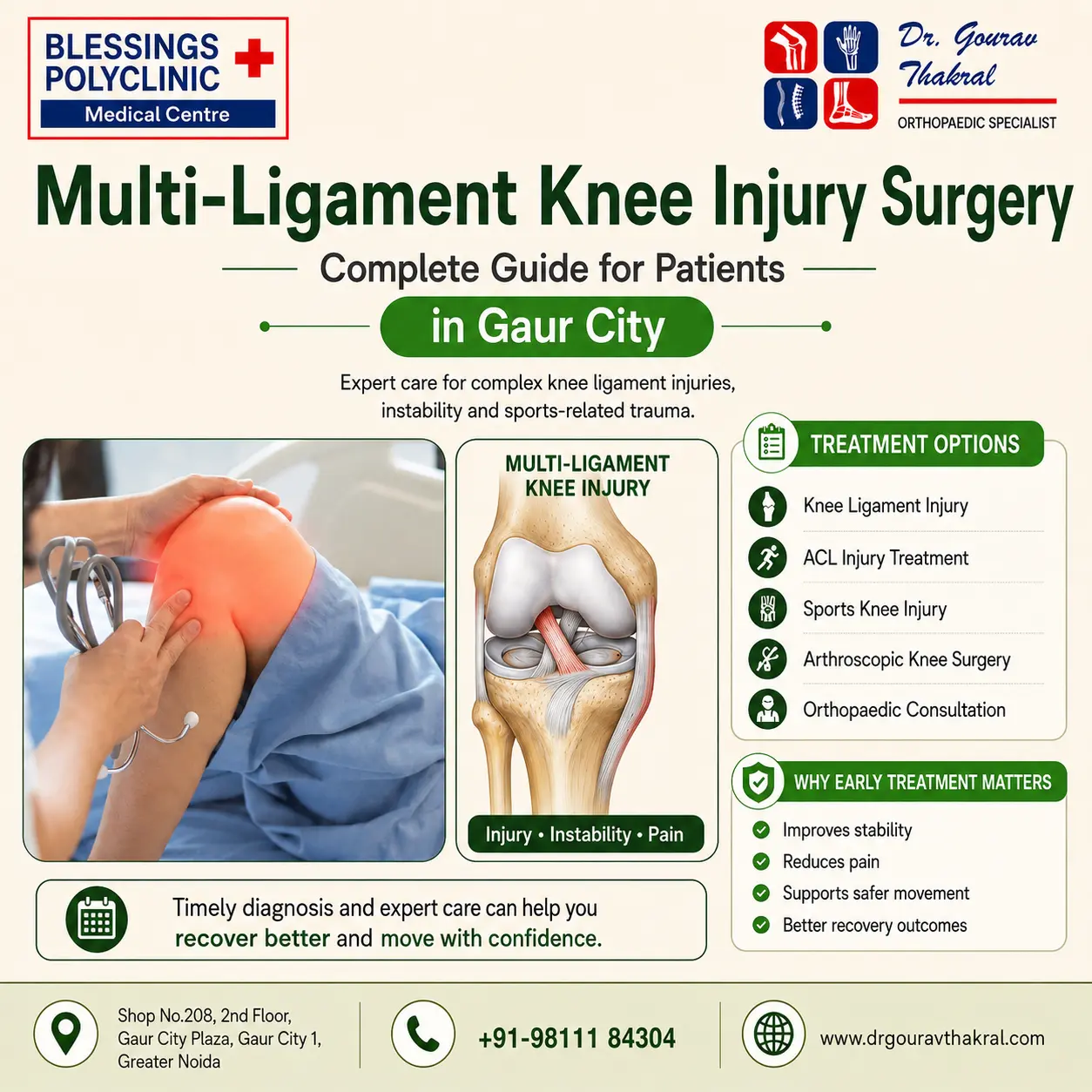
Multi-Ligament Knee Injury Surgery: Complete Guide for Patients in Gaur City
Multi-Ligament Knee Injury Surgery in Gaur City is an important treatment option for patients who suffer from serious knee ligament damage after sports injuries, road accidents, twisting injuries, falls, or high-impact trauma. A normal knee depends on multiple ligaments for stability. When more than one ligament gets injured, the knee may become unstable, painful, swollen, and difficult to use during walking, standing, bending, or sports activity.
A multi-ligament knee injury usually involves damage to two or more major knee ligaments, such as the ACL, PCL, MCL, or LCL. These injuries can become complex because they may also involve meniscus damage, cartilage injury, swelling, stiffness, nerve symptoms, or blood vessel concerns in severe trauma cases. Medical literature defines multi-ligament knee injury as injury involving two or more major knee ligament structures.
For patients in Gaur City, Dr. Gourav Thakral provides expert orthopaedic care for knee ligament injuries, sports injuries, arthroscopic procedures, and knee-related problems. His official website describes him as an Orthopaedic Surgeon, Joint Replacement Specialist, and Spine & Pain Expert offering care for bone, joint, spine, and sports-related injuries.
What Is a Multi-Ligament Knee Injury?
A multi-ligament knee injury means that more than one stabilizing ligament of the knee has been damaged. The knee has four major ligaments: ACL, PCL, MCL, and LCL. These ligaments control forward, backward, side-to-side, and rotational stability of the knee. When two or more of these ligaments tear, the knee may lose its normal balance and strength.
A simple ligament sprain may heal with rest, bracing, medicines, and physiotherapy in selected cases. However, a severe Knee ligament injury involving multiple ligaments needs detailed evaluation. The doctor must check which ligaments have torn, whether the knee remains unstable, and whether the patient needs surgery.
Many patients feel that knee pain alone is the main issue. In multi-ligament injuries, instability often becomes equally important. The knee may feel loose, shaky, or unsafe during movement. This is why proper diagnosis matters before starting any treatment.
Common Causes of Multi-Ligament Knee Injury
Multi-ligament knee injuries often happen after high-force trauma. A sudden twist during sports, a direct hit to the knee, a road accident, or a fall can damage more than one ligament at the same time. Athletes may suffer these injuries during football, cricket, basketball, running, gym training, or contact sports.
A Sports knee injury can also happen when the foot stays fixed on the ground while the body suddenly turns. This movement can put heavy stress on the ACL and other supporting ligaments. In severe cases, the knee may dislocate or shift out of its normal position. Knee dislocations and multi-ligament knee injuries can carry a higher risk of nerve or blood vessel injury, so doctors evaluate these injuries carefully.
Accidents and falls can also cause combined ligament tears. Even if the knee goes back into place after injury, internal ligament damage may still remain. Patients should consult an Orthopaedic specialist if pain, swelling, or instability continues after trauma.
Symptoms Patients Should Not Ignore
A multi-ligament knee injury may cause immediate pain and swelling. Some patients hear or feel a pop at the time of injury. Others may feel that the knee has shifted, twisted badly, or become unstable.
Common symptoms include knee swelling, severe pain, difficulty walking, inability to bear weight, knee giving-way, stiffness, bruising, reduced movement, and a feeling that the knee is loose. Some patients may also experience numbness, foot weakness, coldness in the leg, or change in skin colour after severe injury. These symptoms need urgent medical attention.
If you need Knee pain treatment after a sports injury or accident, do not wait for symptoms to become worse. Early evaluation can help detect ligament tears, meniscus injury, cartilage damage, and other hidden problems.
Diagnosis of Multi-Ligament Knee Injury
Diagnosis starts with a detailed history of the injury. The doctor asks how the injury happened, whether there was a fall or twist, whether swelling developed quickly, and whether the knee feels unstable. Physical examination helps check ligament stability, tenderness, swelling, range of motion, and walking ability.
X-rays may help rule out fractures or joint alignment problems. MRI gives a clearer view of ligament tears, meniscus injury, cartilage damage, bone bruising, and soft tissue injury. In severe injuries, doctors may also check blood flow and nerve function because multi-ligament injuries can sometimes occur with vascular or nerve concerns. AAOS also notes that combined knee ligament injuries may require careful evaluation and treatment planning because they are more complex than single ligament tears.
A proper diagnosis helps the doctor decide whether the patient needs bracing, physiotherapy, staged treatment, or surgery.
When Is Surgery Needed?
Not every knee injury needs surgery. However, multi-ligament injuries often create major instability. If the knee remains unstable, the patient may not walk confidently, climb stairs properly, or return to sports safely. Surgery may become necessary when multiple ligaments have torn, the knee gives way repeatedly, the patient has high activity demands, or conservative treatment cannot restore stability.
Ligament injury treatment depends on the number of torn ligaments, injury severity, patient age, activity level, swelling, stiffness, and associated meniscus or cartilage injury. In combined ligament tears, surgeons often plan treatment earlier than they would for some single ligament injuries, especially when repairable structures or urgent associated injuries exist. AAOS explains that surgery for combined ligament tears often happens soon after injury because some ligaments may become harder to repair over time.
A patient should not compare a multi-ligament injury with a minor sprain. This injury needs specialist assessment and a clear treatment plan.
What Happens During Multi-Ligament Knee Injury Surgery?
Multi-ligament knee surgery aims to restore stability, alignment, and function. The exact procedure depends on which ligaments have torn. Some ligaments may need reconstruction, while selected injuries may need repair. Reconstruction usually involves creating a new ligament using a graft. Repair may suit certain fresh ligament injuries where the tissue can be fixed back to its attachment.
ACL injury treatment may involve ACL reconstruction if the ACL has completely torn and the knee remains unstable. If the PCL, MCL, LCL, or posterolateral corner also has injury, the surgeon may plan additional repair or reconstruction. The surgery may happen in one stage or more than one stage depending on swelling, stiffness, skin condition, injury pattern, and overall safety.
Many knee ligament procedures use Arthroscopic surgery techniques. Arthroscopy uses a small camera and specialized instruments to view and treat structures inside the knee. Some complex ligament injuries may also need small open incisions for repair or reconstruction of structures outside the joint.
Recovery After Surgery
Recovery after multi-ligament knee injury surgery takes time and discipline. Patients should understand that surgery is only one part of the treatment. Rehabilitation plays a major role in regaining motion, strength, balance, and confidence.
The early recovery phase usually focuses on swelling control, pain management, wound care, brace use, and safe movement. The doctor may advise limited weight-bearing in the beginning, depending on the ligaments repaired or reconstructed. Physiotherapy gradually works on knee bending, straightening, muscle activation, walking training, and strengthening.
Later phases focus on balance, coordination, controlled exercises, and return to work or sports-specific training. Return to sports takes longer in multi-ligament injuries than simple sprains because the knee needs time to heal and regain stability.
Patients should follow the rehabilitation plan carefully. Rushing recovery can increase the risk of stiffness, pain, weakness, or re-injury.
Why Early Treatment Matters
Early treatment helps reduce complications and supports better recovery. Delayed diagnosis can allow instability to continue. Repeated giving-way episodes may increase stress on the meniscus and cartilage. Over time, untreated instability can affect movement, confidence, and knee function.
Early consultation also helps manage swelling and stiffness before surgery. A stiff knee can make treatment more difficult. This is why patients should not ignore severe knee pain, swelling, or instability after a fall, accident, or sports injury.
For Sports injury treatment, proper timing matters. A sports-related ligament injury needs accurate diagnosis, safe treatment planning, and structured rehabilitation before the patient returns to activity.
Multi-Ligament Knee Injury Surgery in Gaur City by Dr. Gourav Thakral
If you are looking for treatment guidance in Gaur City, Dr. Gourav Thakral can help evaluate the injury and explain the right treatment option. Patients may need clinical examination, X-ray, MRI, and stability testing before final treatment planning.
As an experienced Orthopaedic specialist, Dr. Gourav Thakral focuses on accurate diagnosis and patient-specific care. The goal is not only to reduce pain but also to restore knee stability, movement, walking confidence, and long-term function.
Patients with knee swelling, instability, sports trauma, or suspected ligament tear should take early consultation instead of relying only on painkillers or home remedies.
Final Thoughts
A multi-ligament knee injury is a serious condition that needs proper medical care. It can affect knee stability, walking, sports activity, and daily movement. Surgery may help when multiple ligaments have torn and the knee remains unstable.
If you are dealing with knee pain, swelling, instability, or difficulty walking after a sports injury or accident, consult Dr. Gourav Thakral for proper evaluation. Timely diagnosis and the right treatment plan can help protect your knee and support better recovery.
FAQs
1. What is a multi-ligament knee injury?
A multi-ligament knee injury means two or more major ligaments of the knee have been damaged. It can affect knee stability, walking, and sports activity.
2. Does every multi-ligament knee injury need surgery?
Many severe multi-ligament injuries need surgery because the knee becomes unstable. However, the final decision depends on the injury pattern, MRI findings, symptoms, and patient activity level.
3. Which ligaments can get injured in this condition?
The ACL, PCL, MCL, LCL, and corner structures of the knee can get injured. Some patients may also have meniscus or cartilage damage.
4. Is arthroscopic knee surgery used for ligament injuries?
Yes, many ligament procedures use arthroscopic techniques. Some complex injuries may also need open repair or reconstruction depending on the damaged structures.
5. How long does recovery take after multi-ligament knee surgery?
Recovery varies from patient to patient. It usually requires several months of rehabilitation, strengthening, balance training, and gradual return to activity.