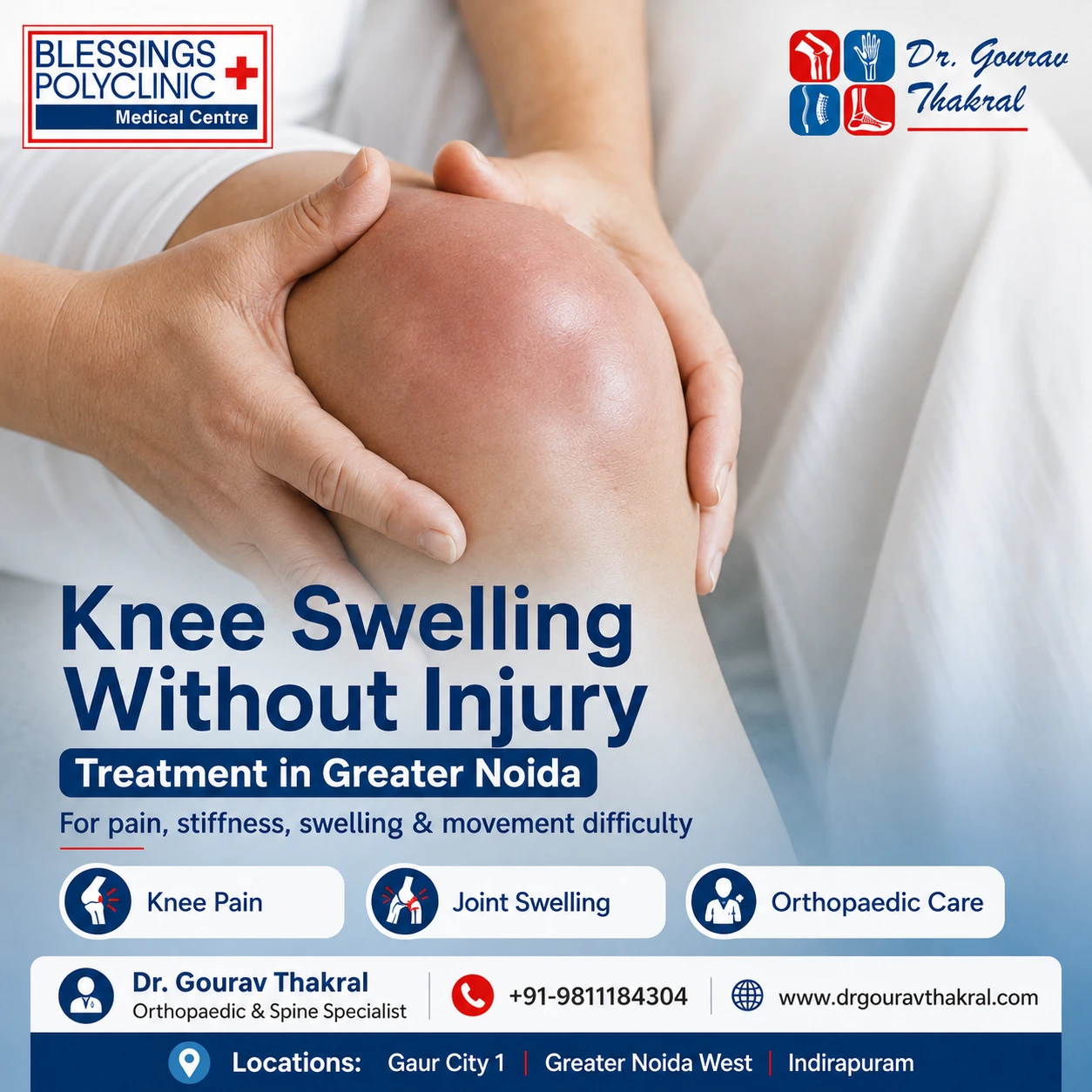
Knee Swelling Without Injury Treatment in Greater Noida
Knee swelling without injury treatment in Greater Noida is important for people who notice puffiness, stiffness, heaviness, warmth, or difficulty bending the knee without a recent fall, twist, or accident.
The swelling may develop slowly or appear suddenly. Sometimes, it causes only mild discomfort. However, a swollen knee may also become painful and make walking, standing, climbing stairs, or getting up from a chair difficult.
Knee swelling can occur when excess fluid collects inside or around the joint. Possible causes include arthritis, bursitis, gout, infection, a Baker’s cyst, inflammation, cartilage problems, or an older knee condition. Treatment depends on the underlying cause rather than the swelling alone.
Dr. Gourav Thakral provides orthopaedic evaluation and personalised treatment guidance for knee swelling, joint pain, arthritis, stiffness, and movement-related knee problems.
Early diagnosis can help reduce swelling, improve movement, protect the joint, and prevent the problem from becoming more difficult to manage.
What Is Knee Swelling?
Knee swelling means that extra fluid has collected inside the joint or in the tissues surrounding it. This condition is sometimes described as water on the knee or knee effusion.
The knee contains bones, cartilage, ligaments, tendons, muscles, a joint lining, and small fluid-filled sacs called bursae. Irritation or inflammation in any of these structures may lead to swelling.
The knee may appear:
- Puffy
- Larger than the other knee
- Tight
- Warm
- Stiff
- Difficult to bend
- Painful while walking
The swelling may affect the front, back, inner side, outer side, or complete knee.
Can Knee Swelling Happen Without an Injury?
Yes. A knee can become swollen even when there has been no clear injury.
Non-injury causes may include:
- Osteoarthritis
- Rheumatoid arthritis
- Gout
- Knee bursitis
- Joint infection
- Baker’s cyst
- Cartilage wear
- Overuse
- Inflammatory conditions
- Old knee damage
- Excess joint fluid
- Medication-related or medical conditions
Sometimes, repeated walking, prolonged standing, gym exercise, or an unnoticed minor strain may irritate the knee even when the patient does not remember an injury.
Common Symptoms
Knee swelling may occur with other symptoms.
Common signs include:
- Visible puffiness
- Joint stiffness
- Knee pain
- Warmth
- Tenderness
- Difficulty bending the knee
- Difficulty straightening the knee
- Pain while walking
- Pain while standing
- Difficulty climbing stairs
- Heaviness in the knee
- Clicking or grinding
- Reduced movement
- Pain after sitting
- Tightness behind the knee
- Limping
A warm, red, severely painful knee associated with fever or feeling unwell requires urgent medical attention because a joint infection may be possible.
Common Causes of Knee Swelling Without Injury
Several conditions can cause spontaneous or gradual knee swelling.
Knee Osteoarthritis
Osteoarthritis develops when the protective cartilage inside the knee gradually wears down.
As the joint becomes irritated, it may produce extra fluid. Therefore, the knee may become painful, swollen, and stiff.
Common symptoms include:
- Pain during walking
- Morning stiffness
- Swelling after activity
- Difficulty climbing stairs
- Reduced knee movement
- Grinding or cracking sounds
- Pain while getting up from a chair
Arthritis commonly causes inflammation, pain, swelling, and stiffness in affected joints. Weight-bearing joints such as the knee are often involved.
Early arthritis may often be managed with medicines, physiotherapy, exercises, weight management, and activity changes.
Rheumatoid Arthritis
Rheumatoid arthritis is an inflammatory condition that can affect the lining of the knee joint.
It may affect both knees and can also involve the wrists, fingers, ankles, or other joints.
Symptoms may include:
- Knee swelling
- Morning stiffness
- Warmth
- Joint pain
- Tiredness
- Swelling in several joints
- Reduced movement
Blood tests and specialist evaluation may be required when inflammatory arthritis is suspected.
Gout
Gout occurs when uric-acid crystals collect inside a joint.
Although gout often affects the big toe, it may also involve the knee.
Symptoms may begin suddenly and include:
- Severe knee pain
- Swelling
- Redness
- Warmth
- Extreme tenderness
- Difficulty moving the knee
A gout attack can sometimes look similar to a joint infection. Therefore, a hot and swollen knee should be medically assessed instead of being treated only with home remedies.
Knee Bursitis
Bursae are small sacs that reduce friction around the knee.
Knee bursitis develops when one of these sacs becomes irritated or inflamed.
Possible causes include:
- Prolonged kneeling
- Repeated pressure
- Overuse
- Infection
- Arthritis
- A minor unnoticed impact
The affected area may feel warm, tender, swollen, and painful during movement.
Treatment may include activity modification, medicines, physiotherapy, and further care depending on the cause.
Baker’s Cyst
A Baker’s cyst is a fluid-filled swelling behind the knee.
It often develops when another problem inside the joint causes excess fluid. Common associated conditions include osteoarthritis and meniscus problems.
Symptoms may include:
- Tightness behind the knee
- A visible lump
- Pain during bending
- Reduced knee movement
- Swelling in the calf
- A feeling of pressure
A painful or suddenly swollen calf should be evaluated promptly because other serious conditions may produce similar symptoms.
Joint Infection
A joint infection, also called septic arthritis, can cause rapid swelling, severe pain, redness, warmth, fever, and difficulty moving the knee.
This condition requires urgent medical care. Treatment may involve antibiotics and drainage of infected joint fluid.
Do not delay evaluation when the knee is hot, red, very painful, or associated with fever or chills.
Meniscus or Cartilage Problems
A meniscus tear or cartilage problem may sometimes exist without a memorable injury.
Age-related wear can make the meniscus weaker. As a result, normal twisting, squatting, or getting up may irritate it.
Symptoms may include:
- Swelling
- Pain along the joint line
- Clicking
- Knee locking
- Difficulty bending
- Pain while standing
- Pain during stairs
An MRI may be advised when locking, repeated swelling, or cartilage damage is suspected.
Overuse
Long walking, running, repeated stairs, gym exercise, or prolonged standing may irritate the knee.
Overuse-related swelling is more likely when:
- Activity has increased suddenly
- The muscles are weak
- The patient is overweight
- Footwear is unsuitable
- The walking pattern is altered
- Arthritis is already present
Rest and activity changes may help temporarily. However, repeated swelling should be assessed.
Medication or Medical Conditions
Some medical conditions can cause swelling in more than one joint or leg.
These may include:
- Kidney problems
- Heart-related fluid retention
- Inflammatory disease
- Thyroid problems
- Blood-clotting disorders
- Certain medicines
If both legs are swollen or the swelling extends far below or above the knee, a general medical evaluation may also be needed.
Knee Swelling Treatment in Greater Noida
Knee swelling treatment in Greater Noida begins with identifying why fluid has collected.
The doctor may ask:
- When did the swelling begin?
- Did it appear suddenly or slowly?
- Is pain present?
- Is the knee warm or red?
- Is fever present?
- Does the knee lock?
- Is there morning stiffness?
- Has the knee swollen before?
- Are other joints affected?
- Is walking difficult?
- Is there a history of arthritis or gout?
Afterward, the knee is checked for movement, tenderness, warmth, fluid, muscle strength, joint stability, and walking pattern.
Treatment is then planned according to the diagnosis.
Diagnosis of Knee Swelling
A detailed examination may include:
- Comparing both knees
- Checking the location of swelling
- Assessing knee movement
- Testing joint stability
- Checking for warmth and redness
- Examining the kneecap
- Assessing muscle strength
- Checking the back of the knee
- Observing walking
- Looking for swelling in other joints
Further tests may be advised when required.
Digital X-Ray
An X-ray may help identify:
- Knee arthritis
- Joint-space narrowing
- Bone spurs
- Bone damage
- Old fracture
- Alignment problems
- Advanced joint wear
However, an X-ray does not show ligaments, cartilage, or the meniscus clearly.
MRI Scan
An MRI may help detect:
- Meniscus tears
- Cartilage damage
- Ligament problems
- Tendon disorders
- Joint inflammation
- Baker’s cyst
- Hidden bone changes
An MRI is not required for every patient. It is advised according to the symptoms and examination findings.
Blood Tests
Blood tests may be recommended when the doctor suspects:
- Gout
- Rheumatoid arthritis
- Infection
- Inflammatory disease
- Another medical condition
Test results should always be reviewed together with the patient’s symptoms.
Joint-Fluid Test
In some cases, a sample of fluid may be removed from the knee with a sterile needle.
The fluid may be tested for:
- Infection
- Gout crystals
- Blood
- Inflammation
Testing joint fluid can help determine whether swelling is caused by infection, gout, or another condition.
Knee Pain Treatment in Greater Noida
Knee swelling and pain often occur together. However, pain treatment should address the underlying condition.
Knee pain treatment in Greater Noida may include:
- Prescribed medicines
- Ice application
- Activity changes
- Physiotherapy
- Knee exercises
- Weight management
- Knee support
- Injection treatment
- Joint-fluid drainage
- Surgery in selected cases
The goal is to reduce pain while restoring movement and protecting joint health.
Non-Surgical Knee Swelling Treatment
Many causes of knee swelling can be managed without surgery.
Rest and Activity Modification
Activities that increase pain or swelling may need to be reduced temporarily.
These may include:
- Running
- Jumping
- Deep squatting
- Repeated stair climbing
- Long standing
- Heavy gym exercise
However, complete bed rest is usually not needed.
Ice Application
Ice may help reduce pain and swelling.
A wrapped ice pack may be applied for 15 to 20 minutes at a time. The ice should not be placed directly on the skin.
Elevation
Keeping the leg raised may help control swelling.
The knee may be supported comfortably while resting.
Medicines
Pain-relief or anti-inflammatory medicines may be prescribed when suitable.
Patients should avoid long-term self-medication because medicines may hide symptoms without treating the underlying cause.
Physiotherapy
Physiotherapy may help:
- Restore knee movement
- Reduce stiffness
- Strengthen thigh muscles
- Improve balance
- Improve walking
- Protect the joint
- Prevent repeated swelling
Exercises should begin according to the cause and severity of swelling.
Knee Support
A brace or knee support may be advised for selected patients.
However, long-term support should not replace muscle strengthening.
Weight Management
Extra body weight increases pressure on the knee joint.
Weight management may help:
- Reduce knee load
- Improve movement
- Lower pain during walking
- Support arthritis treatment
- Improve exercise tolerance
Joint Aspiration
If a large amount of fluid is present, the doctor may remove some fluid from the knee.
This may help:
- Reduce pressure
- Improve movement
- Test for infection or gout
- Identify the cause
Fluid removal is not required in every case.
Injection Treatment
Injection treatment may be considered for selected arthritis or inflammatory conditions.
The decision depends on:
- Cause of swelling
- Joint condition
- Patient’s age
- Medical history
- Previous treatment
- Infection risk
Injections should not be given before ruling out a joint infection.
Joint Pain Treatment in Greater Noida
Joint pain treatment in Greater Noida may be needed when swelling affects the knee along with the hip, ankle, shoulder, wrist, or other joints.
Treatment may include:
- Clinical evaluation
- Blood tests
- X-ray or MRI
- Medicines
- Physiotherapy
- Exercise guidance
- Weight management
- Injection therapy
- Specialist referral
Swelling in several joints may suggest an inflammatory or systemic condition rather than an isolated knee problem.
Knee Care in Greater Noida
Complete knee care in Greater Noida should focus on more than temporary swelling relief.
A personalised knee-care plan may include:
- Identifying the cause
- Reducing pain and swelling
- Restoring movement
- Strengthening muscles
- Improving balance
- Protecting cartilage
- Correcting walking
- Managing arthritis
- Preventing repeated symptoms
- Planning surgery only when needed
Regular follow-up is useful when swelling keeps returning.
When Is Surgery Required?
Most cases of knee swelling do not require surgery.
However, surgery may be considered when:
- Advanced arthritis affects daily activities
- A meniscus tear causes locking
- Cartilage damage is severe
- The joint repeatedly fills with fluid
- A structural problem is present
- Non-surgical treatment does not help
- Infection requires surgical drainage
- Knee movement remains badly restricted
The procedure depends on the diagnosis.
Role of an Orthopaedic Surgeon in Greater Noida
An orthopaedic surgeon in Greater Noida evaluates knee problems involving bones, cartilage, ligaments, tendons, meniscus, and joint fluid.
During the consultation, the surgeon may:
- Examine the swollen knee
- Check movement and stability
- Review X-rays or MRI
- Advise blood or fluid tests
- Identify arthritis or cartilage damage
- Plan physiotherapy
- Recommend medicines
- Drain excess fluid when required
- Discuss surgery in selected cases
Correct diagnosis helps prevent unnecessary treatment and repeated swelling.
When Should You Seek Urgent Medical Care?
Seek urgent care if knee swelling is associated with:
- Fever
- Chills
- Redness
- Significant warmth
- Severe pain
- Inability to move the knee
- Inability to walk
- Rapidly increasing swelling
- Feeling generally unwell
- Swelling after a major injury
- A cold or numb foot
A hot, red, swollen joint with fever may be a joint infection and needs prompt treatment.
Tips to Prevent Repeated Knee Swelling
Helpful habits include:
- Maintain a healthy body weight
- Strengthen thigh muscles
- Warm up before exercise
- Increase activity gradually
- Avoid deep squatting when painful
- Wear supportive footwear
- Take breaks from long standing
- Treat arthritis properly
- Avoid repeated self-medication
- Follow physiotherapy guidance
- Seek care when swelling returns
These steps can support better knee movement and long-term joint health.
Why Choose Dr. Gourav Thakral?
Dr. Gourav Thakral provides orthopaedic care for knee swelling, knee pain, arthritis, meniscus problems, joint stiffness, sports injuries, and movement-related conditions.
Patients looking for knee swelling treatment in Greater Noida can consult him for detailed evaluation and personalised treatment guidance.
His approach focuses on:
- Correct diagnosis
- Pain and swelling relief
- Better knee movement
- Improved muscle strength
- Joint protection
- Safe rehabilitation
- Prevention of repeated swelling
- Surgery only when required
Conclusion
Knee swelling can occur even without a recent injury. Arthritis, gout, bursitis, infection, Baker’s cyst, cartilage problems, overuse, and inflammatory conditions are possible causes.
For knee swelling without injury treatment in Greater Noida, consult Dr. Gourav Thakral for knee evaluation, pain management, physiotherapy guidance, fluid assessment, arthritis care, and complete orthopaedic treatment.
Early diagnosis can help reduce swelling, improve mobility, and prevent long-term knee problems.
FAQs
Why is my knee swollen without an injury?
Possible causes include arthritis, gout, bursitis, infection, Baker’s cyst, cartilage wear, overuse, or inflammatory disease.
Can arthritis cause knee swelling?
Yes. Arthritis can inflame the joint lining and cause pain, stiffness, swelling, and reduced movement.
Is a swollen knee always serious?
Not always. However, severe swelling, redness, warmth, fever, or inability to walk needs urgent medical evaluation.
Can knee swelling improve without surgery?
Yes. Many cases improve with medicines, activity changes, ice, physiotherapy, weight management, or fluid drainage.
When is joint fluid removed from the knee?
Fluid may be removed when swelling is severe or when testing is needed for infection, gout, blood, or inflammation.
Is physiotherapy helpful for a swollen knee?
Yes. Once medically appropriate, physiotherapy can improve movement, muscle strength, balance, and knee function.